
Using public transit with a bike often boils down to two options: external bike racks or folding bikes. Both solve the "first/last mile" problem but differ in convenience, cost, and practicality.
- Bike Racks: Great for full-size bikes like mountain bikes. They’re free to use but limited to 2–3 bikes per bus and often restricted during peak hours. Bikes are exposed to weather and road debris.
- Folding Bikes: Compact and allowed on all transit at any time. They eliminate the need for racks and can be stored indoors, reducing theft risks. However, they’re pricier, and smaller wheels may feel less stable.
Quick Comparison:
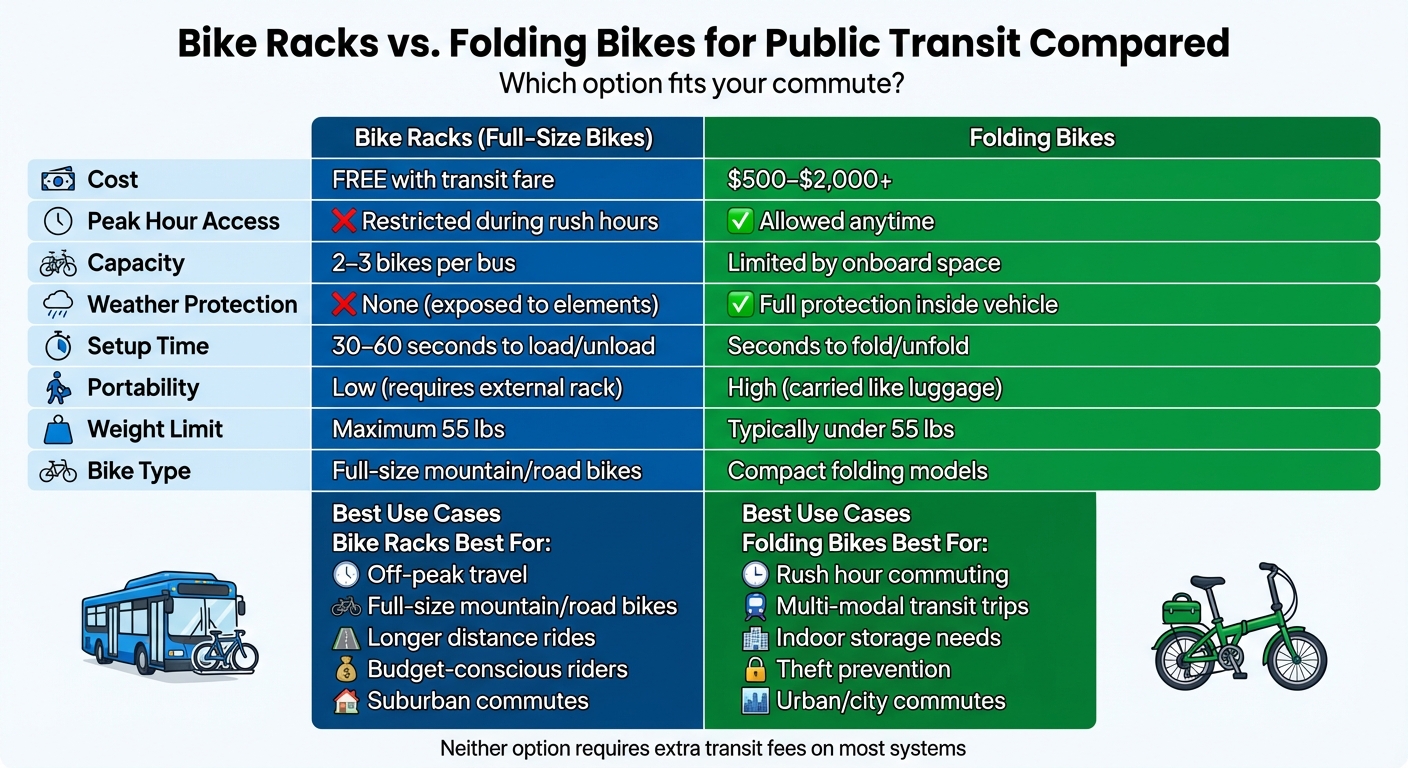
| Feature | Bike Racks (Full-Size Bikes) | Folding Bikes |
|---|---|---|
| Cost | Free with transit fare | $500–$2,000+ |
| Access | Restricted during rush hours | Allowed anytime |
| Capacity | 2–3 bikes per bus | Limited by onboard space |
| Weather Protection | None | Full protection |
| Setup Time | ~30–60 seconds | Seconds to fold/unfold |
The best choice depends on your commute, timing, and bike type. Full-size bikes excel for longer rides and off-peak travel, while folding bikes shine for crowded commutes and multi-modal trips.
Bike Racks vs Folding Bikes for Public Transit: Complete Comparison
How Bike Racks on Public Transit Work
Bike Rack Operation and Loading
Most public transit buses are equipped with sturdy metal racks mounted on the front exterior, designed to hold two or three standard bicycles. Using these racks is fairly simple, but it’s important to follow a few safety steps.
Before the bus arrives, make sure to remove any loose items from your bike, like water bottles or bags. When the bus pulls up, catch the driver’s attention with eye contact and a signal to indicate you’ll be loading your bike. Always approach the rack from the curbside to avoid stepping into traffic.
To load your bike, pull the release handle to lower the rack. Place your bike into the designated wheel slots and secure it by pulling the support arm over the front tire. Make sure the arm rests on the tire itself, not on the frame or fender, to avoid damage. When it’s time to unload, let the driver know as you exit the bus, remove the support arm, and lift your bike off the rack.
Keep in mind, bikes cannot be locked to the rack for safety reasons. It’s a good idea to sit near the front of the bus so you can keep an eye on your bike during the ride.
These steps highlight both the convenience and the care required when using bike racks on public transit.
Benefits of Using Bike Racks
Bike racks make it easy to transport your full-size bike without needing to switch to a folding model or disassemble parts. Whether you ride a hardtail or a full-suspension mountain bike, as long as it weighs under 55 pounds and has tires no wider than 3 inches, it should fit securely on the rack.
Another big perk? Using the bike rack doesn’t cost extra – it’s included with your regular bus fare. This makes it an economical option for extending your commute or reaching trailheads that might otherwise require driving. Plus, bike racks can be a lifesaver if you encounter bad weather, a flat tire, or simply run out of energy on a long ride.
Limitations of Bike Racks
While bike racks are convenient, they do have a few drawbacks. Since they operate on a first-come, first-served basis, you might need to wait for the next bus if the rack is already full when yours arrives.
Your bike will also be exposed to the elements, as well as road debris. And because transit agencies don’t take responsibility for bikes that are stolen or damaged while on the rack, there’s a small risk involved. Loading and unloading your bike can also add a bit of time to your trip. Additionally, some bus routes – especially those served by express or articulated buses – may not have bike racks at all.
In the case of NJ TRANSIT, only about half of the bus fleet is equipped with bike racks, meaning availability can vary depending on your route and location. Heavier e-bikes or mountain bikes that exceed the 55-pound weight limit, as well as bikes with wheelbases longer than 46 inches or handlebars wider than 42 inches, may not fit properly on the racks.
Folding Bikes for Public Transit
Folding Bike Features
Folding bikes provide a portable and practical alternative for transit users, eliminating the need for bike racks.
These bikes are designed with collapsible frames, which allow them to deliver the performance of a full-size bike while folding down into a compact, easy-to-carry size. Many models fold in less than 20 seconds, making them incredibly convenient for commuters.
One standout feature is their smaller wheels, typically ranging from 16 to 20 inches in diameter – much smaller than the 26–29-inch wheels found on standard bikes. This smaller size enhances maneuverability and makes storage a breeze. Folding bikes are often made from materials like steel, aluminum, or titanium, with weights varying from ultra-light designs at around 16.5 pounds to sturdier models weighing up to 31 pounds.
"The smaller wheels on a folding bike provide a quicker start and stop ability, making them particularly advantageous at traffic lights and bustling intersections." – Brompton
It’s important to test the folding mechanism before buying one. Instructions are sometimes unclear, as Bernie Deitrick, Senior Test Program Leader at Consumer Reports, pointed out:
"It took a bit of time, and some digging on the internet, to figure out how to properly fold some of these bikes so that they’d be as small as possible"
Benefits of Folding Bikes
Folding bikes offer more than just compact storage – they bring several distinct advantages for transit users.
One of their biggest perks is unrestricted access to public transit. Unlike full-size bikes, which often face limitations like exterior racks or rush-hour bans, folding bikes are usually allowed inside buses, subways, and trains as long as they remain folded. For instance, the New York MTA permits folding bikes on all subways and most buses, while full-size bikes face restrictions during peak hours on commuter rail.
Another key benefit is theft prevention. Folding bikes can be taken indoors – whether to the office, an apartment, or a shop – eliminating the need to leave them locked outside at potentially risky locations.
Folding bikes also shine in multi-modal commuting. They’re perfect for bridging the "first and last mile", fitting easily into car trunks or train luggage racks without requiring additional parking. For urban dwellers with limited space, these bikes can be stored in a closet or even under a bed, unlike full-size bikes that demand dedicated floor space or wall mounts.
Drawbacks of Folding Bikes
While they offer plenty of advantages, folding bikes do come with some trade-offs.
The cost can be a hurdle, as quality models range from $500 to over $2,000. Budget options under $500 often sacrifice durability.
Smaller wheels, while great for quick starts and compactness, can reduce stability and comfort on uneven terrain. The shorter wheelbase can make these bikes feel "twitchy" or less stable compared to full-size bikes, especially at higher speeds or on bumpy roads. This makes them less suited for mountain biking or long-distance rides on rugged trails.
Weight is another factor to consider. While some ultra-light models weigh under 17 pounds, many folding bikes exceed 30 pounds, which can make carrying them up stairs or lifting them into storage more challenging. Electric folding bikes are even heavier, and some models come with rider weight limits around 250 pounds. Additionally, the folding hinges and clamps require regular checks to ensure they remain secure and rattle-free.
Folding Bike – the Good and the Bad
sbb-itb-9d75ae1
Bike Racks vs. Folding Bikes: Direct Comparison
This side-by-side comparison highlights the practical differences between bike racks and folding bikes. While earlier sections explained the mechanics and limitations of each option, this breakdown focuses on key factors to help you decide based on your commute, budget, and transit preferences.
Access and timing: Folding bikes offer unmatched flexibility since they’re allowed on transit at any time. In contrast, full-size bikes on racks are often restricted during peak hours. If your commute falls during rush hour, folding bikes can save you from delays.
Capacity considerations: Bus racks can typically hold 2–3 bikes. If the rack is full, you’ll need to wait for the next bus. Folding bikes, however, can be brought onboard as long as there’s space available under seats or on the floor.
Weather protection: Bikes on external racks are exposed to the elements. On the other hand, folding bikes stay with you inside the climate-controlled vehicle, keeping both you and your bike protected from rain, snow, or excessive heat.
Here’s a quick comparison to sum up the pros and cons of each option:
Comparison Table
| Feature | Bike Racks (Full-Size Bikes) | Folding Bikes |
|---|---|---|
| Portability | Low; requires use of an external rack or designated rail car | High; easily carried like luggage into stations and offices |
| Cost | No extra transit fee; full-size bikes start around $200 and up | No extra transit fee; folding bikes range from $330 to $2,200 |
| Capacity | 2–3 bikes per bus, up to 8 bikes per train car | Limited by available floor or under-seat space |
| Weather Protection | None; bikes are exposed on external racks | Full protection when stored inside the vehicle |
| Setup Time | 30–60 seconds to load and secure | A few seconds to under a minute with practice |
| Peak Hour Access | Restricted during rush hours | Allowed at all times when folded |
| Weight Limit | Maximum of 55 lbs per bike on rack | Typically under 55 lbs; some models weigh as little as 24 lbs |
This comparison highlights the practical differences between the two options, making it easier to choose based on your specific needs.
When to Use Bike Racks or Folding Bikes
Both bike racks and folding bikes tackle the "last-mile" challenge, but the right choice depends on your commute’s timing, distance, and the type of bike you prefer.
Best Uses for Bike Racks
Bike racks shine during suburban commutes, especially during off-peak hours, and are perfect for riders using full-size mountain or road bikes. Most buses come equipped with front-mounted racks that can hold two or three bikes, making them a dependable option when traffic is lighter.
If you’re covering long distances, a full-size bike on an exterior rack offers better comfort and performance. However, it’s important to check if your specific bus route has bike racks, as some express routes or those crossing bridges might not provide this service.
For commuter rail users, off-peak travel is key. Agencies like the MTA, NJ Transit, and MBTA often restrict full-size bikes during weekday rush hours, but they’re usually allowed during quieter times. Capacity rules vary by system, so plan accordingly. Additionally, around 90% of NJ Transit stations feature bike parking racks, giving you the option to park your bike at the station instead of bringing it aboard.
These considerations make bike racks a solid choice for longer commutes during less crowded times.
Best Uses for Folding Bikes
Folding bikes are a game-changer for peak-hour travel. If you’re commuting during busy morning or evening rush hours, a folding bike is often your best – or only – option.
For city dwellers navigating multiple transit modes, folding bikes eliminate uncertainty. In San Francisco, for instance, full-size bikes are prohibited on Metro vehicles, light rail, and historic streetcars, but folding bikes are allowed. If your commute involves switching between subway, bus, and light rail, a folding bike ensures seamless travel without restrictions.
They’re also perfect for tight spaces. Whether you need to tuck your bike under a desk at work, in a small apartment, or even in a dorm room, their compact design makes storage easy. Plus, in crowded transit conditions where space is at a premium, a folding bike’s portability is a major advantage.
Conclusion
Deciding between bike racks and folding bikes ultimately comes down to your travel needs, timing, and personal preferences. Full-size bikes on racks are a solid choice for off-peak commutes, especially if you’re covering longer distances and want a smoother ride. However, bike racks do have their limits – they usually hold only 2–3 bikes per bus, and if the rack is full, you might have to wait for the next one. On top of that, many commuter rail systems restrict full-size bikes during peak hours.
Folding bikes, on the other hand, sidestep these restrictions entirely. As long as they’re folded and stored correctly, they’re allowed on almost all transit vehicles at any time. This makes them a great option for crowded commutes, multi-modal trips, or when secure outdoor bike parking isn’t available. That said, they do come with some compromises – smaller wheels can feel less stable, and certain models weigh over 30 lbs.
The good news is that neither option comes with extra fees on major transit systems like MTA, NJ Transit, or King County Metro. Just keep in mind that riders are responsible for loading and unloading their bikes, and transit agencies don’t cover theft or damage.
FAQs
What are the cost differences between using a bike rack and a folding bike for transit?
When comparing costs, the choice often boils down to upfront expenses versus long-term savings. A basic bike rack for your car or public transit use is generally the more budget-friendly option, with prices often under $100. If you already own a full-size bike, this can be an economical way to get started.
Folding bikes, however, come with a higher initial price tag, typically ranging from a few hundred to over a thousand dollars. That said, they offer savings over time by eliminating the need for extra hardware like racks and helping you avoid fees for bike racks on buses or trains. Their compact design also makes them perfect for small living spaces or tight car storage.
Ultimately, your decision depends on your budget and lifestyle. If you’re looking for a low-cost option and already own a bike, a rack might be the way to go. But if portability and convenience are key for you, investing in a folding bike could pay off in the long run.
Are folding bikes more convenient than full-size bikes during crowded commutes?
Folding bikes are a practical choice for crowded commutes since they can be easily carried onto buses or trains, eliminating the hassle of relying on external bike racks. Instead of competing for limited rack space – which tends to fill up quickly during rush hours – you can simply keep your folded bike nearby, either at your seat or in a designated area. This makes traveling more convenient, even when public transit is packed.
On the other hand, full-size bikes present more challenges. They typically need to be placed on front-mounted racks, which usually hold only two or three bikes. If the rack is already full, you might have to wait for the next bus or train, adding unnecessary delays to your trip. Some transit systems also impose restrictions on non-folding bikes during peak hours, while folding bikes are almost always permitted. For those navigating crowded commutes, folding bikes provide a level of flexibility and ease that full-size bikes often lack.
What are the advantages of using a folding bike instead of a bike rack for security and storage?
Folding bikes bring a lot to the table when it comes to security and storage. Unlike traditional bikes, you can take a folding bike indoors with you, eliminating the need to leave it vulnerable on a public rack. This simple feature significantly cuts down the risk of theft. Plus, their compact design means they can fit into tight spaces – whether that’s under your desk, tucked away in a closet, or even in your car’s trunk.
These practical benefits make folding bikes a smart option for anyone seeking convenience and a little extra peace of mind, especially for commuters or city dwellers dealing with limited storage options.