Installing a rear derailleur may seem daunting, but with the right tools and steps, you can do it yourself and save money on repair costs ($25–$50 in U.S. bike shops). This guide covers everything from removing the old derailleur to fine-tuning the new one for smooth shifting. Here’s what you’ll need to know:
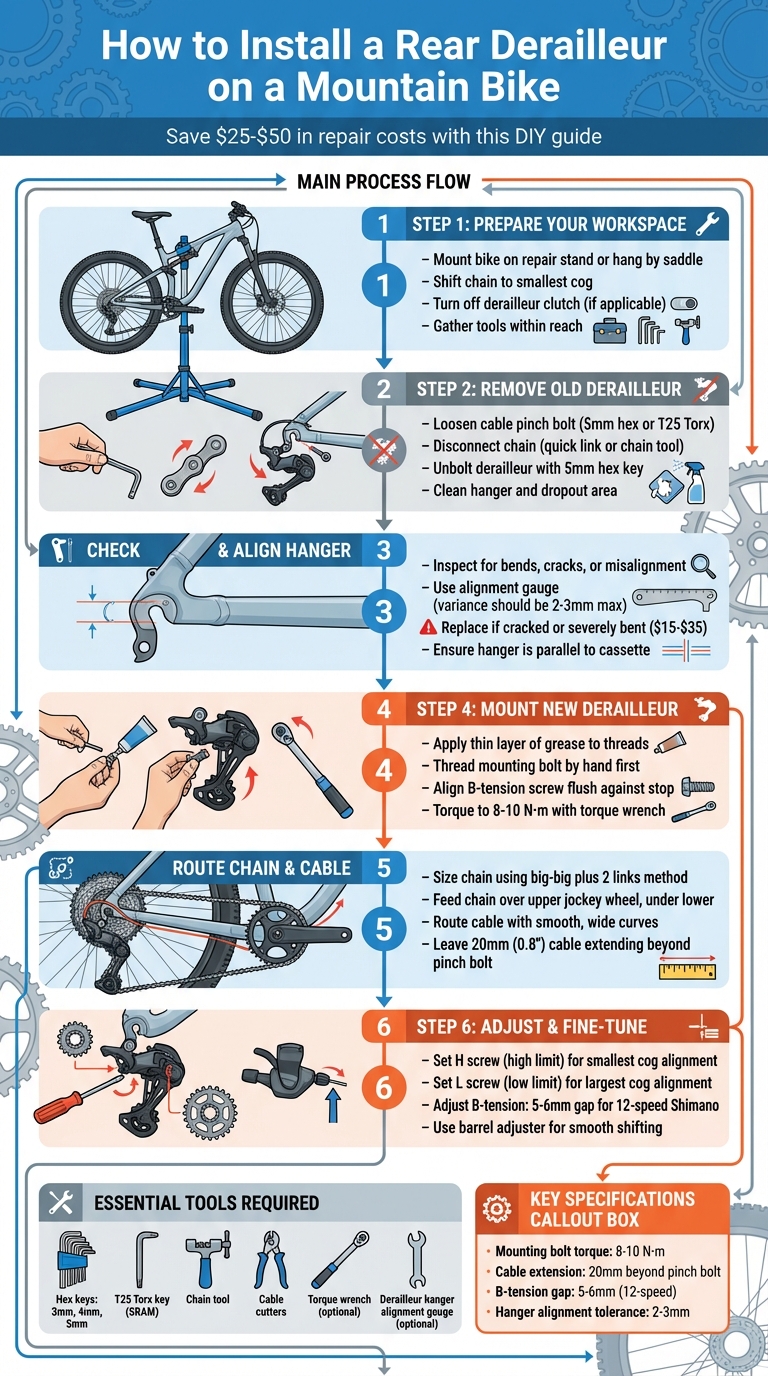
- Tools: Hex keys (3mm, 4mm, 5mm), Torx key (for SRAM), chain tool, cable cutters, and optional tools like a derailleur hanger alignment gauge and torque wrench.
- Preparation: Shift to the smallest cog, turn off the derailleur clutch if applicable, and ensure your workspace is stable and well-lit.
- Steps:
- Remove the old derailleur, chain, and cable.
- Inspect and align the derailleur hanger.
- Mount the new derailleur, ensuring proper torque (8–10 Nm).
- Route and secure the chain using the big-big plus two links method.
- Install and adjust the cable, leaving about 20mm of slack.
- Fine-tune limit screws, B-tension, and shifting using a barrel adjuster.
- Testing: Test shifting on a repair stand and during a short ride, making minor adjustments as needed.
Step-by-Step Guide to Installing a Rear Derailleur on a Mountain Bike
How To Install A Rear Derailleur | Mountain Bike Maintenance
Tools and Materials Needed
Before diving into the installation, it’s essential to have the right tools on hand. This ensures a smoother process and helps avoid any shifting problems later. Below, you’ll find a breakdown of both basic and optional tools that can make a big difference in achieving precise results.
Basic Tools
Start with hex keys in 3mm, 4mm, and 5mm sizes. The 3mm hex key is perfect for adjusting Shimano limit screws, while the 5mm works for mounting bolts. If you’re dealing with SRAM components, you’ll need a T25 Torx key for the cable pinch bolt. A chain tool is indispensable for breaking and rejoining your chain, and quality cable cutters are a must for clean, precise cuts that ensure smooth shifting. If adjustments require it, keep a #2 Phillips screwdriver handy for certain screws.
For direct mount systems, you’ll need to remove the green B2-link plate and use a bracket axle with a 5mm hex key. If you’re working with Shimano Di2 components, the TL-EW300 tool is necessary.
Additionally, gather some consumables: a new shift cable and housing (if you’re not reusing the old ones), a replacement derailleur (if required), and either grease or anti-seize compound for the mounting threads. Having these items ready will save time and keep the process efficient.
Additional Tools for Better Accuracy
Though not strictly necessary, a derailleur hanger alignment gauge can be a valuable addition – especially if you ride on technical trails often. Even small, nearly invisible bends in the hanger can disrupt shifting performance. A torque wrench is another useful tool, ensuring bolts are tightened to the correct specifications: 8–10 Nm for mounting bolts and 4–5 Nm for SRAM cable pinch bolts. These tools help fine-tune your setup for optimal performance.
Preparing the Bike
Setting Up Your Workspace
Creating a stable and well-lit workspace is key to making the installation process smoother and safer. If you have a repair stand, mount your bike on it – this will provide the stability you need. No repair stand? No problem. You can hang the bike by the saddle as an alternative. Make sure your tools, including hex keys, Torx keys, a chain tool, and quick-link pliers, are within easy reach on a clean surface.
Before diving in, shift the chain to the smallest cog and, if your derailleur has a clutch mechanism, turn it off. You can usually find a small lever or switch on the derailleur body for this. This step reduces tension on the derailleur and cable, making removal much easier. Gloves, along with a rag and some degreaser, are also handy to have nearby.
Once your workspace is set, you’re ready to move on to removing the old derailleur.
Removing the Old Derailleur
Start by loosening the cable pinch bolt using a 5mm hex key (or a T25 Torx key if you’re working with SRAM components). Pull the cable free from the derailleur and set it aside. Then, disconnect the chain. If your chain has a quick link, use quick-link pliers; otherwise, use a chain tool for pin-style connections. Carefully thread the chain out of the derailleur cage.
When you’re ready to remove the derailleur, support it while unbolting it with your 5mm hex key. Keep any washers or spacers organized in a parts tray so they don’t go missing. Once the derailleur is off, take a moment to clean the hanger and dropout area to clear away debris and old grease. While you’re at it, closely inspect the hanger for bends, cracks, or misalignment. These issues are among the most common causes of poor shifting brought into bike shops across the U.S., and catching them now will set you up for precise alignment later.
Checking and Aligning the Derailleur Hanger
Inspecting the Hanger
With the old derailleur removed, take a moment to carefully examine the hanger. Stand directly behind the bike and check that the hanger is parallel to the cassette and perpendicular to the ground. If it leans inward toward the spokes or bows outward, there’s an issue. Feel for any twists, sharp bends, cracks, or stress marks near the mounting points. Even small bends can throw off shifting accuracy.
Hangers are typically made of soft aluminum, designed to bend and protect the frame and derailleur during impacts. This makes them prone to misalignment, especially on mountain bikes. If you notice visible cracks or a severe bend, replace the hanger immediately rather than attempting to straighten it. Most mountain bike hangers cost between $15 and $35 in the U.S., so it’s a good idea to keep a spare specific to your bike for unexpected repairs on the trail. For minor misalignments, you can move on to using an alignment gauge.
Using an Alignment Tool
Once you’ve inspected the hanger, a derailleur hanger alignment gauge can help fine-tune it. These tools are essential for precise adjustments, going beyond what a visual check can reveal. The gauge threads into the hanger just like a derailleur and uses the rim as a reference point to measure alignment. Popular options include the Park Tool DAG-2.2 (priced around $80–$90) or the DAG-3 (approximately $120–$140), which features a longer, stiffer arm for the tighter tolerances required by 11- and 12-speed drivetrains.
Before starting, ensure the rear wheel is properly seated and secured in the dropouts, as a crooked wheel will skew your measurements. Thread the alignment gauge into the hanger by hand and tighten it gently. Rotate the tool around the wheel and check the gaps; if the variance exceeds 2–3 mm, adjustments are necessary. Make small, incremental adjustments until the variance falls within 2–3 mm. If the hanger resists adjustment or springs back out of alignment, it’s best to replace it. A straight hanger is essential for smooth, reliable shifting, especially on demanding trails.
Installing the Rear Derailleur
Preparing the Threads
Before you attach the new derailleur, take a moment to clean the hanger and the threads on the mounting bolt. If you notice any corrosion or damage, you might need to chase the threads gently or even replace the hanger altogether. Once everything is clean, apply a thin layer of waterproof grease or an anti-seize compound to the mounting bolt threads. This step not only makes installation smoother but also helps protect against corrosion – especially if you ride in wet or muddy conditions. Be careful not to overdo it with the grease, as too much can attract grit and make accurate torque readings tricky. With the threads clean and lightly lubricated, you’re ready to mount the derailleur.
Mounting the Derailleur
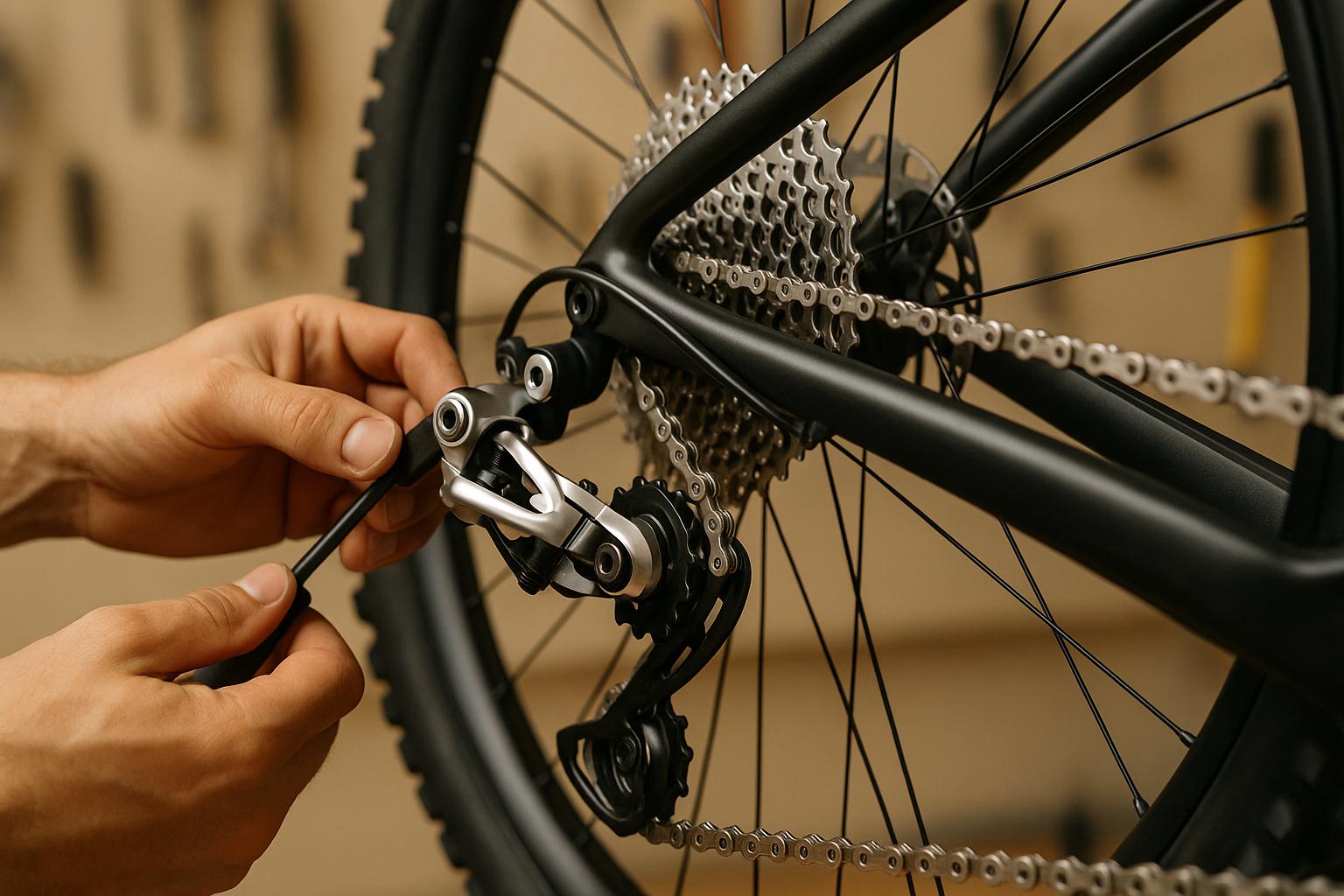
Now it’s time to attach the derailleur. First, figure out whether your bike uses a standard hanger or a direct-mount hanger. If you’re working with a standard hanger, leave the B-link or B2-link plate in place on Shimano derailleurs. For direct-mount frames, remove the intermediate plate and mount the derailleur directly using the provided axle or bolt. Start threading the mounting bolt by hand – this avoids cross-threading, which can easily damage an aluminum hanger.
As you thread the bolt, make sure the B-tension screw or stopper tab sits flush against the hanger’s B-tension stop without any gaps. Shimano’s dealer manual emphasizes this point: “Be sure to install the rear derailleur so that the stopper plate contacts the B-tension stop, with no gap in between” to ensure proper function.
Once the bolt is hand-tight and the B-tension stop is properly aligned, use a torque wrench to tighten the mounting bolt to 8–10 N·m. This torque range is common for many Shimano mountain bike derailleurs. If you don’t have a torque wrench, a 5 mm hex key can work as a substitute. Hold it midway to reduce leverage, tighten the bolt until it’s firmly seated, and then give it one additional turn – but avoid over-tightening. After securing the bolt, press on the derailleur cage to check its stability. If it moves, the bolt might be under-tightened. On the other hand, if the hanger feels stressed or the bolt doesn’t turn smoothly, you may have cross-threaded or over-tightened it.
It’s worth noting that many home mechanics either tighten the bolt too much or not enough, which can lead to damaged threads or a derailleur that shifts under load. Taking the time to get it right now can save you a lot of hassle – and money – later. With the derailleur securely mounted and the B-tension stop properly seated, you’re ready to move on to routing the chain and cable.
sbb-itb-9d75ae1
Routing and Installing the Chain and Cable
Routing the Chain
To determine the correct chain length, use the big-big plus two links method. Here’s how: wrap the chain around the largest chainring and the largest cassette cog (skipping the derailleur), pull the chain ends together, add two links, and then cut the chain to size. This method works well for most U.S. mountain bikes with 1× drivetrains. However, double-check that the derailleur isn’t overstretched in the big-big configuration and that the cage maintains tension in the small-small setup, avoiding any slack.
Once the chain is properly sized, shift the derailleur to the smallest rear cog to ensure a straight chain line during installation. Feed the chain through the derailleur cage, making sure it runs over the upper jockey wheel and under the lower jockey wheel. Pay attention to any directional markings on the chain – they should face outward. Use a quick link to reconnect the chain. Align the two halves of the link, push them together, and pull firmly on the cranks until you hear a distinct click, signaling the link is locked in place. With the chain installed, you’re ready to move on to the cable.
Securing the Cable
Start by setting the shifter to the smallest cog to ensure the cable has enough slack. When routing the cable housing, use smooth, wide curves to avoid kinks, especially near the rear triangle. Make sure the ferrules or sealed caps are fully seated into each stop. If they’re not, the housing may settle during rides, leading to inconsistent shifting.
Feed the inner cable through the derailleur’s anchor point, pull it tight, and secure it with the pinch bolt. Shimano recommends leaving about 20 mm (approximately 0.8 inches) of inner cable extending beyond the pinch bolt. This length makes future adjustments easier while keeping the cable clear of the spokes. Trim any excess cable, attach an end cap to prevent fraying, and confirm that neither the cable nor the housing interferes with the spokes or tire. After a quick test ride, expect some initial cable stretch. Use the barrel adjuster to fine-tune the tension as needed.
Adjusting the Derailleur
Once the derailleur is securely mounted and the chain is properly routed, the next step is fine-tuning its performance through careful adjustments.
Setting the Limit Screws
Limit screws prevent the chain from going too far in either direction on the cassette. Start with the H screw (high limit). Shift to the smallest cog and adjust the H screw so the upper jockey wheel sits directly under it. Turn the screw clockwise to move the derailleur inward or counterclockwise to move it outward. Make small, precise quarter-turn adjustments until the alignment is spot on.
Next, adjust the L screw (low limit). Shift to the largest cog and ensure the upper jockey wheel aligns directly beneath it. Turning the L screw clockwise moves the derailleur closer to the spokes, while counterclockwise moves it away. These small tweaks are essential to prevent the chain from derailing or damaging components.
Adjusting B-Tension
The B-tension screw determines the gap between the upper jockey wheel and the cassette. For Shimano 12-speed systems, aim for a gap of about 5–6 mm (roughly 0.2 inches). To increase the gap, turn the B-screw clockwise; to reduce it, turn it counterclockwise.
Shift into the largest cog and check the spacing between the upper jockey wheel and the bottom of the largest cog. Using a G-gap gauge can help achieve the ideal distance for most Shimano 12-speed drivetrains. Shimano guidelines also recommend ensuring there’s no gap at the B-tension stop during installation to maintain proper alignment .
Fine-Tuning Shifting
The barrel adjuster is your tool for perfecting gear shifts. If shifting to larger cogs feels slow or unresponsive, turn the barrel adjuster counterclockwise. If the chain overshoots or hesitates on smaller cogs, turn it clockwise. Make small adjustments in quarter-turn increments, testing the shifting after each tweak, until it feels smooth and precise.
Testing and Final Setup
Testing Gear Shifting
Start by testing the rear derailleur on a repair stand. Spin the pedals freely and shift into the small chainring paired with a middle cog on the cassette to maintain a straight chain line. Gradually shift through each gear, one at a time, across the entire cassette – both up and down – while keeping a steady pedaling rhythm. Watch for any hesitation, skipping, or unusual noises during this process.
If the chain struggles to move to larger cogs or makes a rattling sound, use the barrel adjuster to increase cable tension slightly. Turn it in quarter-turn increments until the shifting improves. On the other hand, if the chain hesitates when dropping to smaller cogs, reduce the tension by turning the barrel adjuster clockwise in small steps. Continue fine-tuning until the shifting feels smooth and responsive.
Once the stand testing is complete, take the bike for a short outdoor ride in a quiet, flat area. Shift through all the gears under light pedaling pressure. Sometimes, issues that don’t show up on the stand become noticeable while riding. Also, briefly test extreme gear combinations to identify any chain rub or interference.
Making Final Adjustments
After your test ride, focus on fine-tuning the setup as needed.
First, check the limit screws. Shift to the smallest cog and ensure the chain stays securely in place. Then shift to the largest cog to confirm the chain doesn’t drop off the cassette.
Next, verify that all bolts are properly tightened, including the derailleur mounting bolt, cable pinch bolt, and any jockey wheel bolts that might have been loosened during installation. Trim any excess cable, leaving about 1.5 to 2 inches beyond the pinch bolt, and crimp a cap on the end to prevent fraying.
Before heading out on a longer ride, plan to recheck your shifting after the first few miles. New cables often stretch slightly, and the housing may settle, which might require a small adjustment using the barrel adjuster.
Conclusion
You’ve successfully installed a rear derailleur: removed the old one, checked the hanger, routed the cable, and fine-tuned the shifting. This essential bike maintenance skill helps save both time and money while boosting your bike’s performance. Here are a few key points to keep in mind: always tighten the mounting bolt to 8–10 N·m (about 6–7 ft-lbs) to prevent thread damage, ensure the hanger is aligned before starting, and make small adjustments to the barrel adjuster to achieve smooth shifting across the cassette. Keeping this precision intact requires regular maintenance.
For riding in US conditions, it’s important to clean and lubricate the chain regularly, inspect the cable housing, and, if your derailleur has a clutch (like Shimano Shadow RD+), check it to minimize chain slap on bumpy trails. If shifting feels sluggish or you hear odd noises, inspect these components first before assuming the derailleur itself is the issue.
This task is manageable with the right tools and a bit of patience. However, if you encounter persistent problems like a bent hanger, stripped threads, or inconsistent shifting, it’s a good idea to visit a local bike shop. Professional mechanics can quickly diagnose issues and handle warranty-related repairs, especially during peak riding season when you need your bike ready to hit the trails.
Once you’ve mastered this, consider expanding your skills to include tasks like indexing gears, replacing worn chains and cassettes, or adjusting a front derailleur. For more US-based guides, gear recommendations, and product reviews, check out Intermountain Bikes.
FAQs
How can I tell if my derailleur hanger needs to be aligned?
If your bike’s chain is skipping gears, slipping unexpectedly, or the shifting feels rough and unpredictable, it could be a sign that your derailleur hanger is out of alignment. A bent or misaligned hanger can lead to these problems and impact how well your bike performs. Fixing this issue quickly can make your shifting smoother and your rides much more enjoyable.
How can I figure out the correct chain length for my mountain bike?
To figure out the right chain length for your bike, start by shifting to the smallest chainring and the smallest rear sprocket. Next, thread the chain through the drivetrain and pull it snug. Gradually add links until the chain can easily reach the largest rear sprocket without being overly tight or slack. This method helps ensure smooth shifting and keeps your bike running efficiently.
Why should I use a torque wrench when installing a rear derailleur?
Using a torque wrench is essential for tightening the derailleur to the manufacturer’s specified torque settings. This not only prevents overtightening, which could harm delicate parts, but also ensures the derailleur stays secure for smooth and efficient shifting. Sticking to the correct torque helps extend the lifespan and reliability of your bike’s drivetrain.