Choosing between an e-bike and a mountain bike depends on your goals, terrain, and budget. Here’s a quick breakdown:
- E-Bikes (e-MTBs): Great for tackling steep climbs, covering long distances, and reducing fatigue. They’re heavier, costlier ($3,000–$10,000+), and require more maintenance due to motors and batteries. Perfect for riders who want assistance on tough trails or have varying fitness levels.
- Mountain Bikes (MTBs): Powered by you, offering a lighter, more agile ride. Ideal for fitness, technical trails, and skill-building. Costs range from $1,000–$8,000+, with lower maintenance needs. Best for those seeking a challenge and unrestricted trail access.
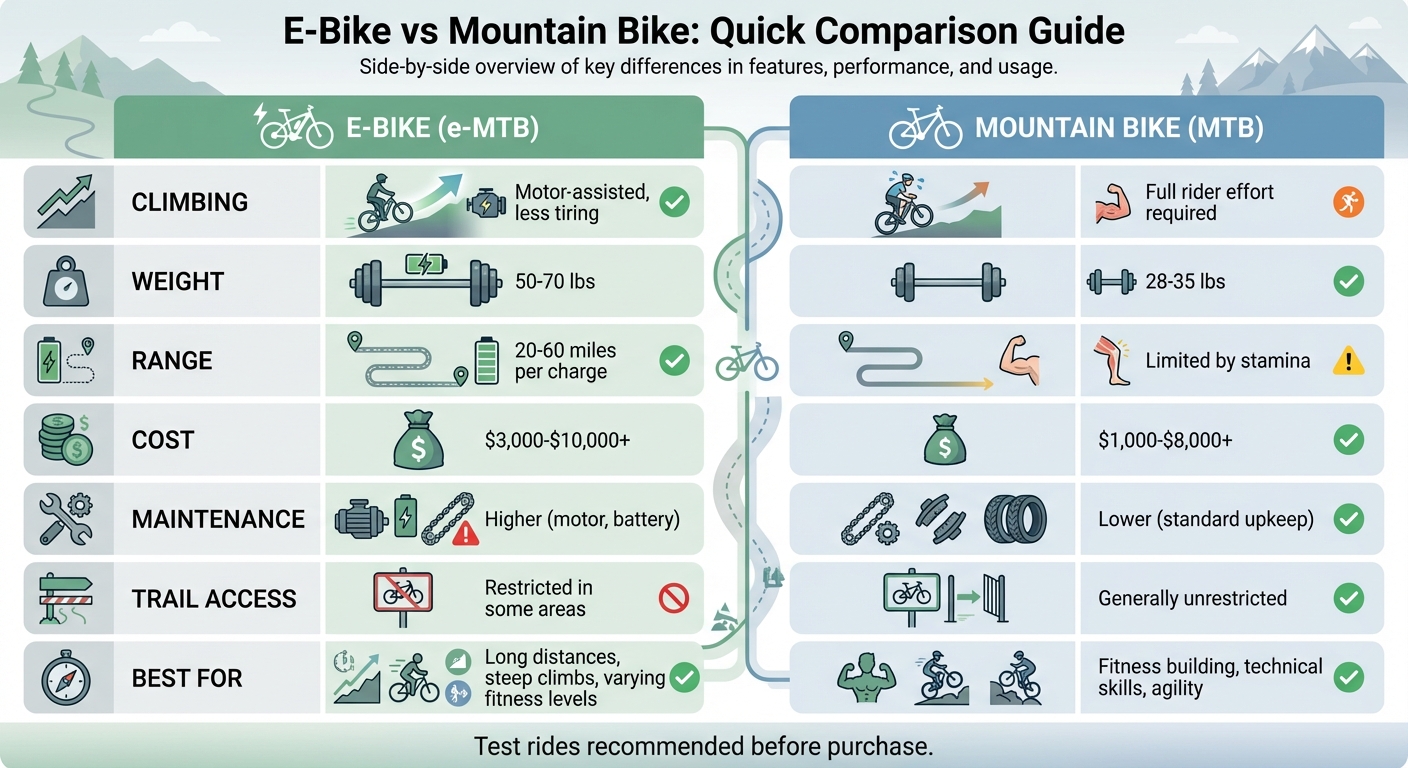
Quick Comparison:
| Feature | E-Bike (e-MTB) | Mountain Bike (MTB) |
|---|---|---|
| Climbing | Motor-assisted, less tiring | Full rider effort required |
| Weight | 50–70 lbs | 28–35 lbs |
| Range | 20–60 miles per charge | Limited by stamina |
| Cost | $3,000–$10,000+ | $1,000–$8,000+ |
| Maintenance | Higher (motor, battery) | Lower (standard upkeep) |
| Trail Access | Restricted in some areas | Generally unrestricted |
Key Takeaway: If you value ease on climbs and longer rides, go for an e-bike. If fitness and skill-building are your focus, stick with a mountain bike. Test rides are essential to make the best choice for your needs.
E-Bike vs Mountain Bike Comparison: Cost, Weight, Range and Maintenance
Identify Your Riding Goals and Terrain
Set Your Riding Goals
Start by jotting down your top three riding priorities. These might include improving your cardiovascular fitness, mastering technical skills like navigating tricky obstacles, or tackling long backcountry loops. Defining your goals will make it easier to choose the bike that best fits your needs.
If building fitness is your main focus, a traditional mountain bike (MTB) is an excellent choice. It demands more effort, helping you boost endurance and strength. For technical skill development – like perfecting cornering techniques or handling drops – a traditional MTB’s lightweight and responsive design provides the precision you need.
On the flip side, if your sights are set on covering long distances or exploring remote trails, an electric mountain bike (e-MTB) could be a game-changer. With motor assistance, you can conquer steep climbs and reach far-off trailheads without draining all your energy. E-MTBs also shine in group rides, especially when participants have varying fitness levels, ensuring no one gets left behind on those challenging ascents.
Once your goals are clear, think about how the trails you frequent align with what you want to achieve.
Assess Your Terrain
Now, take a closer look at the terrain you usually ride. Your regular trails should heavily influence your decision. If steep and sustained climbs are part of your routine, an e-MTB can make those long ascents far less grueling by providing motorized support. This can be especially helpful if you’re tackling routes with significant elevation gain.
For technical descents, tight switchbacks, or slow-speed rock gardens, a traditional MTB often provides better control and agility, thanks to its lighter frame and responsive handling. That said, some riders appreciate the extra traction and stability an e-MTB offers on rough terrain. Flow trails and bike parks? Either bike type works well, but the choice depends on your preferences – e-MTBs let you climb back up faster, while traditional MTBs often feel more playful on jumps and berms.
To get a clearer picture, try a quick terrain review. Use a tracking app like Strava or Trailforks to analyze your last 5–10 rides. Look at the distance, total elevation, and trail type (e.g., singletrack, gravel, or rocky technical sections). If your rides are usually under 10–12 miles with moderate elevation and you enjoy the workout, a traditional MTB might be your best bet. However, if fatigue frequently cuts your rides short or you avoid tough climbs, an e-MTB could open up new possibilities.
Main Decision Factors
After defining your goals and evaluating your terrain, it’s time to prioritize. What’s most important to you: fitness, speed, or exploration? Riders focused on fitness often lean toward traditional MTBs for the unassisted pedaling challenge. If keeping up with faster friends or speeding up climbs is your priority, the motor boost of an e-MTB can make all the difference. For those who crave exploration – whether it’s longer loops, mixed surfaces, or high-elevation trails – e-MTBs provide the range and climbing ease to tackle ambitious rides.
To simplify your decision, create a quick comparison chart. List your primary goal, the steepness and technical difficulty of your terrain, and how each bike type matches up. If fitness and technical riding are your focus, a traditional MTB is likely the way to go. But if you’re drawn to long, exploratory rides with challenging climbs, an e-MTB might be your perfect match. This approach can help you narrow down your options before even stepping into a bike shop for a test ride.
E-Bikes vs. Traditional Mountain Bikes: Direct Comparison
Performance and Riding Experience
E-Mountain Bikes (e-MTBs) come equipped with battery-powered motors that assist with pedaling, while traditional mountain bikes (MTBs) rely entirely on your own effort. When it comes to climbing, the motor assistance on e-MTBs makes a noticeable difference. Steep hills become more manageable, and you can tackle them with less fatigue. On flatter trails or rolling singletrack, e-bikes allow you to cover greater distances – think 15–25 miles in a single outing – without being limited by fitness levels.
However, the added motor and battery make e-MTBs significantly heavier. This added weight can be a hurdle when lifting the bike over obstacles or loading it onto a car rack. On the flip side, the extra mass provides more stability and traction on descents, though it can feel less nimble on tight switchbacks or technical features. Traditional MTBs, being much lighter, excel in maneuverability, which is a big plus for riders navigating highly technical trails in the U.S..
Another key difference is range. Modern e-MTBs typically offer 20–60+ miles per charge, though factors like battery capacity, rider weight, terrain, and elevation can push this range higher or lower. Some brands even claim ranges of 30–100 miles under ideal conditions. However, on steep or technical trails, you’ll likely experience the lower end of this spectrum. In contrast, the range of a traditional MTB is limited only by your stamina. Fit riders can often manage 15–30 miles in a day, with endurance riders going even further – though this comes at the cost of greater physical exertion.
| Aspect | E-MTB (Electric Mountain Bike) | MTB (Traditional Mountain Bike) |
|---|---|---|
| Climbing | Motor assistance makes steep climbs easier and less tiring, even on technical ascents. | Requires full rider effort, offering a challenging but rewarding workout. |
| Descending | Extra weight adds stability and traction but requires more braking control in tight areas. | Lighter weight offers a playful, responsive feel on technical descents. |
| Maneuverability | Heavier design makes technical maneuvers like bunny hops more difficult. | Lighter and more agile, ideal for tight or technical terrain. |
These differences in performance also influence how each bike type is maintained.
Maintenance Requirements
E-bikes have additional components – like motors, batteries, wiring, and control units – that require extra care. This means regular checks on the motor and electronics, along with routine maintenance, which drives up service costs. For example, keeping the battery in good shape involves avoiding full discharges, following manufacturer charging guidelines, and occasionally updating firmware. Specialized tools may be needed for motor system checks, and regular cleaning helps avoid issues with wiring or sensors.
Both e-MTBs and traditional MTBs share basic maintenance needs, such as tuning the drivetrain, replacing brake pads or rotors, servicing the suspension, and truing wheels. In the U.S., a basic tune-up typically costs $75–$150, while more extensive suspension servicing may run $150–$300. E-bikes, however, add costs for motor inspections, firmware updates, and potential replacement of pricey components like batteries or motors.
Cost Breakdown
In the U.S., trail-ready e-MTBs generally start around $3,000–$4,000, with high-end models featuring advanced motors, larger batteries, and premium suspension systems costing $6,000–$10,000 or more. Traditional MTBs cover a broader price range: entry-level hardtails for casual riders can cost under $1,000, while mid-range trail bikes typically fall between $1,500–$3,500. High-end full-suspension models can reach $5,000–$8,000+ depending on the materials and components. The higher upfront cost of e-MTBs largely stems from their motor and battery systems.
Over time, e-MTBs tend to incur higher expenses. Batteries eventually need replacement, often costing several hundred dollars, and motors may require repairs if they’re out of warranty. Additionally, wear-and-tear items like chains, cassettes, brake pads, and tires tend to wear out faster on e-MTBs due to higher speeds and torque. Traditional MTBs, on the other hand, typically involve lower long-term costs, limited to standard consumables and optional upgrades.
| Cost Category | E-MTB (Electric Mountain Bike) | MTB (Traditional Mountain Bike) |
|---|---|---|
| Purchase Price | $3,000–$10,000+ | $1,000–$8,000+ |
| Annual Maintenance | Higher – includes motor, battery, and electronics diagnostics | Lower – covers standard wear items and suspension |
| Long-Term Expenses | Includes battery replacements and motor repairs | Limited to standard consumables and upgrades |
These comparisons provide a clear picture of how each bike type aligns with different riding goals, terrains, and budgets.
Legal Rules, Trail Access, and Logistics
E-Bike Classes and Where You Can Ride
Before you settle on an e-bike, it’s important to ensure it complies with local laws and trail access rules. In the U.S., e-bikes are generally categorized into three classes:
- Class 1: Pedal-assist only (no throttle), with the motor cutting off at 20 mph. These are the most commonly allowed e-bikes on natural-surface and multi-use trails.
- Class 2: Features throttle assistance up to 20 mph. However, some trail systems restrict these bikes, especially on singletrack, due to concerns about speed and potential trail damage.
- Class 3: Offers pedal assist up to 28 mph. These are typically limited to roads, bike lanes, and paved paths and are often prohibited on non-motorized dirt trails because of their higher speeds.
These classifications are crucial because access rules are often based on the e-bike class rather than a general definition. Land managers – whether overseeing city parks, state parks, national forests, or private trails – tailor their policies accordingly. Traditional mountain bikes, by contrast, face far fewer restrictions and are generally permitted wherever bikes are allowed, including non-motorized singletrack, state and local parks, and bike parks. Even Class 1 e-bikes may be restricted in some areas, with access limited to specific trails or loops. On federal lands, e-bikes are often treated as motorized vehicles, meaning they’re confined to designated routes.
To determine if your e-bike is allowed on local trails, start by identifying its class from the manufacturer’s label or specifications. Then, review your state’s e-bike laws, typically found on transportation or DMV websites. Next, check which agency manages your destination – whether it’s a city park, county open space, state park, BLM land, or U.S. Forest Service property – and read their official e-bike policies. If you’re unsure, contact the ranger office or a local bike shop for guidance. Always double-check trailhead signage and periodically review policies, as they can change.
Keeping these access rules in mind, also think about how transportation, storage, and charging needs will fit into your daily riding routine.
Transport, Storage, and Charging Needs
Practical logistics play a big role when choosing an e-bike. Weighing between 50–70 pounds – compared to 28–35 pounds for traditional mountain bikes – e-bikes often require heavy-duty racks rated for 60–80 pounds. Roof racks are less practical for these heavier bikes, making pickups, vans, or SUVs with ramps a better option. If needed, removing the battery can help lighten the load. Lifting a 50+ pound bike onto a roof rack can be both challenging and unsafe, so ramps or assisted systems are often safer and more convenient.
Storage also requires some extra thought. Like traditional mountain bikes, e-bikes benefit from dry, secure storage to prevent rust. However, e-bikes need special care for their batteries. Lithium-ion batteries perform best when stored at temperatures between 50–77°F. To preserve battery life and minimize fire risks, store the bike in a dry garage and keep the battery indoors during extreme weather. For long-term storage, aim to keep the battery charged at 30–60%.
Charging adds another layer of planning. Most e-MTB batteries, typically 400–700 Wh, take about 3–6 hours to fully charge with a standard charger. Depending on terrain, assist level, and rider weight, these bikes usually provide a range of 20–60 miles per charge. For longer trips, identify charging options ahead of time – whether at a lodging outlet, a campground with power, or via a vehicle inverter. Always pack the original charger to avoid compatibility issues. Traditional mountain bikes, of course, sidestep these concerns entirely, making them a simpler choice for spontaneous rides or multi-day backcountry adventures.
sbb-itb-9d75ae1
How to Make Your Decision: Step-by-Step
Evaluate Your Fitness and Riding Style
Begin by honestly assessing your fitness level. Ask yourself: Can you comfortably ride 10–20 miles over moderate terrain without feeling overly fatigued? If the answer is yes, a traditional mountain bike might suit you well, offering a more natural workout. On the other hand, if steep climbs leave you drained, an e-bike – with motor support that can cover up to 100 miles depending on conditions – could make your rides far more enjoyable.
Your health is another important factor. For instance, if you’re over 50, recovering from an injury, or dealing with joint issues like knee pain, an e-bike’s adjustable pedal assist can significantly reduce strain. Many models deliver torque in the 40–80 Nm range, which helps take the pressure off your joints.
Think about your riding style and the pace of your group as well. If you’re an aggressive rider who loves technical challenges, the light handling of a traditional mountain bike may be ideal. But if your outings vary – sometimes fast-paced, other times more relaxed – the consistent assistance of an e-bike might better suit your needs.
After considering your fitness level, health, and riding preferences, you’ll have a clearer picture of which bike type aligns with your needs.
Match Your Profile to a Bike Type
Now, apply a simple framework to narrow down your options. If you have lower fitness or frequently ride in hilly terrain, an e-bike’s motor support will be a game-changer. But if you’re in great shape and enjoy technical challenges, a traditional mountain bike’s lighter, skill-driven design might be more your speed.
Think about your goals too. Are you aiming to cover long distances or build endurance? Or is your focus on improving technical riding skills? E-mountain bikes shine on long rides, especially with their ability to assist on tough climbs. Meanwhile, traditional mountain bikes offer a more authentic, pedal-powered experience.
Your lifestyle matters as well. If you need a bike that can handle both commuting and trail adventures, the versatility of an e-mountain bike might outweigh its higher cost and added weight.
Once you’ve narrowed it down, the next step is to confirm your choice through a hands-on test ride.
Test Ride and Confirm Your Choice
Testing both bike types is essential to see how they perform in real-world conditions. Schedule test rides on similar terrain for about 20–30 minutes each. Pay close attention to comfort – does the upright position of an e-mountain bike feel better, or do you prefer the aggressive geometry of a traditional mountain bike?
Evaluate handling by tackling descents and tight turns. You might notice that e-mountain bikes provide stable performance, while traditional mountain bikes feel more nimble and responsive.
Also, monitor your fatigue levels during and after each ride. Experiment with different pedal-assist settings on the e-bike to see if the motor reduces your climbing effort by around 50% – a good indicator that it’s meeting your needs. Make sure to test on a mix of terrain, from hills to technical sections, to fully experience each bike’s capabilities.
Finally, rate each bike on a scale of 1–10 for comfort, handling, and how you feel post-ride. If one bike consistently scores above 7, chances are you’ve found the perfect fit.
MTB Vs EMTB | What’s The Ultimate Trail Bike?
Conclusion
Deciding between an e-bike and a traditional mountain bike comes down to your personal needs and riding goals – there’s no one-size-fits-all answer. If you’re looking for help with steep climbs, want to cover more ground in less time, or need a bike that accommodates age or fitness challenges, an e-bike’s motor assistance can be a game-changer. On the other hand, if you prefer a lighter bike that offers a full-body workout, helps sharpen your skills, and comes at a lower cost, a traditional mountain bike might be the better fit.
Your riding environment and trail access also play a big role. E-MTBs shine on climbs and can travel 20–60 miles per charge, but some trails still limit their use. Traditional mountain bikes, however, have universal trail access and are easier to transport due to their lighter weight. Keep these factors in mind when weighing performance, price, and logistics.
Cost is another key consideration. E-MTBs come with a higher upfront price and ongoing expenses for battery and motor maintenance. In contrast, traditional mountain bikes are more budget-friendly to buy and maintain. E-bikes also require access to charging stations, can be heavier to transport, and take up more storage space. Be sure to think about trail conditions, maintenance needs, and your overall lifestyle when making your choice.
Finally, nothing beats a test ride. Trying out both options will give you firsthand insight into comfort, handling, and fatigue levels, helping you make an informed decision.
For more tips, gear recommendations, and in-depth reviews, check out Intermountain Bikes at https://intermountainbikes.com.
FAQs
What’s the difference in maintenance between e-bikes and mountain bikes?
E-bikes come with electrical components like batteries, motors, and wiring that demand special attention. Regular inspections, cleaning, and sometimes replacing these parts are key to keeping your e-bike running smoothly.
On the other hand, traditional mountain bikes rely on mechanical maintenance. This includes taking care of the brakes, gears, and tires through cleaning, lubrication, and occasional adjustments.
Because of their electronic systems, e-bikes tend to have more complex and pricier maintenance needs, while mountain bikes are typically easier and less costly to maintain.
How do local trail rules impact whether you should choose an e-bike or a mountain bike?
Local trail regulations can heavily influence whether you should choose an e-bike or a traditional mountain bike. Across the U.S., many trails have specific rules regarding e-bike use – some permit them only on designated paths, while others may ban them entirely.
If the trails you frequent have restrictions on e-bikes, sticking with a traditional mountain bike might be the smarter choice to guarantee full access. Be sure to review the rules for your local trails ahead of time to steer clear of any unexpected limitations.
What should I think about when deciding if an e-bike is worth the investment?
When weighing whether an e-bike is worth the extra expense, think about how often you ride, the terrain you usually encounter, and your specific needs. E-bikes are a fantastic option for those who ride often, deal with steep or tricky trails, or want an easier, more efficient commute. They’re also a smart choice if you could use a bit of extra help due to fitness levels or physical challenges.
Although e-bikes come with a higher initial price tag, they can save you time and effort, especially if you’re covering long distances or navigating hilly routes. If these advantages fit your lifestyle, investing in an e-bike might just make perfect sense.