
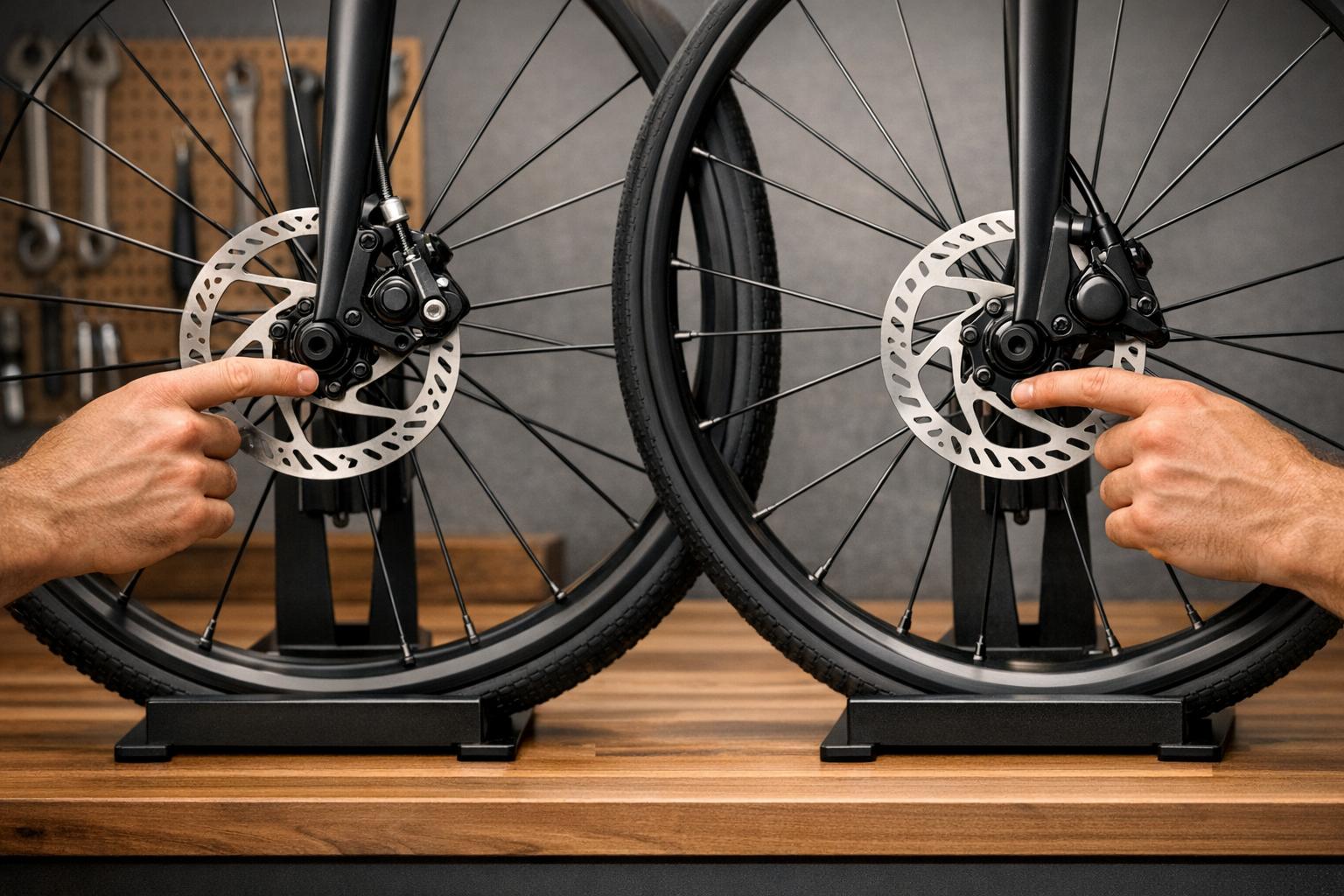
Shopping for bike brakes? Here’s the bottom line: mechanical disc brakes are affordable, simple to maintain, and ideal for casual riders or those touring in remote areas. Hydraulic disc brakes, on the other hand, deliver superior stopping power, smoother control, and are perfect for mountain biking, steep descents, or e-bikes. The choice comes down to your riding style, budget, and maintenance preferences.
Quick Overview:
- Mechanical Brakes: Lower cost ($20–$50), easier to repair, but require more hand effort and frequent adjustments.
- Hydraulic Brakes: Higher cost ($70–$150+), powerful one-finger braking, minimal day-to-day upkeep but harder to fix in the field.
Quick Comparison:
| Feature | Mechanical Disc Brakes | Hydraulic Disc Brakes |
|---|---|---|
| Braking Power | Moderate, more hand effort | High, effortless control |
| Maintenance | Simple, frequent tweaks | Less frequent, more complex |
| Cost | $20–$50 (entry-level) | $70–$150+ (entry-level) |
| Field Repairs | Easy with basic tools | Difficult, specialized tools |
| Best For | Commuters, touring cyclists | Mountain bikers, e-bikes |
Think about your terrain, budget, and how hands-on you want to be with maintenance. If possible, test both before deciding.
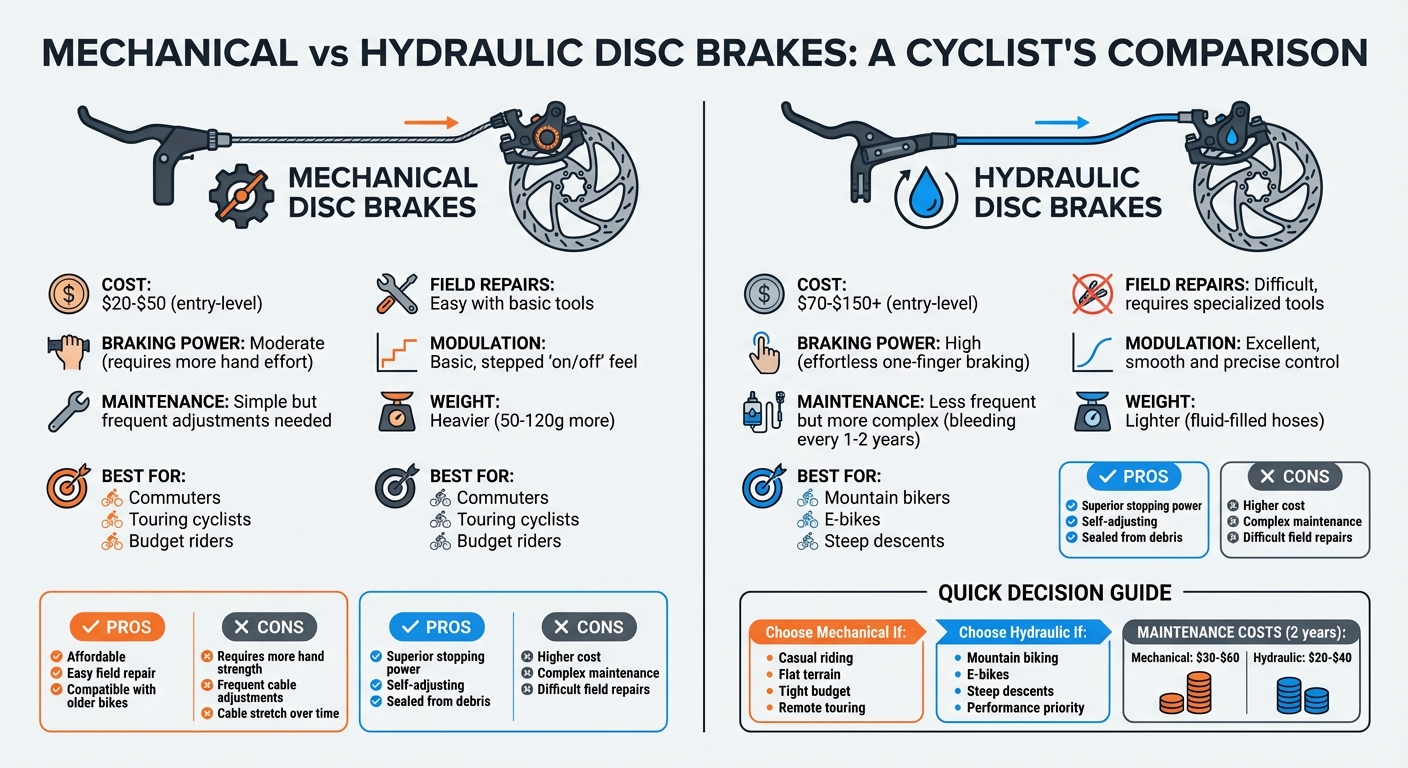
Mechanical vs Hydraulic Disc Brakes Comparison Chart
Mechanical vs. Hydraulic Disc Brakes For Road And Mountain Bikes. Comparison With SIckBiker.

sbb-itb-9d75ae1
How Mechanical Disc Brakes Work
Mechanical disc brakes operate using a straightforward cable-pull system, much like traditional rim brakes. When you squeeze the brake lever on your handlebars, it pulls a braided steel cable encased in protective housing. This cable runs from the lever to the brake caliper mounted on the wheel hub, transferring the force directly to the braking mechanism.
At the caliper, the cable engages an actuation arm, which uses either a screw or cam mechanism to press the brake pads against the rotor. In single-piston systems, only one pad moves, causing the rotor to flex until it contacts the stationary pad. Dual-piston systems, on the other hand, move both pads simultaneously, providing more even clamping pressure.
| Component | Role in Force Transfer |
|---|---|
| Brake Lever | Converts hand pressure into linear cable movement |
| Steel Cable | Transfers force from the lever to the caliper |
| Cable Housing | Guides the cable smoothly and protects it |
| Actuation Arm | Turns cable pull into clamping force at the caliper |
| Pistons/Cam | Pushes the brake pads toward the rotor |
While the design is simple and effective, it’s not without its challenges. Friction inside the cable housing, often caused by dirt or corrosion, can reduce the efficiency of force transfer. Over time, steel cables also stretch, which means you’ll need to regularly adjust the tension using barrel adjusters to maintain proper braking performance. Unlike hydraulic systems, which self-adjust as the brake pads wear down, mechanical brakes require manual adjustments to keep the pads close to the rotor.
The simplicity of mechanical disc brakes makes them easy to repair on the go. A replacement cable typically costs around $5, making them a favorite among touring cyclists and commuters. However, they do require more hand strength compared to hydraulic systems to achieve the same stopping power.
How Hydraulic Disc Brakes Work
Hydraulic disc brakes replace the traditional steel cable used in mechanical systems with a sealed system filled with an incompressible fluid – either mineral oil or DOT brake fluid. When you squeeze the brake lever, a piston inside the master cylinder (located in the lever) forces fluid through a reinforced, sealed hose toward the caliper at the wheel. Since liquids don’t compress, this setup ensures that your lever input directly translates into pressure at the caliper.
This precision is what sets hydraulic systems apart from mechanical ones. As James Huang, a writer for Velo, explains:
"The critical aspect of hydraulic disc brakes is the fluid itself… the key is that the fluid is non-compressible… because of that… there’s virtually no ‘signal degradation’."
At the caliper, the pressurized fluid drives one or more pistons outward, pressing the brake pads against both sides of the rotor. This dual-piston action ensures even clamping pressure and allows the system to self-adjust. As the brake pads wear down, the pistons automatically advance to maintain a consistent gap of about 0.02 inches (0.5 mm) from the rotor. This precise fluid control not only delivers consistent braking but also amplifies the force you apply to the lever.
Hydraulic systems also act as force multipliers. They amplify the pressure from your fingers, enabling powerful braking with minimal effort. This means you can achieve maximum stopping power without straining your hands.
Another advantage of hydraulic brakes is their sealed design, which keeps out mud, water, and debris – common issues that can degrade mechanical cables. However, the system isn’t without its vulnerabilities. If the brake fluid overheats and vaporizes (a condition known as vapor lock), the resulting compressible gas can cause a spongy lever feel and reduced braking performance. To prevent this, regular maintenance is essential. An annual bleed to remove air bubbles helps ensure the system continues to perform at its peak.
Mechanical vs. Hydraulic Disc Brakes: Direct Comparison
Let’s break down how mechanical and hydraulic disc brakes stack up against each other. These comparisons draw directly from their functionality and show how they impact a rider’s experience.
When it comes to braking power, hydraulic systems take the lead. Thanks to the use of incompressible fluid, they amplify the force you apply, allowing for effortless one-finger braking. On the other hand, mechanical brakes rely solely on cable tension. This design often requires more hand strength – sometimes even two fingers on extended descents – to achieve similar stopping power. As Lance Branquinho puts it:
"Hydraulic disc brakes make your finger inputs immensely powerful and the modulation and feedback is far superior to that of the cable-actuated equivalent"
Modulation, or how well you can control braking pressure, is another key difference. Hydraulic brakes offer smooth, progressive control, making it easy to "feather" the brakes on tricky terrain. Mechanical brakes, however, can feel more abrupt, with power delivered in noticeable steps due to cable friction. This can be a challenge on slippery surfaces like wet roots or loose gravel, where precise braking is crucial.
Consistency is yet another area where hydraulic systems shine. Their sealed design keeps out mud, water, and debris, ensuring a reliable lever feel every time you ride. Mechanical brakes, being cable-based, are more vulnerable to grime and cable stretch, which can lead to inconsistent performance. Regular adjustments using the barrel adjuster are often necessary to account for cable stretch and pad wear.
Here’s a quick summary of the major differences:
Comparison Table: Main Differences
| Feature | Mechanical Disc Brakes | Hydraulic Disc Brakes |
|---|---|---|
| Braking Power | Moderate; requires more hand effort | High; effortless one-finger braking |
| Modulation | Basic; "on/off" or stepped feel | Excellent; smooth and precise control |
| Lever Feel | Firm/heavy; can cause hand fatigue | Light and consistent |
| Maintenance Needs | Frequent adjustments for cable stretch | Less frequent but more complex (requires bleeding every 1–2 years) |
| Repair Ease | Easy; uses standard tools | Moderate to difficult; requires bleed kits |
| Bad Weather Performance | Good; cables can get gritty/stiff | Excellent; sealed system remains unaffected |
| Cost | Low/affordable (entry-level around $35) | High/premium (entry-level around $100, up to $400) |
| Weight | Heavier (50–120 g more due to steel cables) | Lighter (fluid-filled hoses) |
These differences go beyond just performance – they also influence maintenance routines and the overall feel of your ride.
Mechanical Disc Brakes: Advantages and Disadvantages
Advantages of Mechanical Disc Brakes
Mechanical disc brakes stand out for their simplicity and affordability, often costing far less than hydraulic systems. This makes them an appealing choice for budget-conscious riders.
One of their biggest strengths is their field repairability. If a cable snaps, you can replace it in minutes with basic tools like a 5mm hex key or a multitool. As Zachary Friedman, author of Where The Road Forks, explains:
"Mechanical disc brakes are easier to service in the field. You can maintain and repair them with basic tools and just a few spare mechanical brake parts."
This ease of repair makes mechanical disc brakes a go-to option for bikepackers and touring cyclists venturing into remote areas. Replacement cables are inexpensive and widely available, and there’s no risk of dealing with messy fluid leaks. Plus, long-term maintenance is light on the wallet – cables cost just a few dollars compared to the $60–$100 often required for professional hydraulic brake servicing.
Another advantage is their compatibility with older bike systems, including standard rim brake levers, which makes them a practical upgrade for older bikes. For riders who enjoy hands-on maintenance, the straightforward cable mechanism is easy to understand and can be quickly adjusted using barrel adjusters.
While these brakes are reliable and budget-friendly, their simplicity comes with some performance limitations.
Disadvantages of Mechanical Disc Brakes
The same simplicity that makes mechanical disc brakes easy to use also limits their performance. One major drawback is the loss of braking efficiency. Cable stretch, housing compression, and internal friction reduce the force transmitted to the brake pads, resulting in weaker stopping power. Riders often need to apply more effort – sometimes using two fingers instead of one – leading to hand fatigue on long, steep descents where consistent braking is critical.
Another issue is modulation, or the ability to control braking power smoothly. Mechanical brakes often feel more "on/off" rather than allowing for gradual, precise adjustments. This lack of finesse can make it harder to control speed on technical terrain and increases the risk of wheel lock-up on loose surfaces.
Mechanical systems also require frequent adjustments. Steel cables stretch over time and are prone to collecting dirt, grit, and rust. Unlike hydraulic brakes, which automatically adjust as pads wear, mechanical disc brakes need manual pad repositioning to maintain performance. This can be inconvenient for riders who prefer low-maintenance options.
Additionally, many mechanical calipers use a single-piston design, which pushes the rotor against a stationary pad. This can cause uneven pad wear and requires precise alignment to prevent rotor rub. The exposed cable housing is another vulnerability – it’s susceptible to corrosion, water intrusion, and even freezing in extreme cold, which can make braking sluggish or unreliable.
While mechanical disc brakes are practical and cost-effective, these trade-offs may not suit riders who demand top-tier performance or minimal upkeep.
Hydraulic Disc Brakes: Advantages and Disadvantages
Advantages of Hydraulic Disc Brakes
Hydraulic disc brakes stand out for their impressive performance, but they come with considerations around cost and upkeep. Here’s what sets them apart:
Hydraulic systems use incompressible fluid to amplify the force from your hand, making it possible to brake with just one finger – even on steep, demanding descents. Professional mountain biker Oliver L. sums it up well:
"Hydraulic disc brakes are significantly more reliable than their mechanical counterparts… they produce a lot more stopping power"
One of the standout features is modulation, which allows for precise control over braking force. This is especially useful on tricky surfaces like loose gravel or wet roots, where locking up your wheels can spell disaster. Plus, the sealed, self-adjusting design keeps the system consistent in feel while protecting against dirt, mud, and water. As Chris Reynolds, a certified coach, explains:
"The hydraulic fluid provides a seamless and smooth braking experience"
These systems also reduce hand fatigue, thanks to their efficient fluid transfer, making long rides less tiring. On top of that, hydraulic brakes are lighter – typically 50g to 120g less than their mechanical counterparts – since they use compact hoses instead of bulkier steel cables.
While the performance benefits are clear, hydraulic disc brakes aren’t without their challenges.
Disadvantages of Hydraulic Disc Brakes
The most obvious downside is the cost. Entry-level hydraulic systems start at around $100, but high-end options can climb to $400. And while they require less frequent servicing, maintenance is more complex. You’ll need specialized tools like bleed kits, syringes, and specific fluids (either Mineral Oil or DOT fluid, depending on the system – mixing them can ruin internal seals). Regular maintenance, typically every 1–2 years, is necessary to remove air bubbles that can cause a spongy lever feel.
Field repairs are another challenge. If a hydraulic hose gets damaged or a seal fails during a ride, you’re likely out of luck. Unlike mechanical brakes, where you can quickly swap out a cable, hydraulic systems require more intricate fixes. Finding replacement parts, especially in remote areas, can be tricky too – hydraulic hoses and fluids aren’t as readily available as standard steel cables.
Hydraulic brakes also face unique risks under extreme conditions. On long, steep descents, the brake fluid can overheat and boil. If this happens and you release the lever, the brakes may fail temporarily until the system cools down. Additionally, leaking fluid can contaminate brake pads and rotors, often requiring a full pad replacement because the fluid ruins the friction material.
These trade-offs highlight why hydraulic disc brakes are a favorite for performance-focused riders, but they also require a bit more commitment when it comes to maintenance and preparation.
What to Consider When Choosing Between Brake Types
Your Riding Style and Terrain
The type of brakes you need often depends on how and where you ride. If your rides are on flat terrain, city streets, or casual commutes, mechanical brakes are a practical and affordable choice. They work well for level ground and don’t require the added stopping power needed for more demanding conditions.
For mountain biking or tackling technical trails, hydraulic brakes are the go-to option. They provide the power and control necessary for steep descents and challenging features while reducing hand fatigue during extended rides. Lance Branquinho, a seasoned mountain biking writer, sums it up:
"In mountain biking, there is no question: hydraulic brakes are a must. The maintenance burden is only once a season, and a hydraulic braking system’s confidence is massive."
Hydraulic brakes also excel in "feathering" – a technique used to slow down gently without locking the wheels – essential for navigating loose surfaces like sand, wet roots, or gravel.
E-bike riders have a simpler decision to make: hydraulic brakes are almost always the better option. The added weight and higher speeds of electric bikes demand the superior stopping power and heat management that hydraulic systems offer. Plus, their sealed design makes them more reliable in wet or harsh weather since they resist mud, snow, and grit better than mechanical systems, which can suffer from debris buildup or freezing cables in extreme conditions.
After considering your riding needs, the next step is to align those with your budget.
Your Budget
Cost is a big factor when choosing between mechanical and hydraulic brakes. Mechanical disc brake sets are budget-friendly, starting at $20 to $50 for basic models, with mid-range options around $150. Hydraulic brakes, on the other hand, start at $70 to $100 for entry-level models and can go up to $300 to $400 for premium sets.
When it comes to maintenance, the story gets more nuanced. Over two years, maintaining mechanical brakes typically costs $30 to $60, while hydraulic brake maintenance averages $20 to $40 because it’s needed less often. Replacing a mechanical brake cable is inexpensive – just a few dollars – but cables stretch and pads wear out faster, requiring more frequent adjustments. Hydraulic systems, while less demanding day-to-day, can be pricier to maintain when needed. A DIY bleed kit and fluid run about $40 to $50, and a professional bleed service costs $60 to $100. However, bleeding is only required every one to two years, depending on usage.
Scott from TheBikr offers this perspective:
"Although hydraulic disc brakes are initially pricier, they can be a wiser investment in the long run due to their durability and lower maintenance needs."
If you’re a frequent rider or prioritize performance, the higher upfront cost of hydraulic brakes might pay off over time. But if you’re on a tight budget or prefer keeping initial costs low, mechanical brakes are a sensible choice.
Finally, think about how comfortable you are with maintaining your brakes.
Your Maintenance Preferences
Your willingness and ability to handle maintenance should also guide your decision. Mechanical disc brakes are simpler to maintain because they use a basic steel cable system, similar to traditional rim brakes. Adjustments are straightforward – usually just a matter of turning a barrel adjuster or tightening a bolt with a standard 5mm hex key or multitool.
One of the biggest advantages of mechanical brakes is how easy they are to repair in the field. A snapped cable can be replaced in minutes using common tools and spare parts you likely already carry. As one source puts it:
"Mechanical disc brakes win because a frayed cable is a two-minute fix with a multitool and spares you already packed."
Hydraulic brakes, in contrast, are more of a "set-and-forget" system in the short term. They automatically adjust as the pads wear down, maintaining a consistent lever feel without manual tweaks. However, when they do need maintenance – such as bleeding to remove air bubbles – it’s a more involved process requiring specialized tools and some patience. Additionally, a damaged hydraulic hose or seal can end your ride entirely, often requiring professional repairs.
Ultimately, your choice comes down to balancing performance, cost, and how hands-on you want to be with maintenance.
Conclusion
Deciding between mechanical and hydraulic disc brakes isn’t about picking the "best" option – it’s about finding what works best for your needs. Mechanical brakes are straightforward, cost-effective, and easy to repair on the go. This makes them a great choice for commuters, budget-conscious cyclists, and bike-packers who value a system they can maintain with just basic tools. On the other hand, hydraulic brakes offer stronger stopping power, smoother modulation, and less strain on your hands, making them ideal for mountain bikers, e-bike riders, and anyone navigating steep or technical trails.
Your decision should focus on three main factors: your riding style and terrain, your budget (both upfront and for maintenance), and how much effort you’re willing to put into upkeep. Mechanical brakes need more frequent adjustments but are easy to handle yourself, while hydraulic systems require less day-to-day maintenance but do need occasional bleeding, which requires specific tools and expertise.
Still unsure? Try both systems before committing. Head to your local bike shop and test how each feels – compare the lever effort, modulation, and overall performance. As Chris Reynolds, a USA Cycling Certified Coach, explains:
"Choosing between hydraulic and mechanical disc brakes boils down to your specific cycling needs, preferences, and budget."
FAQs
Can I upgrade from mechanical to hydraulic disc brakes on my bike?
Upgrading from mechanical to hydraulic disc brakes is definitely an option. Hydraulic brakes provide stronger stopping power, smoother control, and better heat management. That said, making the switch might involve replacing several parts, such as the brake levers, calipers, and possibly even the fork or frame if they aren’t compatible. To avoid any issues, it’s a good idea to consult a professional bike mechanic who can check compatibility and handle the installation properly.
How do I know if my braking issues are adjustment-related or need new pads/rotors?
To figure out what’s causing braking problems, start by looking for symptoms such as unusual noises, vibrations, or a noticeable drop in braking power. Examine the brake pads closely – are they worn down? Also, check the rotors to see if they’re warped or damaged. If both seem fine, the problem might come down to adjustments.
For mechanical brakes, ensure the cable tension is correct and the alignment is spot on. If you’re dealing with hydraulic brakes, inspect the system for air bubbles or fluid leaks. If you find air in the system, bleeding the brakes can help restore proper function.
Which brake type is better for cold, wet, or muddy rides?
Hydraulic disc brakes excel in cold, wet, or muddy conditions, offering reliable and strong braking performance when the weather takes a turn. Unlike mechanical brakes, which rely on cables, hydraulic systems use sealed fluid to transfer pressure. This design makes them less vulnerable to water, mud, or dirt interfering with their function. Plus, they retain their responsiveness and control even in wet environments, making them a top choice for tough riding scenarios.