
Eagle AXS by SRAM is a wireless electronic drivetrain designed to deliver precise, consistent, and effortless shifting for mountain biking. By replacing traditional cables with a secure wireless connection, it eliminates issues like cable stretch and dirt buildup. This 12-speed system is powered by an 80,000 RPM motor, ensuring fast and accurate gear changes every time. Key features include:
- Three Versions: XX1 ($2,000) for cross-country, X01 ($1,900) for enduro, and GX for a more budget-friendly option.
- Durability: IP69K waterproofing, 10mm extra ground clearance, and an Overload Clutch to protect the derailleur from impacts.
- Customization: The AXS app allows riders to adjust button functions, shifting logic, and monitor performance data.
- Battery Life: The derailleur battery lasts 20–25 hours, while the shifter’s CR2032 battery lasts up to two years.
- E-MTB Compatibility: Features like Single Click mode prevent drivetrain damage under high torque.
Eagle AXS offers a lightweight, low-maintenance, and highly durable solution for riders who demand precision and reliability on challenging terrains.
Pros and Cons of Wireless? Long-Term SRAM AXS Review

Wireless Shifting Technology
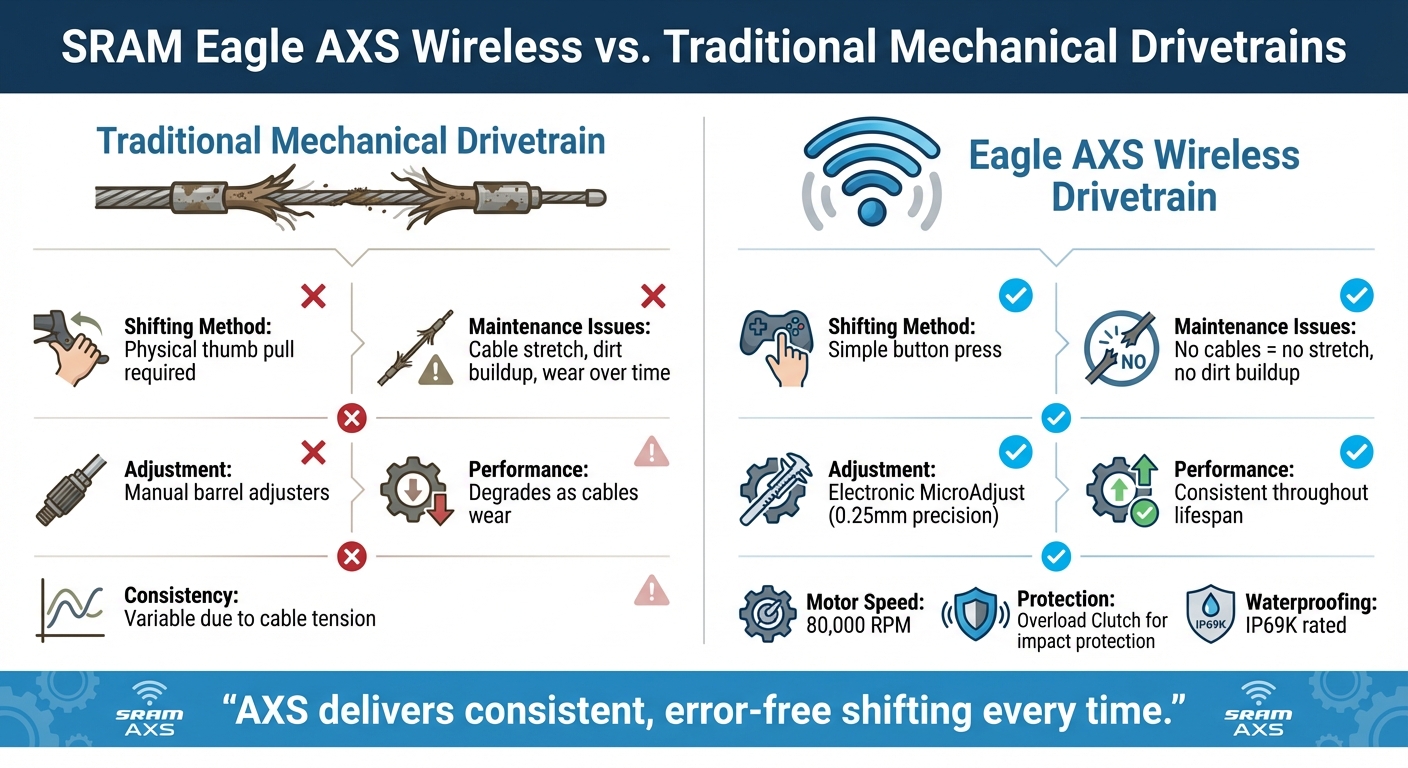
SRAM Eagle AXS vs Mechanical Drivetrain Comparison
How the Wireless System Works
SRAM’s Eagle AXS ditches traditional cables in favor of a secure, encrypted wireless connection between the shifter and derailleur. Here’s how it works: when you press the shifter button, it sends a signal to the derailleur’s onboard processor. This processor, which contains pre-programmed shift tables, ensures the derailleur moves precisely to the right position – completely sidestepping the inconsistencies caused by cable tension.
To make this happen, the derailleur’s internal motor spins at an impressive 80,000 RPM, delivering smooth and accurate gear changes every time. Plus, it’s smart – an integrated accelerometer puts the system into sleep mode when stationary and wakes it up immediately when you start moving again. Pairing the shifter and derailleur is simple: press a button on each, and they link up securely, avoiding any interference. Riders can even fine-tune their setup with electronic trimming, allowing 0.25mm micro-adjustments by holding a button while shifting.
This wireless system offers a clear contrast to traditional mechanical setups, leaving behind the limitations of cables and manual adjustments.
Differences from Mechanical Drivetrains
Mechanical drivetrains rely on cables, which are prone to stretching, wearing out, and collecting dirt – issues that can lead to inconsistent performance. Eagle AXS eliminates these problems entirely by removing cables from the equation.
"AXS delivers consistent, error-free shifting every time."
Another key difference? Mechanical systems require a physical thumb pull to shift gears, and performance can degrade as cables wear out. With AXS, shifting is as simple as pressing a button, reducing physical effort and ensuring a smoother experience. The system also includes an integrated Overload Clutch, which protects the derailleur during impacts. If hit, the clutch disengages the motor gearbox, allowing the derailleur to swing inward safely before snapping back into place.
This combination of precision, ease, and durability sets Eagle AXS apart from its mechanical counterparts.
Hardware Components
Rear Derailleur Design
The Eagle AXS derailleur takes a leap forward with its high-torque motor and gearbox, doing away with traditional cable-related problems like stretch and friction. It also features the Overload Clutch, which disengages the motor during impacts to protect the system. As professional enduro rider Jerome Clementz shared:
"I have put the Eagle AXS derailleur into the dirt and into rocks and it is still there – still shifting. I think it is quite smart, this derailleur."
The pulley cage is 10mm shorter than its mechanical counterparts, giving it better ground clearance and improved chain wrap on the cassette. This design results in smoother shifts and extends the system’s lifespan. The derailleur also uses X-Horizon Technology, a straight parallelogram structure that restricts movement to the horizontal axis, ensuring consistent shift accuracy across the full cassette range. Built tough, it meets IP69K standards for water and dust resistance, making it ready for extreme conditions. Fine-tuning is a breeze, thanks to electronic trimming that allows micro-adjustments via the controller or app – no need for barrel adjusters.
The derailleur pairs seamlessly with advanced controllers and shifters, which further enhance its precision and ease of use.
Controllers and Shifters
Building on the derailleur’s innovations, the controllers and shifters offer an intuitive, streamlined experience. Shifting is as simple as a touch: pressing the top of the textured cover shifts in one direction, while pressing the bottom shifts in the other. For quick reactions, the Secret Sprint Paddle lets you shift to a harder gear with just a tap of your finger or knuckle – no need to adjust your grip.
The controller is powered by a single CR2032 coin-cell battery, which lasts around two years. An LED indicator helps you monitor the battery status. The system’s flexibility shines through its AXS app, where you can customize button functions – for example, assigning a button to control a wireless dropper post or reversing shift directions. Weighing just 68 grams, the shifter integrates neatly with SRAM brake levers using the MatchMaker X system, keeping your cockpit clean and organized.
Cassette and Chain Technology
Eagle AXS cassettes come in 10-50t and 10-52t configurations, offering a massive 520% gear range, comparable to traditional 2×11 drivetrains. The shorter derailleur cage enhances chain wrap, delivering smoother shifts and extending the cassette’s lifespan.
The chainrings use X-SYNC 2 Technology, with tall, square tooth profiles that grip the chain earlier than standard designs. Rounded chamfer edges further improve chain control, ensuring reliable performance even in tough conditions. High-end XX1 components feature a titanium nitride PVD coating (Rainbow finish) on both the cassette and chain, reducing friction and increasing durability. For e-MTB riders, the AXS app includes a single-click shifting mode to prevent multiple shifts under high torque, protecting the chain and cassette during demanding rides. GX-level chains feature solid pin construction and Eagle PowerLock for dependable performance under load. All AXS derailleurs are compatible with SRAM Eagle 12-speed cassettes, though they’re optimized for the newer 10-52t range.
Together, these cassette and chain technologies round out the Eagle AXS system, ensuring precise shifts and dependable performance across varied terrains.
AXS App Integration
The AXS mobile app changes the way you interact with your Eagle drivetrain, bringing full control right to your smartphone. Designed to complement SRAM’s precision-engineered hardware, the app allows you to fine-tune and monitor your shifting performance. It’s available for free on the Apple App Store and Google Play, connecting to your components via Bluetooth to unlock customization options that simply aren’t possible with mechanical systems. As SRAM explains:
"AXS lets you connect your AXS-enabled components to a mobile app, where you can assign custom actions to your controls."
Getting started is straightforward. Turn on Bluetooth on your phone, then shake your bike to wake up the components. When setting up your bike profile, make sure to select the rear derailleur as the primary component to access the full range of personalization and performance tracking features.
Adjusting Shifting Preferences
The app’s "Configure Controls" menu gives you the freedom to reassign the three touchpoints on your controller to specific actions. For instance, you can set a button to control a dropper post instead of its default gear-shifting function. This level of customization also applies to Multishift, which allows you to decide how many gears the derailleur shifts when you hold down a button.
Another standout feature is MicroAdjust, which lets you make precise 0.2mm electronic tweaks to your chainline for optimal alignment – no need for manual barrel adjustments. For e‑MTB riders, the app offers the option to disable Multishift, helping to protect the drivetrain under high motor loads. As Mike Levy, Tech Editor at Pinkbike, points out:
"The AXS app lets you choose which button controls what, from the shifter to the Reverb remote."
Once your controls are set up, the app continuously tracks performance, keeping you informed every step of the way.
Performance Monitoring
Beyond customization, the AXS app functions as a diagnostic tool, displaying real-time battery levels for all connected components. The derailleur battery typically lasts 20–25 hours, while the CR2032 coin cells in the controllers can last up to two years. Checking these levels before heading out ensures you won’t face any surprises mid-ride.
For more detailed insights, AXS Web takes things further by analyzing ride data synced from your bike computer. It provides reports on shift counts, gear usage, and even time spent in each gear, helping you optimize your setup. As SRAM explains:
"AXS Web analyzes your ride files specific to shifting, gear use, power zones, and tire pressure, so that you can quickly and easily learn more about how your bike is working for you."
For example, if you notice you’re often using the smallest cogs, upgrading to a larger chainring might improve your efficiency. On the other hand, frequent use of the largest cogs could mean you’d benefit from a smaller chainring. The app also handles wireless firmware updates, keeping your system up-to-date with the latest features and improvements.
sbb-itb-9d75ae1
Performance and Durability
Eagle AXS takes performance and durability to a whole new level, building on its advanced shifting mechanics. The wireless design ensures consistently accurate shifting, no matter the trail conditions – whether you’re battling through thick mud or navigating fine sand and dust. Unlike traditional mechanical drivetrains, which can be plagued by cable stretch and housing contamination, Eagle AXS sidesteps these issues entirely. This not only enhances shift precision but also guarantees reliability over time, even on the most punishing trails.
One standout feature is the Overload Clutch, which protects the derailleur during impacts. It works by disengaging the motor gearbox, allowing the derailleur to move inward and then return to its original position. This system also adds 10 mm of extra ground clearance, reducing the likelihood of strikes and keeping your ride smooth.
Real-world testing backs up these durability claims. Over 16 months and across 2,100 km in Scotland, as well as more than 60 rides in Squamish and Whistler, Eagle AXS delivered seamless performance, even after repeated impacts. For instance, BikeRadar’s Alex Evans tested the GX Eagle AXS Transmission group between June 2023 and November 2024, logging 2,100 km and 82,700 meters of elevation in Scotland’s rugged Tweed Valley. Despite the derailleur enduring repeated hits against rocks, it stayed aligned and fully functional throughout the test period. Similarly, Pinkbike’s Mike Levy completed over 60 rides with 45,000 meters of vertical gain in Squamish and Whistler, reporting "zero bad shifts" and noting that "the robot don’t care" about mud or even pressure washing.
The drivetrain’s durability is further bolstered by its impressive waterproofing. With IPX7 and IP69K ratings, it can handle being submerged in up to 1 meter of water for 30 minutes and withstand high-pressure washing. Additionally, Transmission models attach directly to the frame, eliminating the need for a traditional derailleur hanger. This design not only improves stiffness but also ensures precise shifting under heavy loads. As SRAM’s Chris Hilton explained:
"We didn’t just take the road group and slap it on a mountain bike… It’s bigger and tougher, and it’s not likely to be destroyed if you wreck."
The drivetrain’s longevity is also enhanced by its design. Increased chain wrap on the cassette spreads the load across more teeth, reducing wear on both the chain and cassette. Meanwhile, the internal motor spins at an impressive 80,000 RPM, translating that speed into high torque through a finely tuned gearbox.
Battery Life and E-MTB Compatibility
The Eagle AXS battery system is designed to handle long rides and varying terrains with ease. The rechargeable battery for the Eagle AXS derailleur lasts approximately 25 hours on a full charge, with a charging time of about 45–60 minutes. Weighing just 24–25 grams, a replacement battery is priced around $50 USD.
To conserve power, the system includes an auto-sleep function that activates when the bike is stationary and wakes up instantly when motion is detected. However, vibrations during transport can accidentally wake the system, draining the battery. To avoid this, it’s a good idea to remove the battery when storing or transporting the bike. This smart power management is particularly well-suited for the demands of electric mountain biking.
Eagle AXS is designed to perform seamlessly in both traditional and electric mountain biking scenarios, adapting effectively to high-torque loads. When using it with an e-MTB, SRAM recommends disabling MultiShift in the AXS app and enabling Single Click mode. This setting helps safeguard the drivetrain against the high-torque forces generated by e-bike motors. As SRAM explains:
"Single-click does exactly what you would think: it shifts one gear at a time. This is mandatory for e-bike compatibility."
This single-click function ensures that the derailleur only moves one gear at a time, reducing the risk of chain and cassette damage under motor-assisted power. The Eagle AXS battery operates independently of the e-bike’s main battery, and since the battery is interchangeable with other AXS components – like the Reverb AXS dropper post – it offers e-MTB riders the flexibility to manage power across their wireless setup.
For charging, use a USB AC adapter that provides at least 1A at 5V or a USB 3.0 (or later) port. SRAM also offers a Four Battery Charger, which can charge four batteries at once and features a fast-charge option to bring a battery to 75% capacity quickly. To protect the electronic contacts from damage during cleaning, remove the batteries and cover the terminals with the included red plastic caps before washing your bike, especially if using strong cleaners.
Setup and Maintenance
One of the standout features of Eagle AXS is how straightforward it is to install and maintain compared to traditional mechanical drivetrains. Forget about messy cable routing, cutting housing, or fiddling with cable tension. With Eagle AXS, it’s as simple as bolting on the components, setting the limits, and pairing everything wirelessly. The newer Eagle Transmission (T-Type) makes things even easier by ditching high/low limit screws and B-adjust screws altogether. Instead, it uses a direct-mount interface that only requires a torque wrench set to 35 N⋅m.
After mounting, connecting the system wirelessly is just as simple. Start with the rear derailleur – it’s the key component – and sync it with your shifter or controller. Fine-tuning is done electronically through MicroAdjust, which lets you tweak the derailleur position in tiny 0.2mm increments using the controller buttons or the AXS app. As SRAM puts it:
"MicroAdjust one click at a time until performance is optimized. Less is more".
This means you can achieve precise shifting without ever needing a screwdriver.
Once everything is set up, maintaining the system is a breeze. The components are waterproof, with standard Eagle AXS rated to IPX7 and the Transmission rated to IP69K, meaning it can handle pressurized cleaning and harsh weather conditions. Before cleaning your bike, just remove the derailleur battery and insert the red battery block to protect the terminals. Stick to soap and water – harsh degreasers can harm the seals. The derailleur battery lasts between 20 and 60 ride hours, while the CR2032 coin cell in the controller typically lasts 1 to 2 years.
What’s more, Eagle AXS derailleurs are built to last, with modular and rebuildable designs. You can replace parts like skid plates, outer links, pulley wheels, and cage assemblies, extending the life of your derailleur.
Regular firmware updates via the SRAM AXS app keep the system running smoothly and can even add new features. If shifting issues arise, a quick battery check or re-pairing usually solves the problem. The AXS button indicator makes it easy to check battery status. And if your controller battery dies mid-ride, you’re not stranded – just use the derailleur’s AXS button for emergency shifting: one click shifts to a harder gear, and a double click shifts to an easier one.
Conclusion
SRAM’s Eagle AXS takes mountain biking to the next level by eliminating cables for a streamlined setup and delivering precise, reliable shifting. Whether you’re grinding up steep climbs or tackling tricky descents, the system ensures instant, flawless gear changes without the hassle of cable stretch or wear over time.
The Overload Clutch protects the drivetrain during impacts, while the AXS app lets you fully customize your shifts and monitor performance. To highlight its durability, professional enduro rider Mitch Ropelato put the X01 Eagle AXS to the test during an Enduro World Series round. Installed just a day prior, the system handled 3,600 meters of descending and multiple rock strikes without missing a beat. As Mitch summed it up:
"I now ride only Eagle AXS."
With GX upgrade kits starting at around $600 USD and top-tier XX1 groups priced at roughly $2,000 USD, Eagle AXS offers options for different budgets. Add to that its waterproof design (IPX7/IP69K), improved ground clearance, and a battery life of 20–40 hours, and it’s clear this system is designed for riders who demand performance and durability. It’s a true game changer for mountain biking enthusiasts across all disciplines.
FAQs
What makes the Eagle AXS wireless drivetrain better at shifting than mechanical systems?
The Eagle AXS wireless drivetrain ditches traditional cables in favor of an encrypted wireless connection paired with a motor-driven derailleur. This setup delivers quicker, precise, and consistent shifting, even when you’re tackling challenging terrain or shifting under load.
With the AXS app, riders can fine-tune shift settings to match their personal riding style. By eliminating mechanical cables, the system reduces inefficiencies, resulting in a smoother and more dependable experience for mountain bikers.
What customization options does the SRAM AXS app offer for Eagle AXS users?
The SRAM AXS app makes it simple for Eagle AXS users to customize their drivetrain settings. You can tweak Ride Mode by adjusting the Max Power and Assist % sliders to match your preferences. The app also allows you to assign specific functions to each button on the Pod controller and adjust the Pod’s 360° position for maximum comfort. Beyond that, you can fine-tune shifting with MicroAdjust, manage your bike profiles, and ensure your firmware is always up to date for a smoother, more efficient ride.
What does the Overload Clutch do to protect the Eagle AXS derailleur from impacts?
The Overload Clutch serves as a protective mechanism for the Eagle AXS derailleur, disengaging the motor gearbox whenever the derailleur encounters a sudden impact. This clever design allows the derailleur to momentarily shift out of danger and then return to its proper position.
By doing so, it helps shield the derailleur, shift motor, and hanger from possible damage, maintaining dependable performance even in challenging riding environments.