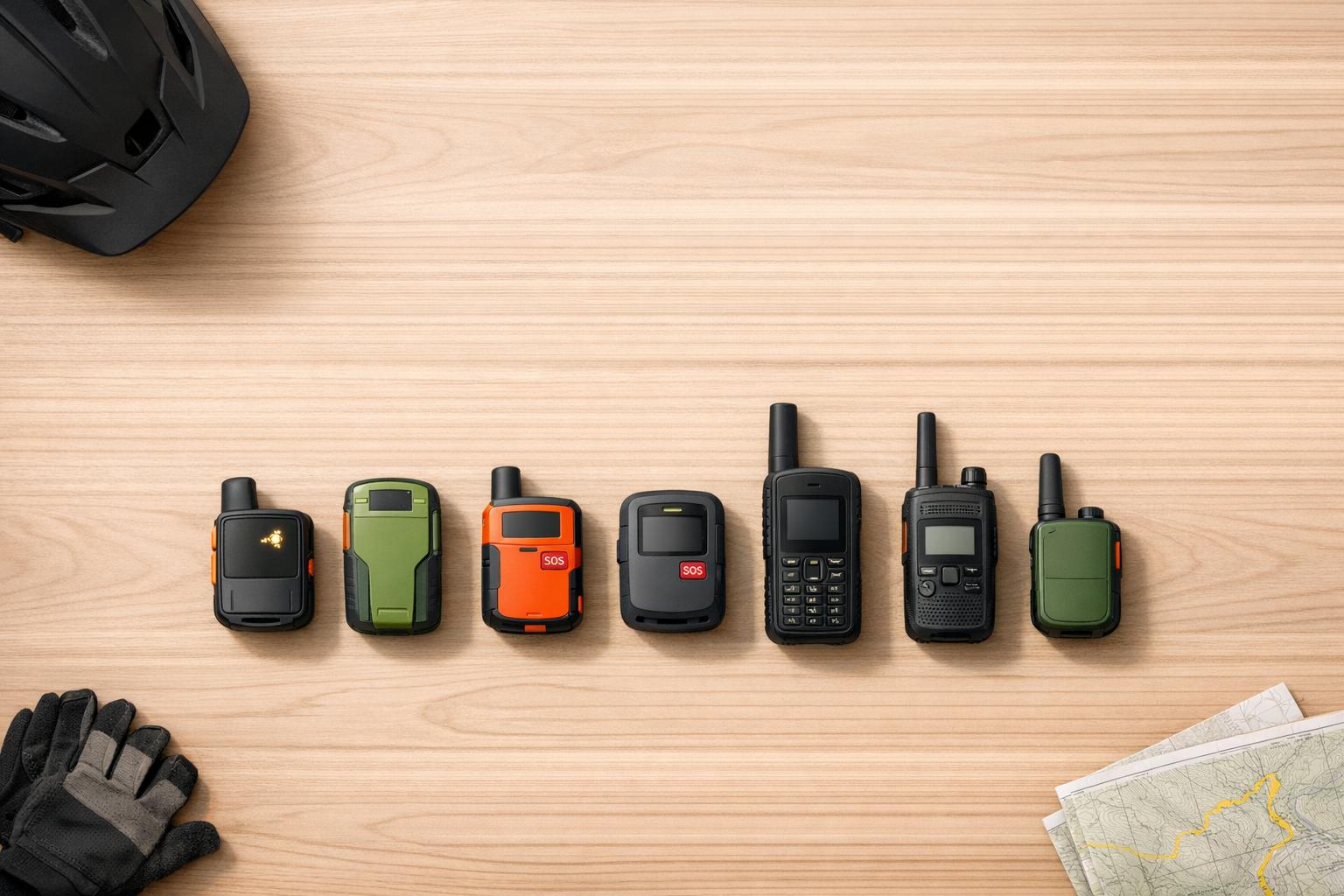
When you’re mountain biking in remote areas with no cell service, having an emergency communication device can save lives. These devices connect via satellite, ensuring you can send SOS signals or messages even in the most isolated locations. Here’s a quick rundown of the best options:
- Garmin inReach Mini 2: Lightweight, two-way messaging, global coverage, and reliable SOS functionality. Costs $399.99 with subscription plans starting at $14.99/month.
- SPOT Gen 4: Affordable one-way messaging device with SOS capabilities. Priced at $149.99, with plans starting at $11.95/month.
- Zoleo Satellite Communicator: Two-way messaging with seamless network switching. Costs $149–$200, with subscriptions starting at $20/month.
- ACR ResQLink 400: A no-subscription SOS-only device using the COSPAS-SARSAT network. Priced at $409.95.
- Garmin inReach Messenger Plus: Advanced two-way messaging with photo and voice memo capabilities. Costs $499.99, with plans from $14.99/month.
- Iridium Extreme Satellite Phone: Offers voice calls and text messaging with global coverage. Costs over $1,000 with monthly plans starting at $50.
- Garmin GPSMAP 67i: Combines GPS navigation with two-way messaging. Priced at $599.99 with subscriptions starting at $14.99/month.
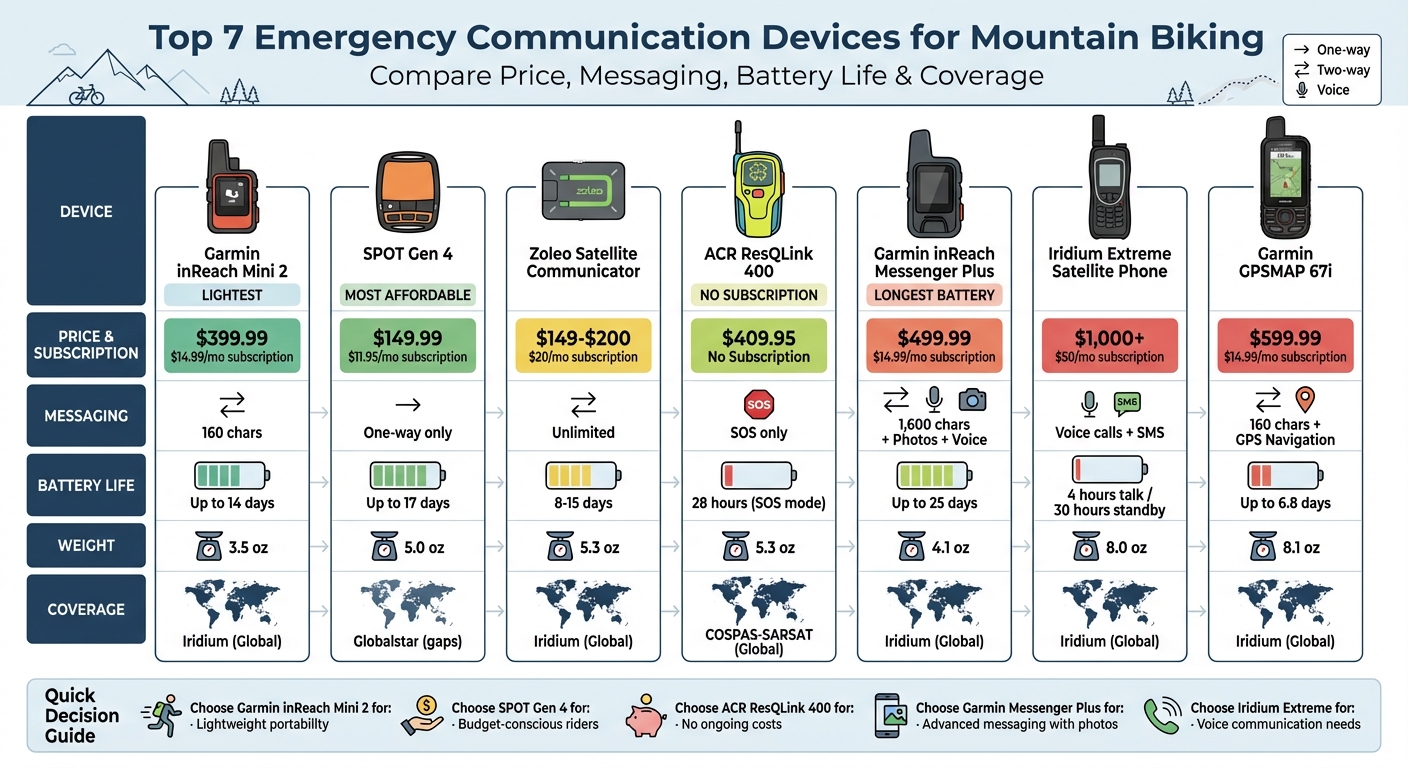
Quick Comparison
| Device | Price | Subscription Cost | Messaging Type | Battery Life (Tracking) | Weight | Coverage Network |
|---|---|---|---|---|---|---|
| Garmin inReach Mini 2 | $399.99 | From $14.99/month | Two-way (160 chars) | Up to 14 days | 3.5 oz | Iridium (global) |
| SPOT Gen 4 | $149.99 | From $11.95/month | One-way | Up to 17 days | 5.0 oz | Globalstar (gaps) |
| Zoleo Communicator | $149–$200 | From $20/month | Two-way (unlimited) | 8–15 days | 5.3 oz | Iridium (global) |
| ACR ResQLink 400 | $409.95 | None | SOS only | 28 hours (SOS mode) | 5.3 oz | COSPAS-SARSAT (global) |
| Garmin Messenger Plus | $499.99 | From $14.99/month | Two-way (1,600 chars) | Up to 25 days | 4.1 oz | Iridium (global) |
| Iridium Extreme Phone | $1,000+ | From $50/month | Voice + SMS | 4 hours talk time | 8.0 oz | Iridium (global) |
| Garmin GPSMAP 67i | $599.99 | From $14.99/month | Two-way (160 chars) | Up to 6.8 days | 8.1 oz | Iridium (global) |
For lightweight portability, the Garmin inReach Mini 2 is a great option. If budget is a concern, the SPOT Gen 4 offers basic functionality at a lower price. For those who want full messaging capabilities, the Zoleo or Garmin Messenger Plus are excellent choices. Choose the device that best fits your needs and ensures safety on your adventures.
Emergency Communication Devices Comparison: Price, Features, and Battery Life
9 Overlooked Grid-Down Communication Tools You’ll Wish You Had
sbb-itb-9d75ae1
1. Garmin inReach Mini 2
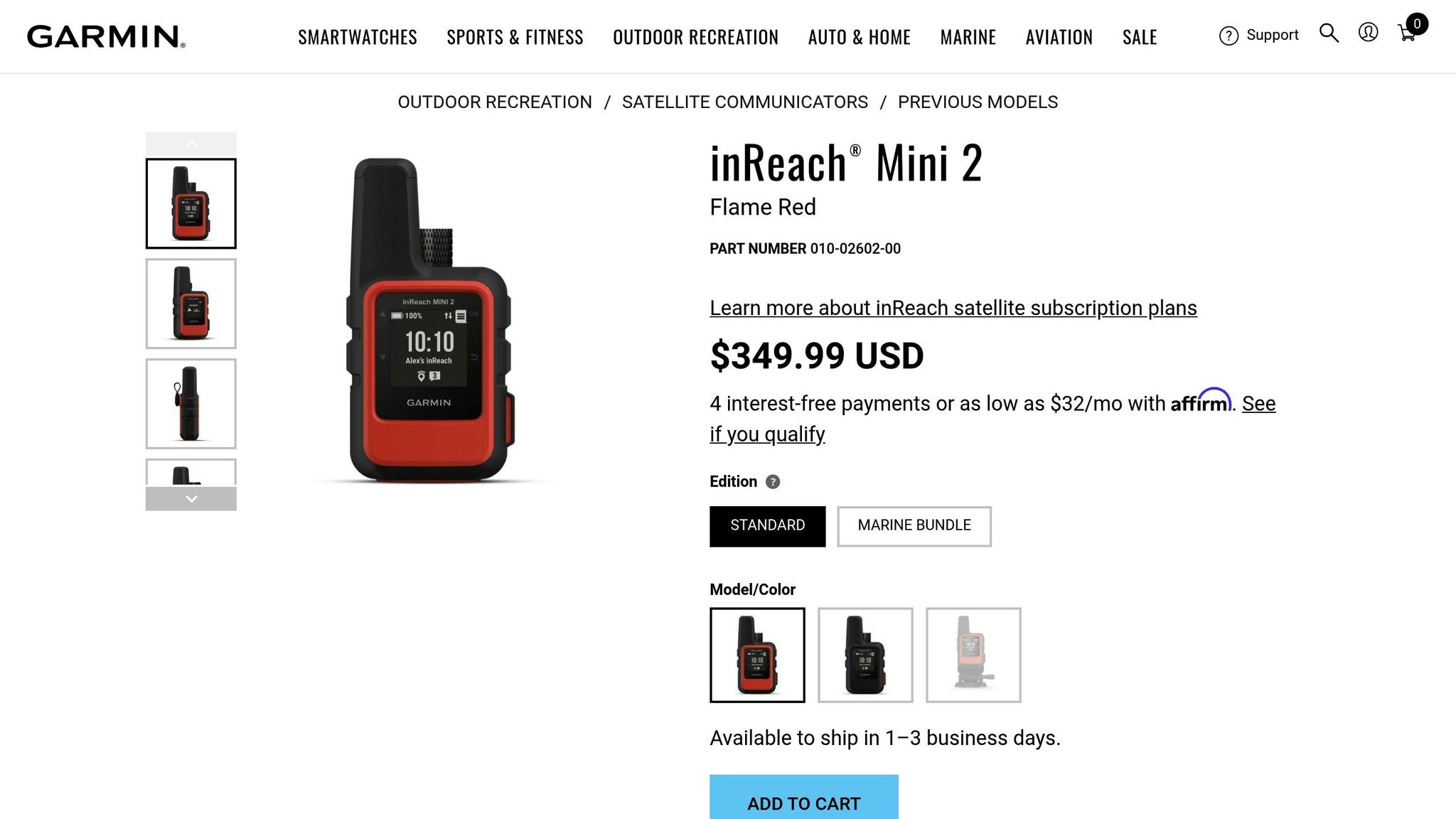
The Garmin inReach Mini 2, weighing just 3.5 oz, connects to the Iridium satellite network, offering global coverage for messaging from virtually anywhere. It pairs seamlessly with the Garmin Messenger app on your smartphone, making communication quicker and more convenient.
Here’s a closer look at how its features redefine emergency communication.
Two-way Messaging Capability
Unlike traditional one-way emergency beacons, the Mini 2 enables two-way text messaging. You can send 160-character messages to cell phones, emails, or other inReach devices using Garmin’s internal email system (ending in @inreach.garmin.com). The device ensures message delivery by automatically switching between satellite, cellular, and Wi‑Fi networks.
This versatility makes it a reliable tool for staying connected, no matter how remote your location.
SOS Functionality
In an emergency, holding the SOS button connects you to Garmin Response, a 24/7 emergency coordination center. In September 2024, adventure journalist Ariella Nardizzi used this feature during a five-week Colorado Trail hike when her partner became critically ill. Within 30 seconds, a dispatcher responded, coordinated with local search and rescue teams, and maintained hourly updates until the pair safely self-evacuated. During an SOS, the device sends location updates every minute for the first 10 minutes, then every 10 minutes afterward. Dispatchers can also access your emergency contacts, medical details, and battery status in real-time, ensuring a well-coordinated response.
"Within 30 seconds of hitting the SOS button, I was connected to a dispatcher who immediately began coordinating rescue efforts." – Ariella Nardizzi, Gear Reviewer, The Trek
Battery Life
The Mini 2 offers impressive battery performance: up to 14 days with 10-minute tracking intervals or 30 days with 30-minute intervals. During her Colorado Trail hike, Nardizzi tested the device over six days, using it for 3–5 hours daily for messaging and weather updates. It charges via USB‑C and can hold a charge for up to a year when powered off.
Pricing and Subscription Requirements
For adventurers planning extended trips, the device is priced at $399.99, with a one-time $39.99 activation fee. Subscription plans include:
- Essential: $14.99/month (50 custom messages, unlimited SOS)
- Standard: $29.99/month (150 messages, unlimited tracking)
- Premium: $49.99/month (unlimited messaging and tracking)
This pricing structure ensures you’re prepared for emergencies, making it a worthwhile investment for backcountry explorers.
2. SPOT Gen 4
The SPOT Gen 4 is a straightforward, budget-friendly option for riders who need a basic one-way messaging device. Priced at $149.99 (and often discounted to $99.99), it allows you to send pre-programmed messages and SOS alerts but doesn’t support receiving replies from emergency contacts or rescuers [28, 30]. Since its launch in 2007, SPOT devices have been credited with initiating over 11,107 rescues globally.
Weighing just 5 oz, the device is built to handle rugged conditions with an IP68 waterproof rating, meaning it’s both dustproof and submersible for up to 30 minutes [28, 30]. Unlike many competitors that use rechargeable batteries, the SPOT Gen 4 runs on 4 AAA lithium batteries, making it easy to replace in the field – though you’ll need to carry spares. Its affordable and durable design makes it a practical choice for those seeking simplicity.
SOS Functionality
When the SOS button is pressed, the device sends your GPS coordinates every 2.5 minutes initially, then every 5 minutes after acknowledgment by FocusPoint International, continuing until the signal is canceled or the battery runs out. The SOS transmission takes priority over all other messages, ensuring it reaches the satellite network immediately.
"The SOS button is an emergency only function… you will be activating a large, urgent response involving dozens or more people." – Jediah Porter, Review Editor, OutdoorGearLab
Because the SPOT Gen 4 doesn’t support two-way communication, rescuers must act as if the situation is critical. FocusPoint contacts local emergency services – 9-1-1 in North America or 1-1-2 in Europe – but cannot confirm the severity of your emergency [27, 28].
Battery Life
Battery performance varies depending on how you use the device. For continuous tracking at 10-minute intervals, the batteries last up to 168 hours (7 days). With motion-activated tracking, battery life extends to 436 hours on a single set of lithium batteries [30, 31]. The device can send approximately 1,250 check-in and custom messages before the batteries need replacing. Motion-activated tracking helps conserve power by pausing transmissions when stationary and resuming once movement is detected. However, there’s no battery indicator, so it’s wise to replace the batteries after any multi-day trip to ensure reliability.
Pricing and Subscription Requirements
The SPOT Gen 4’s affordability extends to its subscription plans, but there are a few additional costs to consider. Alongside the $149.99 device price, there’s a $29.95 activation fee. Monthly plans start at $11.95 with a 12-month contract or $14.95 for a month-to-month option, which also includes a $34.95 annual "Flex Charge". For extra peace of mind, the optional Overwatch X Rescue Plan costs $39.99 per year and covers expenses like helicopter evacuations during search and rescue operations [28, 32].
Messages need to be pre-programmed via computer before heading out [30, 32]. While OutdoorGearLab ranked the SPOT Gen 4 #13 out of 13 satellite communicators, they praised its strong battery life but pointed out the limitations of one-way messaging and the less extensive Globalstar network compared to Iridium-based devices.
3. Zoleo Satellite Communicator
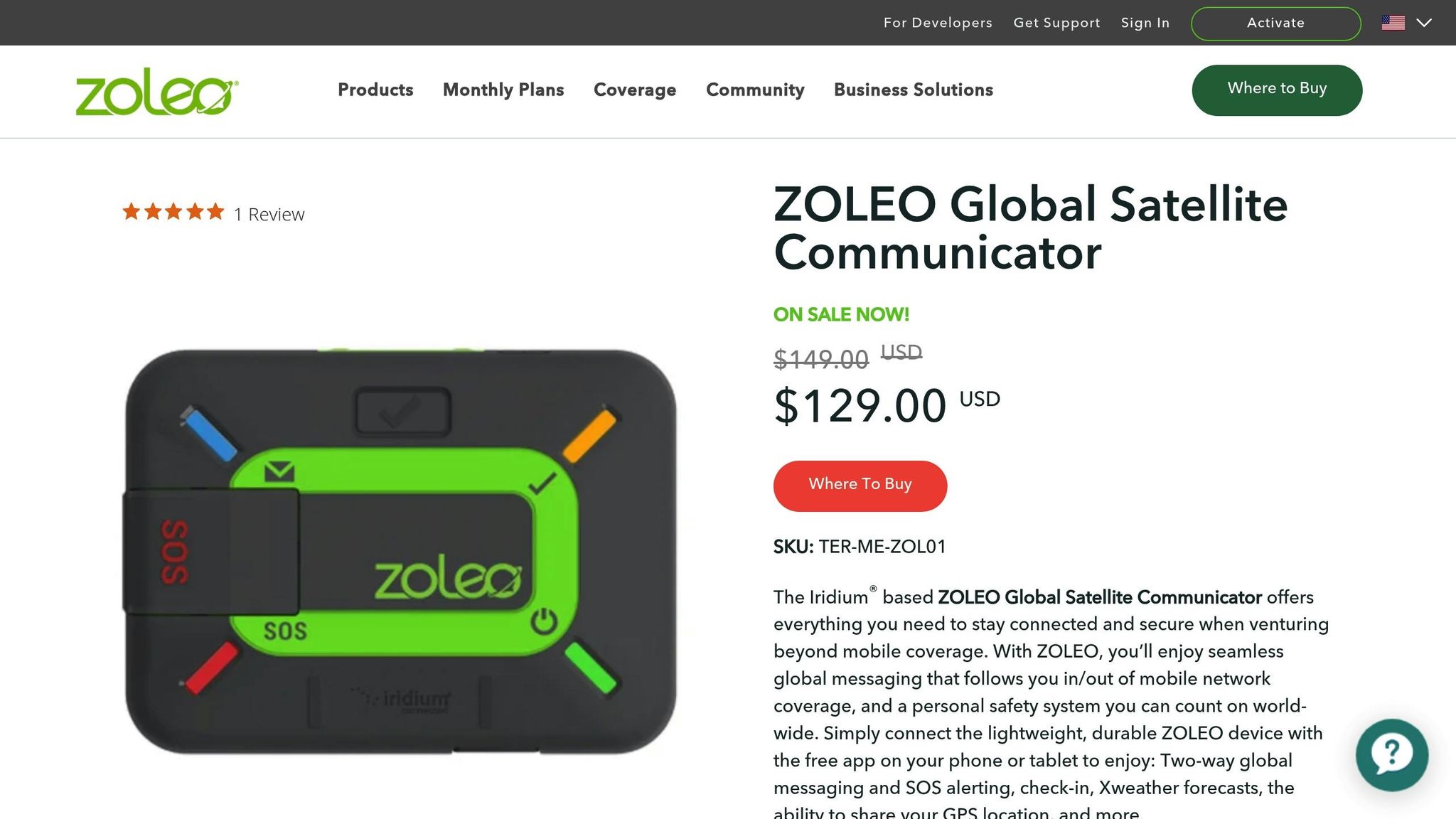
The Zoleo Satellite Communicator offers a smooth messaging experience by automatically switching between satellite, Wi-Fi, and cellular networks to find the most cost-effective option. Priced at $149 with a $20 activation fee, it allows users to send and receive messages seamlessly. Unlike simpler one-way devices, Zoleo provides its own SMS number and email address, enabling full conversations.
Weighing just 5.3 oz, the device is IP68-rated, meaning it’s waterproof up to 5 feet for 30 minutes. It connects to your smartphone via Bluetooth, allowing for messages up to 900+ characters. Even if your phone is out of commission, the physical "Check-in" and "SOS" buttons ensure you can still send critical alerts. OutdoorGearLab recognized its reliability, awarding it Editor’s Choice with a perfect 10/10 for SOS and emergency messaging.
Two-Way Messaging Capability
Zoleo’s two-way messaging is powered by the Iridium satellite network, ensuring global coverage even in areas without cellular service. Using the free companion app, you can send and receive full messages – a key advantage over one-way devices. Professional adventurer Andrew Skurka highlighted its convenience:
"ZOLEO messaging experience is better in every way. For owners, the messaging is centralized (in the ZOLEO App), rather than being split between conventional messaging apps".
Field-tested in the remote Wind River Range, the device performed flawlessly over several days. Its Bluetooth connection remained stable, even when carried inside a backpack. The built-in GPS is accurate to within 8.2 feet under ideal conditions. This two-way capability is particularly useful for group activities like trail rides, where separated members can share their exact location and condition, helping rescue teams prepare appropriately.
SOS Functionality
Zoleo’s SOS feature is managed by Global Rescue, an organization with experience in over 20,000 operations across 200 countries. The Progressive SOS system provides real-time updates through the app, allowing users to communicate directly with responders and share details about their situation. Unlike basic devices that only send coordinates, Zoleo’s two-way communication can be a lifesaver. The SOS button has a cover to prevent accidental use and can be canceled by holding it down for five seconds. LED indicators confirm when the alert has been successfully transmitted. The device also offers 24/7 Medical Assist for non-emergency guidance. In group emergencies, this feature enables better coordination, such as relaying injury details or managing rescues in different locations.
Battery Life
Zoleo’s battery lasts over 200 hours with message checks set to every 12 minutes. It operates in extreme temperatures ranging from –4°F to 131°F and recharges fully in just 2 hours with a 1.5 A charger. Tests show that carrying it in a backpack’s top compartment doesn’t interfere with its satellite signal.
Pricing and Subscription Requirements
Zoleo pairs its hardware with flexible subscription plans. Monthly options include $20 for 25 satellite messages, $35 for 250 messages, or $50 for unlimited messaging. For seasonal users, a $4 per month suspension plan keeps your phone number and email address active between trips. You can also add Location Share+ for $6 per month, which enables unlimited tracking messages. Note that a 90-day initial term is required.
4. ACR Electronics ResQLink 400
The ACR Electronics ResQLink 400 is a specialized Personal Locator Beacon (PLB) designed exclusively for emergency SOS signaling. At $409.95 and with no subscription fees, it’s a solid choice for mountain bikers seeking dependable emergency support without ongoing costs. Lightweight at just 5.3 oz and waterproof up to 16.4 feet for one hour, it meets IP68 standards, ensuring durability in challenging conditions.
SOS Functionality
This device employs triple signal technology – 406 MHz distress signals, 121.5 MHz homing signals, and GPS/GNSS – for reliable emergency communication. It works with the MEOSAR satellite system, which detects signals 95% of the time within five minutes of activation and can pinpoint your location to within 328 feet. Once triggered, the beacon transmits for over 24 hours continuously, while high-intensity LED and infrared strobes enhance visibility in low-light or nighttime conditions.
A real-world example of its effectiveness occurred in June 2023 when a hiker named Karen used her ResQLink 400 after falling in Glenorchy, Queenstown. Despite sustaining serious injuries, including a broken ankle and leg, she was rescued within 30 minutes after the beacon alerted her emergency contacts and local rescue teams.
This combination of robust signaling and efficient power management ensures the device is ready when needed most.
Battery Life
The ResQLink 400 is equipped with a battery that boasts a 5-year shelf life and over 24 hours of operational use once activated. Unlike satellite messengers that drain power during regular use, this PLB remains dormant until an emergency arises. Monthly self-tests are recommended to verify functionality, but the device limits these to 60 standard self-tests and 20 GPS self-tests over its battery life. After five years – or following emergency activation – the non-user-replaceable battery must be serviced by an authorized ACR Battery Replacement Center, with a replacement cost of approximately $250.
Pricing and Subscription Requirements
Priced at $409.95, the ResQLink 400 eliminates ongoing fees and requires only a free NOAA registration, renewed every two years. While the primary functionality is subscription-free, users have the option to subscribe to the "406Link" service for additional self-test notifications.
5. Garmin inReach Messenger Plus
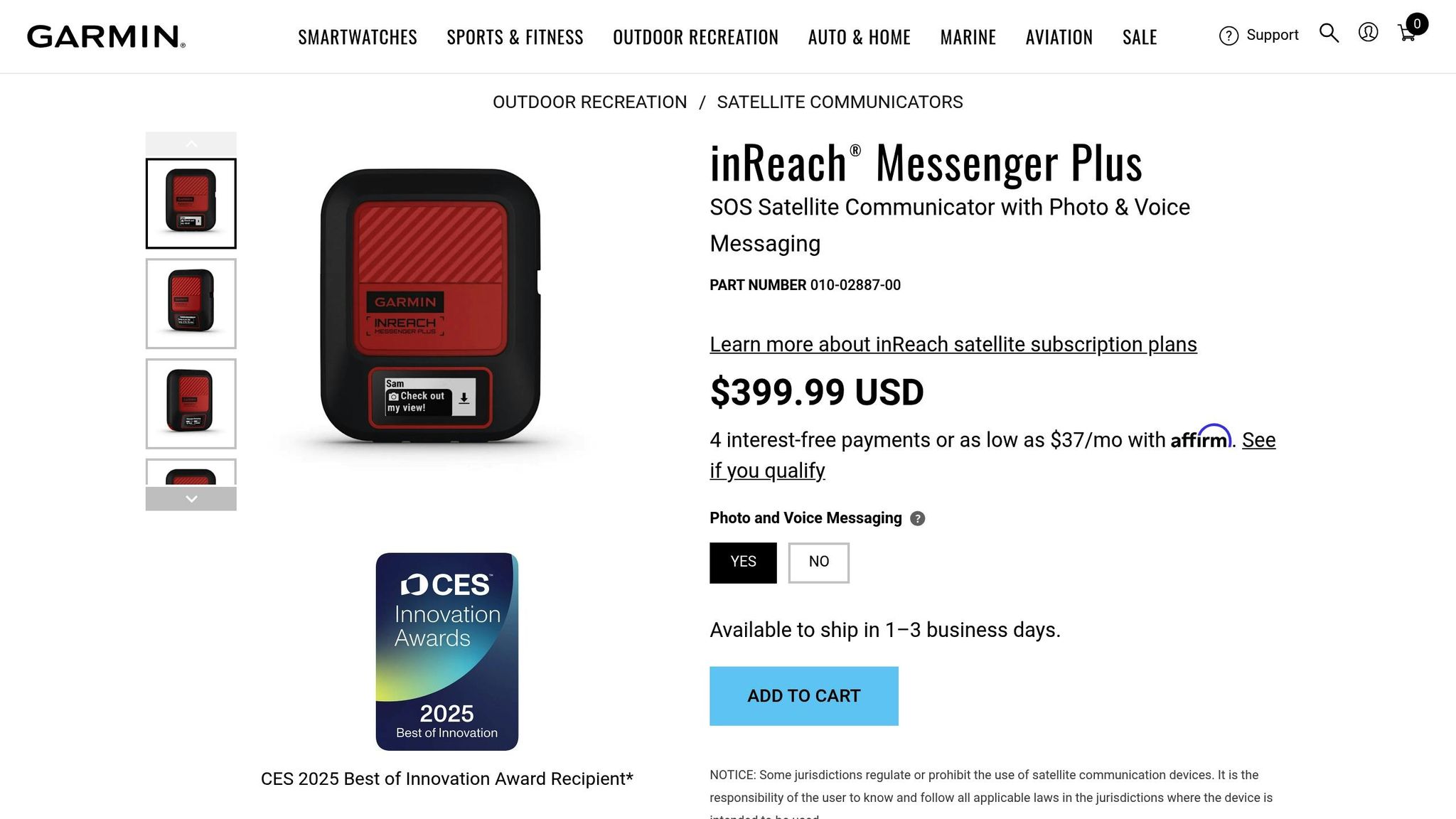
The Garmin inReach Messenger Plus is a standout in the inReach series, offering advanced satellite communication features tailored for mountain bikers tackling remote trails. Weighing just 4.1 oz and boasting an IPX7 waterproof rating (submersible up to 3.3 feet for 30 minutes), this device is built for rugged adventures where reliable communication is essential.
Two-Way Messaging Capability
This device redefines remote communication by enabling text messages up to 1,600 characters – a significant upgrade from the 160-character limit of earlier satellite devices. It’s also the first Garmin communicator to send photos and 30-second voice memos, giving rescue teams critical visual and audio details during emergencies. The device automatically selects the most efficient connection to ensure messages are sent reliably.
For group rides, the Garmin Messenger app simplifies coordination with group chat functionality, making it easier to organize rescues or updates across dispersed trails. While the inReach Messenger Plus can operate independently for check-ins and location sharing, multimedia messages require recipients to use the Garmin Messenger app.
SOS Functionality
The device features a dedicated SOS button protected by a cap, or users can trigger emergency assistance via the Garmin Messenger app. Once activated, it connects to Garmin Response, a 24/7 emergency coordination center that works with local first responders worldwide. During emergencies, the device sends location updates every minute for the first 10 minutes, then switches to 10-minute intervals to conserve battery.
"The new and enhanced messaging capabilities of the inReach Messenger Plus gives users a more personal and emotional way to communicate… Plus, with a rechargeable battery that can last for weeks, safety charging to help restore a depleted phone and the ability to trigger an SOS message, the inReach Messenger Plus is critical gear for remote emergencies." – Dan Bartel, Garmin Vice President of Global Consumer Sales
The interactive SOS feature allows real-time communication with Garmin Response coordinators, including text, photo, and voice messages, ensuring continuous updates during emergencies. Garmin inReach technology has already played a role in over 14,500 SOS activations globally.
Battery Life
The device’s robust battery ensures it’s ready for extended adventures. In low-power messaging mode with 10-minute tracking intervals, the rechargeable battery lasts up to 600 hours (25 days). This longevity outpaces many competitors, making it reliable for multi-day trips. On a full charge, users can send up to 250 media messages (photos or voice memos). Additionally, it retains its charge for up to a year when powered off.
A standout feature is "Safety Charging", which provides a 20-minute power boost to a drained smartphone, enough to send critical messages through the Messenger app. Importantly, the inReach battery won’t drop below 25% during this process.
Pricing and Subscription Requirements
The Garmin inReach Messenger Plus is priced at $499.99 and requires an active subscription. Monthly plans start at $14.99, with an economical "Enabled" plan available for around $8 per month, covering SOS-only functionality with additional fees for other messages. OutdoorGearLab ranked it the top satellite communicator out of 13 models, awarding it an overall score of 85/100 and praising its fast messaging speeds and the life-saving potential of photo sharing for first responders.
6. Iridium Extreme Satellite Phone
The Iridium Extreme 9575 is a satellite phone designed to provide reliable two-way voice calls and SMS messaging, especially in rescue situations. Weighing about 8 oz and priced at over $1,000, it offers global pole-to-pole coverage through the Iridium network’s 66 interconnected satellites.
Two-Way Messaging Capability
This device operates independently for both voice and text communication. It connects quickly and holds its signal better than most, even under challenging conditions like dense forests or deep valleys. Sending a single text message consumes about one minute of airtime. With approximately 4 hours of talk time and up to 30 hours of standby, it’s wise to carry a spare battery for longer trips. These features make it a dependable tool for communication during critical rescue operations.
SOS Functionality
The Iridium Extreme includes a dedicated SOS button that links users directly to the GEOS Worldwide system and the International Emergency Response Coordination Centre (IERCC). When activated, the distress signal is sent through the Iridium satellite network to emergency coordinators. A countdown timer allows users to cancel accidental alerts before they are sent. While the device generally performs well in remote locations like the Amazon or Nepal, signal strength can weaken in deep valleys or canyons where the line of sight to satellites is obstructed. Moving to higher ground usually resolves this issue. These advanced safety features, however, come with a hefty price tag.
Pricing and Subscription Requirements
The Iridium Extreme costs over $1,000, with monthly subscription plans ranging from $50 to $65. Basic plans typically include just 10 minutes of talk or text time, with additional usage priced at around $0.50 per minute. As noted by Treeline Review:
"Satellite phones weigh a half-pound, cost over a thousand dollars… and require a pricey $50 a month subscription".
For those who only need emergency messaging, satellite messengers may offer a more budget-friendly alternative.
7. Garmin GPSMAP 67i
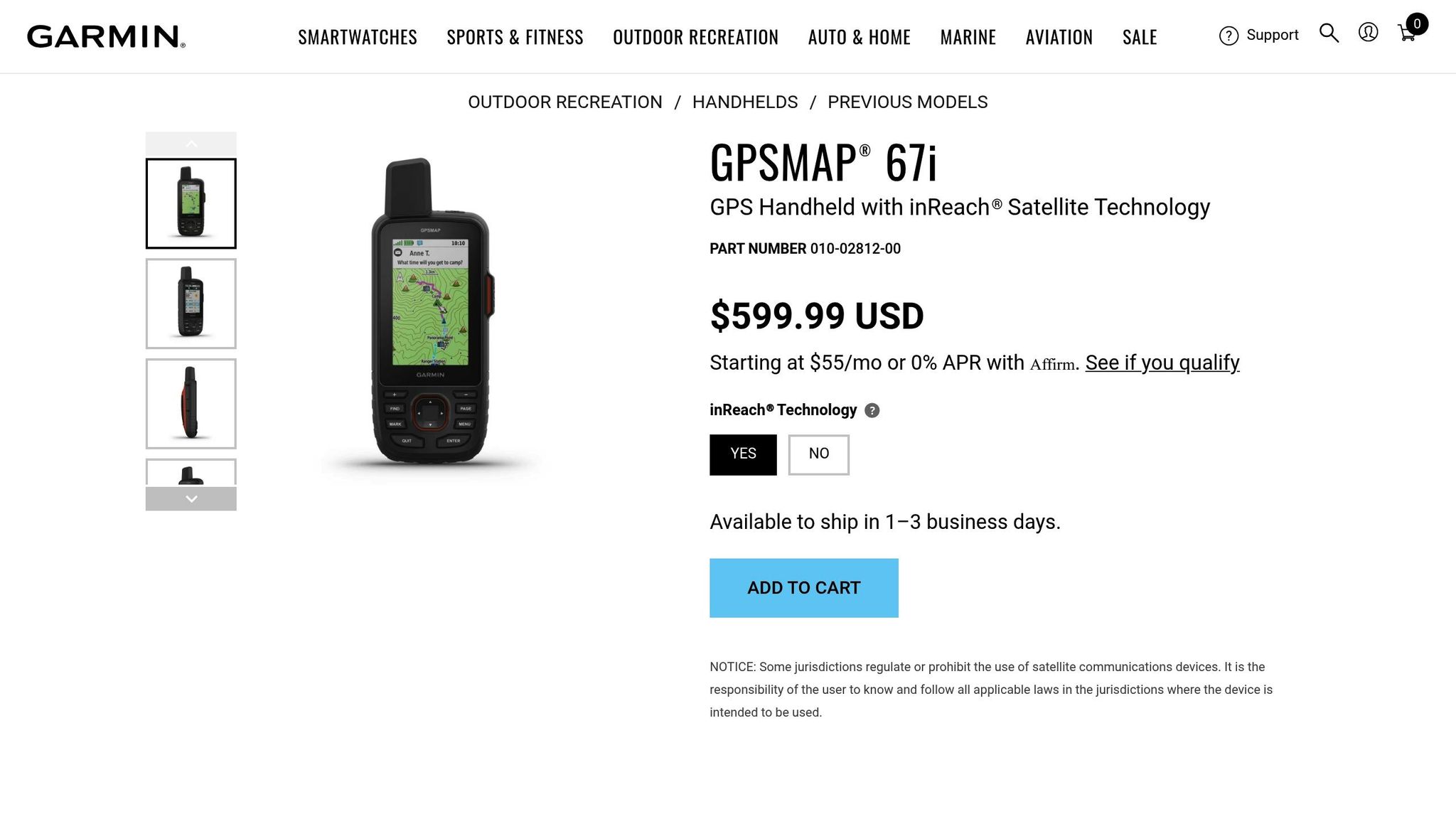
The Garmin GPSMAP 67i combines GPS navigation with satellite communication in a durable, all-in-one device priced at $599.99. Weighing 8.1 oz, it features a 3-inch sunlight-readable color display, MIL-STD-810 durability, and an IPX7 waterproof rating (submersible up to 3 feet for 30 minutes). Leveraging the global Iridium satellite network and multi-band GNSS technology, it delivers positioning accuracy within 6 feet. This makes it an excellent tool for precise navigation and dependable emergency communication, especially in group rescue scenarios.
Two-Way Messaging Capability
The Garmin 67i supports three messaging options: free Check-in messages, customizable Quick Text messages, and full two-way texting via satellite. By pairing it with the Garmin Messenger app, the device can automatically switch between Wi-Fi, cellular, and satellite networks for seamless connectivity. Dean Krakel, a photojournalist and gear reviewer, highlights its performance:
"the 67i uses multi-band technology and has expanded GNSS support which greatly improves location accuracy even in canyons and thick tree cover."
For added convenience, you can pre-configure Quick Text messages using the Garmin Explore platform, allowing for efficient communication while on the trail. This messaging capability transitions smoothly into the device’s emergency SOS features.
SOS Functionality
The 67i is equipped with a dedicated SOS button, protected by a cap, that connects you directly to Garmin Response, a 24/7 emergency coordination center. This feature enables two-way communication with rescue coordinators, so you can provide specific details about your situation. To ensure readiness, users can schedule an SOS test with the International Emergency Response Coordination Center before their trip.
Battery Life
Battery performance is a standout feature of the 67i. It offers up to 165 hours of tracking at 10-minute intervals in standard mode and up to 425 hours in expedition mode (30-minute intervals). If inReach features are turned off, the battery can last up to 840 hours in expedition mode. Hiking Emergency Beacon notes that the battery life is a big improvement over the earlier 66i model. Plus, the USB-C charging port allows for a full recharge in about 2 hours.
Pricing and Subscription Requirements
In addition to the $599.99 device cost, an active satellite subscription is required to access inReach features like SOS, messaging, and tracking. For enhanced functionality, users can opt for the Outdoor Maps+ subscription at $49 per year, which provides detailed satellite imagery and public land boundaries. The device has earned a 4.5-star rating on Amazon from 337 reviews, with many users applauding its dependability for group safety and emergency coordination.
Device Comparison Table
The table below breaks down the cost, subscription fees, and key features of various devices designed for mountain biking emergencies.
| Device | Price | Subscription Cost | Messaging Type | Battery Life (Tracking) | Weight | Coverage Network |
|---|---|---|---|---|---|---|
| Garmin inReach Mini 2 | $400 | From $14.95/month | Two-way satellite (160 characters) | Up to 14 days (10-min intervals) | 3.5 oz | Iridium (100% global) |
| SPOT Gen 4 | $150 | From $11.95–$15/month | One-way messaging | Up to 17 days (10-min intervals) | 5.0 oz | Globalstar (coverage gaps) |
| Zoleo Satellite Communicator | $150–$200 | From $20/month | Two-way satellite (unlimited length) | 8.3–15 days | 5.3 oz | Iridium (100% global) |
| ACR ResQLink 400 | $370 | $0 (no subscription) | SOS only (no messaging) | 28 hours (operational) | 5.3 oz | COSPAS-SARSAT (global) |
| Garmin inReach Messenger Plus | $500 | From $14.95/month | Two-way satellite (1,600 characters) | Up to 25 days (10-min intervals) | 4.1 oz | Iridium (100% global) |
| Iridium Extreme Satellite Phone | $1,000+ | Around $50/month | Voice calls + SMS | 4 hours talk / 30 hours standby | 8.0 oz | Iridium (100% global) |
| Garmin GPSMAP 67i | $599.99 | From $14.95/month | Two-way satellite (160 characters) | Up to 6.8 days (10-min intervals) | 8.1 oz | Iridium (100% global) |
When comparing these devices, it’s clear that each comes with its own trade-offs in price, messaging capabilities, and battery life.
If weight is a priority, the Garmin inReach Mini 2 stands out at just 3.5 ounces, making it a great option for riders who want to travel light. On the other hand, the ACR ResQLink 400 eliminates subscription fees entirely by relying on the government-supported COSPAS-SARSAT network, but it only supports SOS signals, with no messaging features.
For those considering long-term costs, keep in mind that subscription-based devices can total over $1,000 across five years when factoring in both the device price and monthly fees.
Battery life also varies widely. The Garmin inReach Messenger Plus shines with up to 25 days of tracking in low-power mode, while the Iridium Extreme Satellite Phone offers just 4 hours of talk time. Additionally, network coverage plays a crucial role: devices using the Iridium network provide seamless global coverage, including the poles, whereas SPOT’s Globalstar network has notable gaps.
For group rides in remote areas, Iridium-based devices are the most dependable for staying connected and coordinating emergency rescues. Use this comparison to find the device that best fits your needs and ensures safety on the trail.
Conclusion
Choosing the right emergency communication device for mountain biking depends on your specific needs. Group size plays a big role – if you’re riding with others who might split up on the trail, two-way messaging becomes crucial. It allows you to share vital details like the number of injured riders or the severity of injuries. As Jediah Porter, Review Editor, puts it:
"the most important information to relate is 1) where you are and 2) how bad it is".
Your riding environment also helps determine the best device. For areas like high latitudes or deep canyons, Iridium-based devices ensure full coverage. On the other hand, SPOT devices, which rely on the Globalstar network, may struggle to maintain a signal in extreme northern or southern regions.
Cost is another key factor. If you only ride occasionally, a PLB (Personal Locator Beacon) might be a better long-term investment. However, frequent riders who value extra features like check-ins or weather updates may find the ongoing subscription fees for satellite messengers worthwhile.
Safety redundancy is non-negotiable. As PeakPTT wisely notes:
"a single gadget – no matter how rugged – can fail at the worst moment".
Pair your satellite messenger with simple tools like a whistle or mirror to ensure extra layers of protection.
Finally, take the time to test and register your PLB with the NOAA SARSAT database (free in the U.S.). This step is essential for group safety and speeds up rescue operations. Devices with Return Link Service add another layer of reassurance, confirming that your distress signal was received – even when you’re miles from help. By aligning device features with your riding conditions and group dynamics, you can improve rescue coordination and keep everyone safer on the trail.
FAQs
Which device is best for group rides in remote areas?
The Garmin inReach Messenger stands out as a go-to device for group rides in remote locations. It provides dependable satellite communication, supports two-way messaging, and includes an SOS feature for emergencies. This makes it an excellent choice for staying connected when you’re far from traditional networks.
Do I need a subscription, or can I use SOS without one?
Some emergency devices come with SOS features that don’t require a subscription. Take the ACR ResQLink View, for instance – it provides SOS services without any ongoing fees. On the other hand, devices like the Garmin inReach need a subscription to unlock their full range of features. Be sure to review your device’s specifications to see if a subscription is required.
How do I choose between a PLB, a satellite messenger, and a satellite phone?
When selecting a device for emergencies or remote communication, consider these options:
- A PLB (Personal Locator Beacon) is ideal for emergency-only use. It sends out SOS signals along with your GPS location but doesn’t allow for messaging or additional features.
- A satellite messenger offers more flexibility with two-way communication, location sharing, and extras like weather updates. This is a great choice for those who want to stay in touch or share updates during their trip.
- A satellite phone provides full communication capabilities, making it the best option for extended remote adventures where regular contact is essential.
Decide based on your specific needs, budget, and whether you prioritize ongoing communication or a simpler, emergency-focused device.