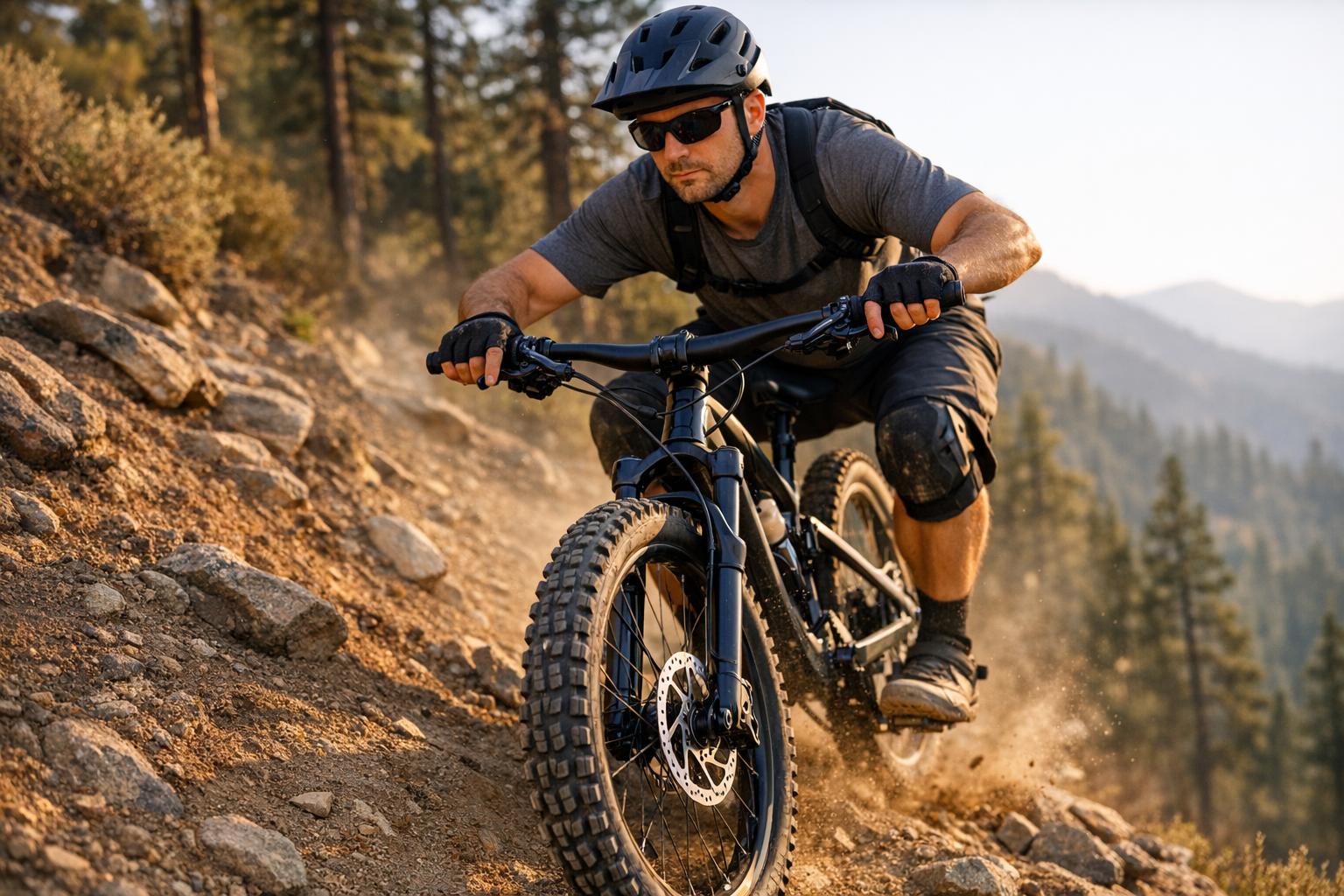

Maintaining momentum while mountain biking is all about conserving energy, staying in control, and navigating trails smoothly. Momentum helps you glide over obstacles, reduces fatigue, and improves safety. Here’s what you need to know:
- Pedaling & Gears: Anticipate terrain and shift gears early. Aim for a cadence of 80–100 RPM to balance power and endurance. Use lower gears for climbs and higher gears for speed on flats or descents.
- Body Position: Stay centered, relaxed, and adapt your stance. Use seated pedaling for efficiency on steady terrain and standing pedaling for power on short climbs or technical sections.
- Cornering: Lean the bike into turns while keeping your body upright. Weight the outside pedal and look ahead to stay on track.
- Obstacles: For roots, rocks, and drops, stay low, wide, and balanced. Use techniques like bunny hopping or manualing to maintain flow.
- Braking: Brake before turns, not during. Use controlled, progressive braking to avoid losing traction or speed.
How Momentum Works on Different Trail Types
What Momentum Means for Mountain Bikers
Momentum is what keeps you moving smoothly over the trail, saving you from constant stops and starts. It’s the force that lets you glide over small obstacles like roots and rocks instead of getting stuck on them. When you maintain good momentum, your ride feels seamless, and you stay in control without exhausting yourself.
Here’s the science behind it: a bike in motion naturally wants to keep moving. This reduces the effort you need to pedal and helps you stay balanced. Instead of battling the trail, you’re working in harmony with its natural flow.
"With good stability and control, you will be able to maintain a more consistent and powerful riding position, improve your aerodynamic silhouette, avoid potholes and debris on the road, manoeuvre more efficiently when riding in a peloton, eat and drink mid-ride more easily, and even corner and climb at greater speeds." – Yoni Fingleson, Six Physio
Every time you stop, you burn extra energy to get moving again. By keeping your momentum steady, your bike can handle small bumps with ease, keeping you balanced and ready to handle whatever the trail throws at you. This is especially important on longer rides, where conserving energy becomes critical as fatigue sets in.
How Trail Features Impact Your Speed
Knowing how to maintain momentum is one thing, but applying it to different trail features is where the real challenge lies. Trails are full of elements that can either help or hinder your flow, and adapting your riding style to these features is key.
Climbs are notorious for slowing you down. Uphill sections, especially technical ones with rocks or roots, force you to work against gravity, often draining your speed. On the flip side, descents can help you pick up speed quickly. The trick is to brake in a controlled way to avoid losing too much momentum. This way, you’ll carry enough speed into flat sections or upcoming climbs.
Then there are the technical bits – rock gardens, rooty patches, and drops. These can throw off your rhythm if you’re not careful, making line choice and technique essential.
| Trail Feature | Momentum Impact | Key Strategy |
|---|---|---|
| Steep Climbs | Slows you down | Shift to lower gears early and keep a steady cadence |
| Technical Descents | Builds speed quickly | Use controlled braking and plan your line ahead |
| Rock Gardens | Disrupts speed | Pick smooth lines and keep a loose, relaxed grip |
| Wet/Muddy Sections | Drains more energy | Stay centered and maintain a steady, consistent pace |
| Hardpack Dirt | Easy to maintain flow | Watch for loose spots and keep momentum through turns |
Soil and trail conditions also play a huge role in how much energy you’ll need to expend. For example, trails with grades over 16% are not only harder to ride but also suffer from higher erosion rates. Trails with gentler slopes (0–15%) are much easier to navigate, allowing you to maintain momentum without as much effort.
Another crucial factor for sustaining momentum is line choice. By looking 12–15 feet ahead, you can spot the smoothest path that maintains your speed and offers good traction. Sometimes, taking a slightly longer route around an obstacle is smarter than powering straight through it. It’s all about finding the balance between efficiency and control.
How To Make Trail Speed (And Keep It!)
Pedaling Techniques to Keep Your Speed Up
Once you’ve got the basics of momentum down, fine-tuning your pedaling technique is the next step to keeping that energy alive. Efficient pedaling is about more than just raw power – it’s about timing, gear selection, and cadence. These small adjustments can make the difference between a smooth, flowing ride and an energy-draining struggle. Let’s dive into how to adapt your pedaling technique for different terrain.
Choosing the Right Gear and Pedal Speed
Picking the right gear at the right moment is key to maintaining momentum. The trick? Anticipate the terrain ahead and shift gears before the challenge hits.
"Always shift in anticipation of the terrain which means change into an easier gear BEFORE you start the climb, or a harder gear BEFORE you start ripping downhill. Shifting into the right gear at the right time takes practice!"
– Ninja Mountain Bike Skills
For the best efficiency, aim for a cadence of 80–100 RPM. This range helps you pedal smoothly without overloading your muscles or wearing yourself out too quickly. Here’s a handy tip many seasoned riders swear by: if your legs are burning, downshift to an easier gear and increase your cadence. On the flip side, if you’re gasping for air, upshift to a harder gear and slow your pedaling speed. As one rider puts it:
"One of the first things I learned when I started mountain biking in the late 80’s was, ‘If your legs hurt, spin an easier gear; if your lungs hurt, use a harder gear.’"
– celswick
Lower gears are your ally for steady climbs, helping you maintain a consistent cadence without overexerting your legs. Higher gears, on the other hand, are perfect for converting your effort into speed on flat sections or descents. When shifting gears, make it a habit to shift one gear at a time and avoid cross-chaining. Keeping the chain aligned reduces wear and tear on your drivetrain.
To get better at managing cadence, try practicing cadence drills on different types of terrain. A bike computer or cadence sensor can give you real-time feedback, helping you find and stick to your ideal rhythm. Once you’ve got gear shifts and cadence under control, the next step is learning when to sit or stand while pedaling.
When to Sit vs. Stand While Pedaling
Deciding whether to sit or stand while pedaling can have a big impact on your speed and energy use. Both positions have their strengths, and knowing when to switch between them helps you maintain momentum and avoid fatigue.
Seated pedaling is your go-to for long, steady climbs or consistent terrain. It’s more energy-efficient because your saddle supports much of your body weight, allowing you to conserve energy over longer distances.
Standing pedaling, on the other hand, is all about power. By using your body weight and engaging larger muscle groups, you can tackle short, steep climbs, sprints, or technical sections with more force.
"In a nutshell, I think that you should use seated pedaling for easy, low tension efforts and you should use standing pedaling for hard, high tension efforts. This is the best way to get the most performance out of your riding while also avoiding a lot of overuse injuries."
– James Wilson, MTB Strength Training Systems
Standing does come with a trade-off – it burns energy faster than sitting. However, it’s often necessary for technical terrain, as it gives you better control and bike handling. When navigating rock gardens, drops, or rough descents, being off the saddle allows you to shift your weight and react to obstacles more effectively.
A smart approach is to alternate between seated and standing positions during your ride. This strategy spreads the workload across different muscle groups, helping to prevent fatigue. On climbs, standing can also improve traction by letting you press more weight into the rear tire – especially useful on loose or steep terrain where wheel spin can be an issue. Just remember, when you stand on a climb, shift to a harder gear to avoid spinning out.
Practicing the transition between seated and standing positions will help you develop an instinct for when each is most effective, keeping your momentum strong throughout your ride.
How to Corner Fast and Pick Better Lines
Just like efficient pedaling keeps your momentum steady, sharp cornering skills ensure you don’t lose speed. Corners are often where riders struggle the most, but with the right technique, body positioning, and line choices, you can glide through them with confidence.
Body Position for Fast Cornering
Your body position plays a huge role in how well you handle corners. A key concept here is "bike-body separation." This means leaning your bike into the turn while keeping your body more upright. Why? It helps maintain traction on uneven surfaces and gives you better control during tricky maneuvers.
The foundation of fast cornering lies in shifting your weight to the outside pedal. This move secures the rear tire’s grip on the ground. As November Bicycles puts it:
"You’ll hear the term ‘bike-body separation’ in the videos, and it’s one that sticks with me. It took me a while, but eventually, I learned to weight my outside pedal not just with my foot but by shifting my weight over it to remain largely upright, while leaning the bike into the corner. This way, the bike can track through the corner, but I am keeping my weight as centered over the contact patch as possible."
- November Bicycles
Stay relaxed by keeping your knees and elbows bent. This allows the bike to move freely beneath you while you maintain balance. On loose or technical terrain, shifting your weight slightly forward can help keep the front wheel tracking correctly. Play around with your weight distribution to find that perfect balance where your tires grip the trail just right.
For really technical sections, keep your pedals level and focus on transferring weight to the outside pedal. This not only improves grip but also helps avoid pedal strikes and keeps your balance steady.
Finding the Fastest Path Through Turns
Beyond body positioning, picking the right line through a corner is just as important. The secret? Look ahead – focus on the exit of the turn rather than the ground directly in front of your wheel. This helps you choose a smooth, flowing path.
"Stay centered and relaxed on your bike, bent knees, bent elbows, and let the bike move… Look through and out off the end of the turn; you will go where you’re looking… Level pedals (best in rooty, rocky, rough terrain and multiple corners/s-bends), or put weight onto your outside pedal to drive your weight into the bike and keep good grip."
- RobinGB
Plan your braking carefully. Always brake before entering a turn, not during it, to avoid losing traction. If you’re familiar with the trail, take note of the best braking points so you can carry as much speed as possible through the corner. For practice, try running "hot laps" on trails with lots of turns. This repetitive training will help you experiment with entry points and apexes, revealing the fastest and smoothest lines.
If you’re new to this, start practicing on a grassy hill. It’s a safe environment to work on bike-body separation and build the muscle memory you’ll need for more challenging terrain. Once you’ve nailed your cornering technique and line selection, you’ll be better prepared to tackle whatever obstacles the trail throws your way.
sbb-itb-9d75ae1
Getting Through Obstacles Without Losing Speed
Building on the fundamentals of efficient pedaling and cornering, this section dives into how to tackle trail features in a way that keeps momentum on your side. Whether it’s roots, rocks, drops, or rollers, the goal is to make these obstacles part of your riding rhythm, rather than something that slows you down.
How to Handle Roots, Rocks, and Drops
Roots can be intimidating, often causing riders to hesitate. As MTB instructor and trail builder Jeremiah "Scratch" Stone puts it:
"Roots are a mental block for so many riders – they see them and in their mind it’s a rolling of the dice type of gamble! But I think it’s like so many other things in MTB – if you have a plan, you can ride with intention and then train your reactions properly."
The trick? Stay low, wide, and centered to absorb impacts effectively. Stone explains:
"Get low, wide, and centered where you and the bike can move and groove. Then when a root kicks you around a few inches, the bike is still underneath you and you’re still in control and balanced."
When approaching roots, focus directly on the obstacle instead of scanning for last-minute adjustments. A perpendicular angle minimizes deflection, and a strong compression just before contact can help you glide over them. For advanced riders, bunny hopping is a great way to clear root sections entirely.
For drops and ledges, maintain a low, balanced stance. Let the front wheel roll off naturally, then push the handlebars forward and pull back to stabilize the rear wheel. On tightly spaced drops, manualing or bunny hopping can help you maintain your speed. At higher speeds, treat small step-downs like trail chatter by staying centered and letting the bike move fluidly beneath you.
Next up: how to turn trail features into opportunities to gain speed.
Using Trail Features to Build Speed
Downhill sections are perfect for generating speed without pedaling. Drop your seat, stay low, and pump your front wheel through small rollers or drops to build momentum. This technique works best on smooth, wide rollers that keep you on your intended line.
For rougher sections, pre-jumping can help you clear obstacles while maintaining speed. Berms are another great tool for carrying momentum through turns. The key is in the berm’s design – steepness matters more than height, and a well-shaped berm with a consistent radius can let you exit a turn faster than you entered it.
When speed needs to be controlled, smart braking techniques ensure you stay in flow.
Smart Braking for Better Flow
Braking doesn’t have to disrupt your ride. Progressive braking – where you gradually increase brake pressure – keeps your bike stable and your descents smooth. On long downhill stretches, try intermittent braking: release the brakes at regular intervals to let your bike roll freely and avoid overheating.
Knowing which brake to rely on is also crucial. On loose or slippery terrain, the rear brake often provides better control, while on steeper descents, the front brake may be more effective. Just be cautious in corners to avoid washing out. When braking hard, shift your weight back by lowering your hips behind the saddle, keeping your arms and legs bent. This position not only improves control but also absorbs impacts, helping you respond quickly to changing conditions on the trail.
Fixing Common Speed Problems
Correcting common speed-related mistakes is essential for keeping your ride smooth and steady. Even seasoned riders can fall into habits that steal momentum, leading to a frustrating stop-and-go experience. The good news? Most of these issues are easy to address. By recognizing these common pitfalls and knowing how to recover, you can transform your ride into a seamless flow. Let’s dive into what slows you down and how to regain your speed.
Mistakes That Kill Your Momentum
- Over-braking: Applying too much brake pressure – especially on the rear wheel – can disrupt your flow and waste valuable energy.
- Skidding: Losing traction not only damages trails but also slows you down significantly.
- Poor climbing habits: Getting off your bike too early on climbs and walking instead of riding limits your progress and drains momentum.
- Body position errors: Sitting during descents can throw off your balance and even lead to being "booted off" your bike. Always remember: "If you’re not pedaling, you should be standing up".
- Excess tension: Staying too rigid on the bike restricts your ability to handle terrain smoothly and react quickly to unexpected obstacles.
- Fixating on obstacles: Your bike tends to follow where your eyes are looking, so focusing on obstacles can pull you off your intended line.
How to Get Your Speed Back Mid-Ride
Once you’ve identified what’s slowing you down, you can use these strategies to recover your momentum quickly.
If you’re approaching a technical section, try downshifting into a harder gear and giving one or two strong pedal strokes. A slightly harder gear can actually work in your favor, as the lower cadence helps prevent pedal strikes and keeps your drivetrain moving efficiently. On tricky terrain, you can also use a technique called ratcheting. This involves pressing the pedals from the 1 to 4 o’clock position, then backpedaling to reset and repeat, maintaining forward motion without full pedal rotations.
Vision plays a huge role, too. When you lose speed, shift your focus to where you want to go – not at the obstacle that caused the slowdown. Keeping your eyes on your desired line helps you correct your path and regain control.
Another tip? Use the rear brake strategically. A light tap can create a slight skid, helping you reorient your bike without coming to a complete stop.
Proper body positioning is just as critical. On steep descents, shift your weight back to stay balanced. On flatter sections, move your weight forward to stay in sync with the terrain. This allows you to work with the trail, not against it.
Taylor Thomas, Owner and Founder of Thomas Endurance Coaching, emphasizes the importance of smooth riding:
"Carrying speed through challenging sections is more important than performing hard maneuvers in order to get through it. Ride clean for the best results."
Sometimes, the simplest approach is the most effective. Focus on smooth, efficient movements, and you’ll find your momentum returning in no time.
Conclusion: Main Points for Keeping Momentum on Trails
Keeping your momentum on the trail comes down to mastering a few essential skills – smooth pedaling, smart gear choices, and reading the terrain ahead. By anticipating changes and picking the best lines, you can avoid losing speed unnecessarily and ride with more control. These basics are the foundation for everything else, from pedaling techniques to cornering like a pro.
Your body position and how you distribute your weight are just as important. Knowing when to hinge at the hips, shift your weight, or use movements like the Row and Anti-Row can make a huge difference. These techniques help you maintain traction and carry speed through corners and over tricky obstacles. In fact, skilled riders can actually gain speed in turns by syncing their body movements with the terrain – something beginners often miss.
Take advantage of the trail itself to build speed. Pump through dips, extend your bike after obstacles, and turn challenges into opportunities to accelerate. These strategies tie directly into the advanced pedaling, cornering, and obstacle-handling techniques covered earlier.
The key to mastering all of this? Practice and a willingness to adapt. Every rider has their own style, and what works for one person might need tweaking for another. Experiment, review your rides, and adjust based on the trail and your strengths.
Momentum is all about efficiency. When you develop muscle memory through consistent practice, maintaining speed becomes second nature. The trails will not only feel smoother and more fun but also far less tiring as you flow through them with confidence and control.
FAQs
How can I shift gears effectively to keep my momentum on different terrains?
To keep your ride smooth and maintain momentum across any terrain, it’s important to anticipate changes in the trail and adjust your gears accordingly. For uphill climbs, shift into an easier gear before the incline slows you down. On descents, move to a harder gear to make the most of your power and speed.
When shifting, pedal lightly and gradually. Avoid changing gears under heavy pressure or while coasting, as this can cause unnecessary strain on your bike’s drivetrain. Also, take time to regularly inspect your derailleur and cable tension to ensure your gear transitions remain smooth and reliable. With consistent practice and a bit of maintenance, you’ll master the art of seamless shifting, ready for whatever the trail throws your way!
What are common mistakes that slow riders down on trails, and how can they be avoided?
One frequent error riders encounter is reducing speed excessively. This can rob the bike of its momentum, making it tougher to tackle obstacles. Another misstep is not looking ahead to plan a path, which often leads to poor choices and unnecessary loss of speed.
To steer clear of these problems, aim to keep a steady and controlled pace while actively scanning the trail ahead. Focus your gaze on where you want to go, rather than fixating on the obstacles right in front of you. This approach allows you to choose smoother paths and maintain your speed. Confidence and a sense of flow are essential for keeping momentum on the trails.
How can I pick the best trail line for a smoother, faster ride?
Choosing the right line on a trail is all about keeping your speed and control in check. Look for the smoothest, most direct route and stay focused on what’s ahead. This way, you can spot obstacles early, prepare for turns, and make the necessary adjustments to keep your momentum steady.
On rough terrain, try to glide over roots and rocks by staying light on your bike and aiming for a straight path whenever you can. This approach helps you save energy and ride more efficiently. Over time, as you practice and get to know the trails better, you’ll naturally get better at reading the terrain and picking smarter lines.