Improving your mobility is key to better performance and injury prevention in mountain biking. Mobility refers to your ability to move joints through their full range of motion with control and strength, which directly impacts your power, bike handling, and endurance. Focus on these areas:
- Ankles: Proper dorsiflexion (10°) and plantar flexion (30°) enhance pedaling mechanics and climbing efficiency.
- Hips: Flexible hip flexors support smooth pedal strokes and better control on technical terrain.
- Thoracic Spine and Shoulders: A mobile upper back improves posture, breathing, and reduces strain on your neck and lower back.
Simple daily exercises, like ankle stretches, hip openers, and thoracic rotations, can make a noticeable difference. Even 15 minutes a day can help you ride harder, breathe easier, and reduce discomfort. Consistency is the key to seeing results.
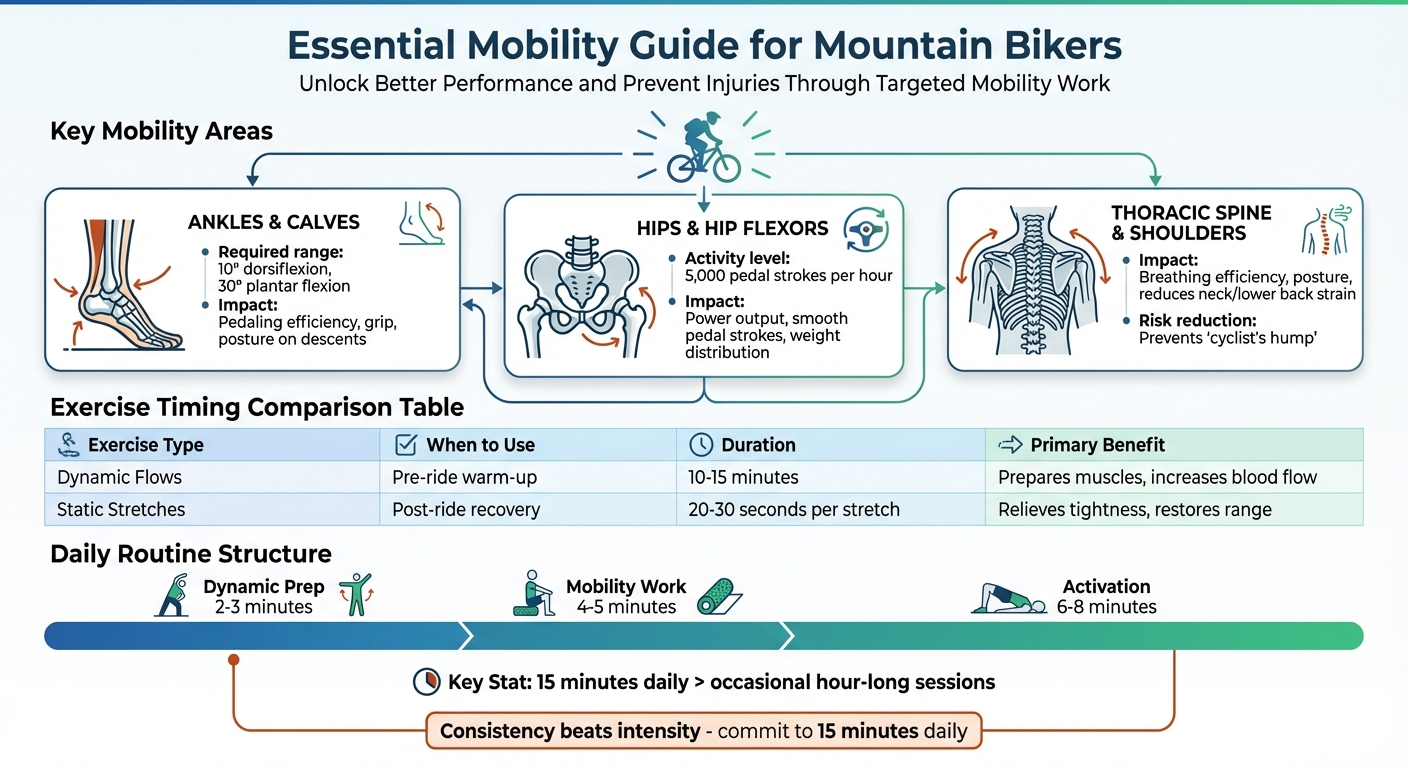
Key Mobility Areas and Exercises for Mountain Bikers
Key Mobility Areas for Mountain Bikers
When you’re out on the trails, your performance hinges on a few key areas of mobility. These zones influence your ability to control the bike, generate power, and maintain endurance. Each plays a unique role in helping you navigate technical terrain, sustain energy, and maximize your pedal stroke. Let’s break them down.
Ankles and Calves
Your ankles are the foundation for everything that happens on the bike. Dropping your heels behind the pedals improves grip and posture, especially on technical descents and during cornering. This movement relies on strong dorsiflexion.
"Cyclists need a minimum of 10 degrees of dorsiflexion and 30 degrees plantar flexion." – Brett Warner, Physical Therapist, Bespoke Treatments
When ankle mobility is limited, it can throw off the alignment of your knee over the pedal. This not only decreases power but also shifts stress to your knees, pelvis, and lower back. To test your ankle mobility, try this: kneel about 5 inches from a wall and attempt to touch your knee to the wall without lifting your heel. If you can’t, it might be time to work on your flexibility. Walking barefoot on uneven surfaces like sand or grass can also help by strengthening the small muscles in your feet and improving balance.
Hips and Hip Flexors
The hips are the engine of your pedal stroke. With an average of 5,000 pedal strokes per hour, even minor restrictions in hip mobility can make a big difference over a long ride. Tight hip flexors can limit your ability to fully extend your hips, reducing power output.
"A limited range of motion in the hip joint, caused by weak and tight hip flexors most often reduces the rider’s ability to pedal smoothly." – Tim Woo, P.T., D.P.T., Founder of GluteDoping
If your hips can’t fully flex during the upstroke, your knee may flare outward, increasing stress and misaligning your pedal stroke. Off the bike, tight hips can force you into a squat-like position instead of a proper hip hinge, which shifts your weight too far back and limits control during technical sections. Learning to hinge at the hips is critical for maintaining a strong, neutral attack position. Before rides, warm up with dynamic moves like walking lunges, and save static stretches for post-ride recovery. Since cycling primarily works in the sagittal plane (forward and backward movements), adding lateral exercises off the bike can help balance your muscles.
Thoracic Spine and Shoulders
Spending hours in a forward-leaning position on your bike demands a mobile upper back and shoulders. A flexible thoracic spine helps prevent the dreaded "cyclist’s hump", a rounded upper back that can disrupt the natural S-curve of your spine. This curve is essential for absorbing trail vibrations and impacts.
"When you develop thoracic mobility issues, the thoracic spine does not move and participate with the rest of the spine as much. This leaves the neck and the lower back to do more work." – Christine Koth, Author of Tight Hip, Twisted Core
If your thoracic spine stiffens, your neck and lower back may overcompensate, leading to discomfort or even injury. Improving thoracic rotation and extension can help reduce risks like rotator cuff problems, nerve impingements, and hand numbness. Exercises like quadruped thoracic rotations or "Open Book" stretches are great for targeting this area. After a long ride, gentle backbends like the Sphinx pose can help restore extension. This is especially important if you spend a lot of time sitting at a desk, as prolonged sitting can worsen thoracic stiffness.
sbb-itb-9d75ae1
Mobility Exercises for Mountain Bikers
Incorporating specific dynamic and static exercises into your routine can make a big difference in your riding experience. These exercises are designed to improve mobility in key areas that affect grip, pedaling efficiency, and overall bike control.
Dynamic movements are best for warming up before a ride, while static stretches work well for post-ride recovery. For static stretches, aim for a tension level around 7 out of 10, holding each position for 20 to 30 seconds and repeating 2 to 3 times. Dynamic movements should last about a minute each during warm-ups. To see noticeable improvements, commit to a daily 15-minute routine. Once progress is made, scaling back to a few sessions per week will help maintain your mobility.
"You’re priming your body as a preventive measure, not just a performance measure." – Chris Howell, C.S.C.S, C.F.C.S.
Start with stretches that ease upper body tension, then move on to exercises targeting your hips and calves.
Rotating Wrist and Forearm Stretch
This stretch is perfect for relieving the hand and wrist tension that builds up from gripping handlebars and operating brake levers, especially on technical trails. It targets both the flexors and extensors in your forearms.
How to do it:
Extend one arm at shoulder height. To stretch the extensors, bend your wrist so your fingers point downward, then gently pull your fingers toward you with your other hand for 30 to 45 seconds. For the flexors, point your fingers upward and pull them back using your opposite hand. Keep your arm parallel to the ground throughout.
This stretch is best used post-ride to release tension from prolonged gripping.
Kneeling Upper Hip and Quad Stretch
Spending hours in the saddle can shorten your hip flexors, which restricts your pedal stroke. This stretch helps release the psoas and rectus femoris, allowing for better hip extension and smoother pedaling.
"In the seated cycling posture, hip flexors are forced into their weakest and shortest length-tension relationship at the top of the pedal stroke." – Tim Woo, P.T., D.P.T., SoCalBikePT
How to do it:
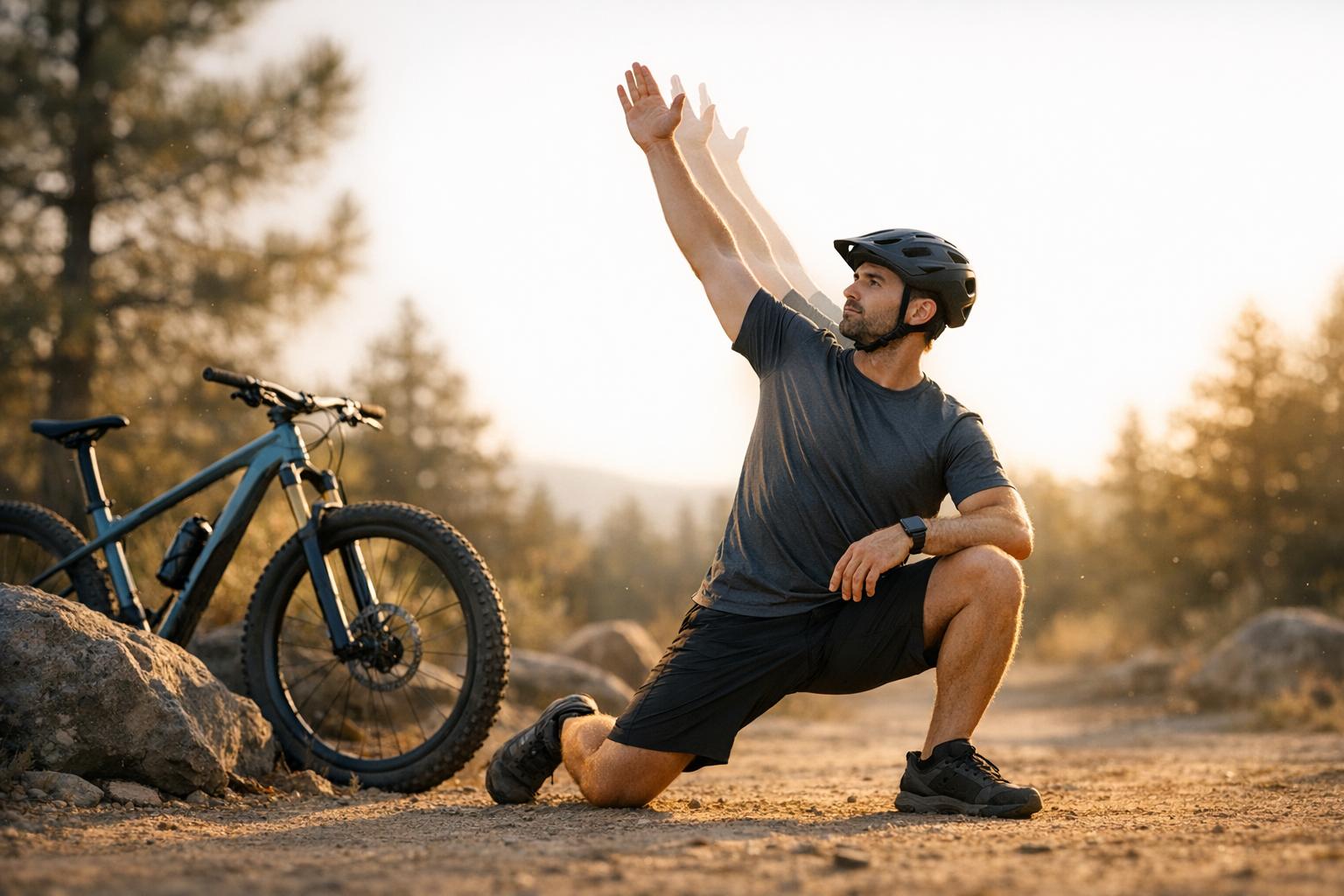
Kneel on one knee with your other foot forward at a 90-degree angle. Engage your glutes and core to stabilize your pelvis. Push your hips forward until you feel a stretch in the front of your hip. For a deeper stretch, reach the arm on the kneeling side upward and lean slightly toward the opposite side. Hold for 90 seconds.
This stretch is ideal during active recovery when your muscles are warm. Considering cyclists can complete around 5,000 pedal strokes per hour, even small gains in hip mobility can make a noticeable difference.
Single Heel-Drop Calf and Achilles Stretch
Ankle mobility is crucial for maintaining proper form and avoiding compensations in your knees, hips, and spine. This stretch targets the lower calf and Achilles tendon, helping you drop your heels effectively on technical descents.
How to do it:
Stand on a raised step with the ball of one foot on the edge. Slightly bend your knee to engage the Achilles and lower calf. Lower your heel below the step’s edge and hold for 30 seconds, or perform 10 dynamic repetitions.
Use this stretch post-ride to reduce the risk of Achilles tendinitis and plantar fasciitis.
Hip Flexor and Groin Flow
Mountain biking mainly involves forward and backward movements, so adding lateral exercises can help balance your muscles and improve stability on uneven terrain.
Cossack Squats:
Stand with your feet wider than hip-width. Shift your weight to one side, bending that knee while keeping the opposite leg straight. Repeat for 5 to 8 reps per side, ensuring your heel stays planted.
90-90 Seated Hip Rotations:
Sit with your front leg bent at 90 degrees (shin parallel to your hips) and your back leg also bent at 90 degrees. Without using your hands, lift and rotate your legs to the opposite side.
These dynamic moves are best included in your pre-ride warm-up, as they raise your body temperature and prepare your muscles for action.
Thoracic Spine and Squat Mobility Routine
A mobile upper back is essential for better breathing and posture while riding. Stiffness in this area can limit your breathing and force your neck and lower back to overcompensate.
Thoracic Extension with Foam Roller:
Place a foam roller under your upper back, just below your shoulder blades. Support your head with your hands and lean back to arch your spine over the roller. This helps counteract the rounded "cyclist’s hump" posture.
Side-Lying Thoracic Rotation:
Lie on your side with your knees stacked and bent at 90 degrees. Open your top arm across your body like a book, aiming to touch the floor behind you while keeping your hips stacked. This improves rotational mobility.
Cat-Cow:
On all fours, inhale as you drop your belly and look upward, then exhale as you round your spine and tuck your chin to your chest. This sequence warms up the entire spine through flexion and extension.
"Improving thoracic mobility can enhance posture on the bike, which allows the cyclist to breathe more freely." – Kristen Gohr, Certified Indoor Cycling Instructor
Incorporate this routine before your ride to improve posture, breathing, and bike handling. A cycling-specific warm-up can take as little as 3 minutes.
Building a Daily Mobility Routine
When it comes to mobility work, consistency beats intensity every time. Spending just 15 minutes a day on a mobility routine can yield better results than occasional hour-long sessions. This daily effort helps reset your posture and counteract the strain caused by cycling.
"I’ve seen this routine do far more for an athlete than a few extra miles of easy pedaling. A dynamic warm-up and activation session can make every ride and every workout more effective." – Renee Eastman, CTS Premier Cycling Coach
A well-structured routine should include three key phases: Dynamic Prep (2–3 minutes), Mobility (4–5 minutes), and Activation (6–8 minutes). This setup ensures your muscles are activated, your joints move freely, and your body builds functional strength in a logical order. Once daily practice becomes a habit, you can scale back to a few sessions per week to maintain your progress.
Dynamic Flows vs. Static Stretches
Choosing the right type of stretching depends on when and why you’re stretching. Dynamic flows involve active movements that mimic cycling motions, while static stretches focus on holding positions to lengthen muscles.
Timing is critical. Static stretching before a ride can reduce lower-body strength by over 8% in a one-rep max squat test. Instead, save static stretches for after your ride, when your muscles are warm and more pliable.
| Exercise Type | Target Areas | Duration | Primary Benefit |
|---|---|---|---|
| Dynamic Flows | Full-body | 10-15 minutes | Prepares muscles and joints for activity |
| Static Stretches | Specific areas | 20-30 seconds | Relieves post-ride tightness and restores range |
"Dynamic stretches are movements that mimic the activity you’re about to perform to help increase blood flow, warm up the muscles, and improve the range of motion." – Jakub Novak, USA Cycling-certified coach
Time-Saving Tips
If 15 minutes feels like too much, a quick 2-minute trailhead routine can still be effective. Focus on compound movements that address multiple areas at once. For example, the Low Lunge with Twist targets thoracic mobility, hip flexors, and inner thighs all at the same time.
"Keeping it simple and relatively quick is how I make sure I do a warmup, because I really can’t convince myself that I don’t have three minutes to spare." – Natascha Grief, Health & Fitness Editor
Consistency is what matters most, and you can perform your routine anywhere. For post-ride recovery, one set of exercises is enough to release tight spots. If mobility work is your main workout for the day, aim for 3–4 sets.
Tracking Progress and Staying Consistent
As you settle into your routine, track your progress to make adjustments and ensure you’re targeting the right areas. Use your mobility exercises as a way to check in with your body – tight spots like hips or ankles often hint at compensations that could lead to bigger issues, such as knee or back pain.
"This is another easy way to check in and get more information about how your body is doing that will help make you a better rider." – Ellen Foster, D.P.T., Beyond Exercise
Improving mobility and flexibility takes time – sometimes months of consistent effort – but the results are worth it. For a pre-ride warm-up, one round of exercises is enough. If your routine is the main workout for the day, aim for two rounds to maximize benefits.
Conclusion
Improving mobility isn’t just about comfort – it directly impacts your power, control, and ability to avoid injuries on the trail. When you focus on key areas like your ankles, hips, and thoracic spine, you create a foundation for smoother pedal strokes, better breathing efficiency, and the confidence to handle technical terrain. For example, cyclists need at least 10° of dorsiflexion and 30° of plantar flexion to maintain an efficient pedal stroke. Without this range, your body compensates in ways that can lead to knee pain, lower back strain, and even reduced power output. Targeted mobility work helps prevent these issues and enhances your performance.
The advantages go beyond just riding faster. A flexible thoracic spine allows for deeper, more efficient breathing during climbs, while mobile hips make it easier to shift your weight through corners and navigate technical sections.
"Yoga has helped to increase my hip mobility, making me more mobile on the bike, without having to fight against tight joints. It has greatly improved my cornering technique and made me faster!" – Étienne Florentin, MTB Yogi
Even dedicating just 15 minutes a day to mobility exercises can make a noticeable difference. Start with the recommended movements and build a simple 15-minute routine that works for you. Whether you’re warming up before hitting the trail or cooling down after a ride, these exercises will help you ride longer, stronger, and with less discomfort. Focus on the areas where you feel the most tension, and aim for consistency rather than intensity.
Your body is your most critical piece of equipment – treat it well, and you’ll see the results every time you ride.
FAQs
How do I know which mobility area is limiting my riding most?
To figure out which part of your mobility might be holding you back while riding, pay close attention to how you move and take note of any discomfort or limitations. For instance, if your hips are the problem, you might notice your hips rocking or your knees not tracking properly as you pedal. On the other hand, issues with your spine could make it hard to keep a neutral posture during your ride. Try mobility exercises targeting your hips, spine, and ankles, and zero in on the spots where you feel stiff, tight, or in pain.
How long until I notice mobility improvements on the bike?
Mobility gains hinge on staying consistent and choosing the right exercises. For many cyclists, noticeable progress can start within just a few weeks of daily effort, with more pronounced changes often showing up around the 4–6 week mark. Prioritize stretches targeting key areas like the hip flexors, hamstrings, and lower back. Dedicating less than 10 minutes a day to these focused stretches can lead to steady, long-term improvements.
Can mobility work fix knee or lower-back pain from riding?
Mobility exercises can play a role in easing some forms of knee and lower-back pain by enhancing joint flexibility, improving muscle control, and promoting better posture. For lower-back pain, movements that focus on spinal and lumbar mobility might help reduce tension and discomfort. Similarly, knee pain caused by stiffness around the joint may benefit from targeted mobility routines. That said, if the pain is severe or doesn’t go away, it’s crucial to consult a healthcare professional, as these exercises won’t address deeper structural problems on their own.