When it comes to endurance mountain bike races, mental preparation is just as critical as physical training. Your mindset can determine whether you push through tough moments or call it quits. Here’s what you need to know:
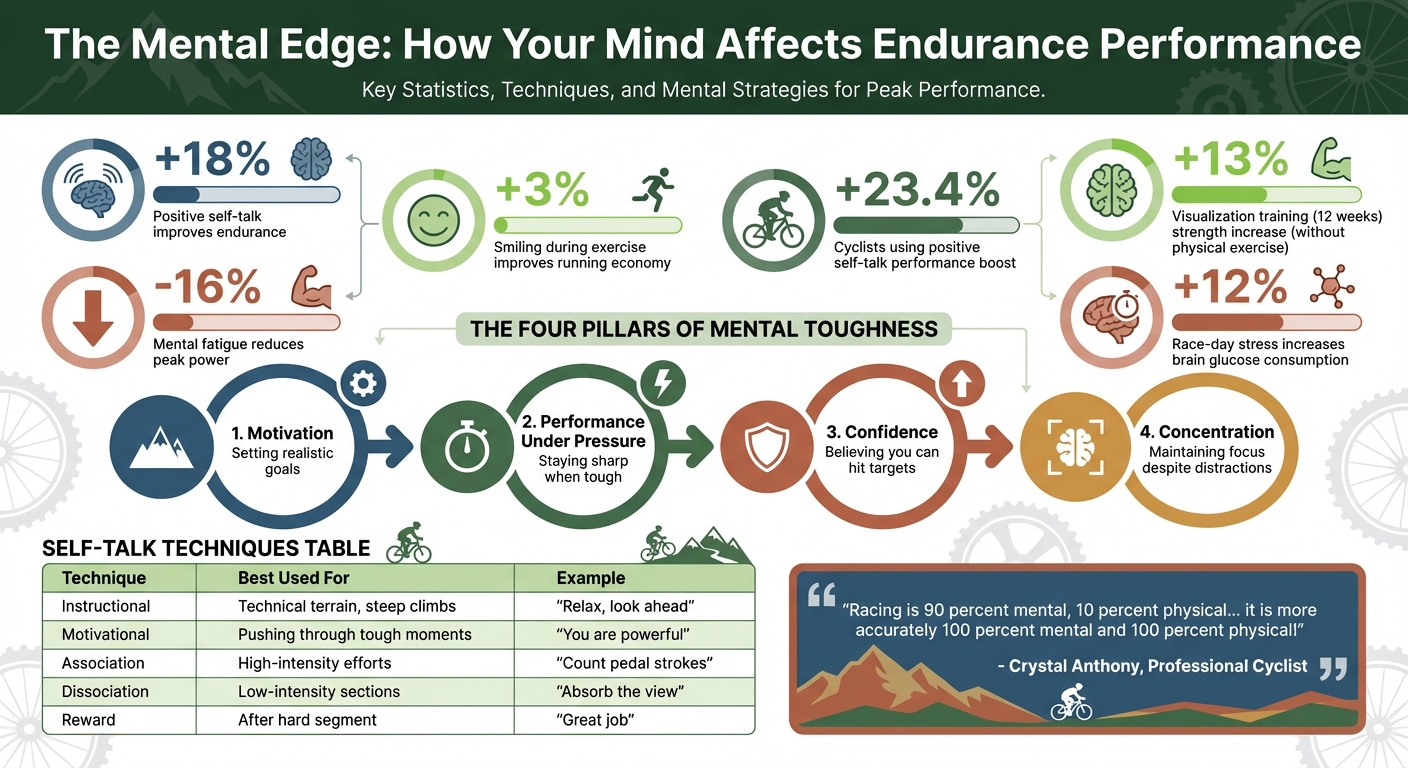
- Mental resilience matters: Positive self-talk can improve endurance by 18%, while mental fatigue can reduce peak power by 16%.
- Key strategies: Visualization, breaking the race into smaller goals, and creating pre-race routines help you stay focused.
- Stay in control: Focus on what you can manage – like pacing and nutrition – and let go of uncontrollable factors, such as weather or other racers.
- After the race: Reflect on what worked, address mental fatigue, and plan for future events to stay mentally sharp.
Mental toughness doesn’t happen overnight, but consistent practice can make a huge difference on race day. Let’s dive into how to train your mind for success.
Mental Training Impact on Endurance Cycling Performance Statistics
How Important Is Mental Toughness in Cycling and 5 Ways to Improve Your Mental Toughness
sbb-itb-9d75ae1
Mental Resilience in Endurance Sports
Mental toughness isn’t just a buzzword – it’s built on four solid foundations: motivation (setting realistic goals), performance under pressure (staying sharp when the going gets tough), confidence (believing you can hit your targets), and concentration (maintaining focus despite distractions). Think of mental resilience as the control center of your endurance efforts. While it can’t replace proper training or fitness, it determines how you react when things get tough and when you decide to call it quits.
How Mental Strength Affects Physical Performance
These pillars of mental resilience directly shape your physical performance. Your brain and body are in constant communication, and when mental fatigue creeps in, tasks that once felt manageable can suddenly feel insurmountable. Research shows that mental fatigue can cut peak power by 16%, while using positive self-talk can stretch your endurance by 18%, illustrating how your mindset and physical output are tightly linked.
Mental resilience also plays a key role in how you handle pain and stress during challenging race segments. On race day, stress ramps up your brain’s glucose consumption by about 12%, increasing calorie burn and diverting energy from your muscles. This underscores the importance of preparing for and managing mental hurdles during long races.
Common Mental Challenges in Endurance Racing
Endurance racing isn’t just physically grueling – it’s mentally exhausting too. Riders often experience something known as "dumb brain", where cognitive fatigue makes decision-making a struggle. Other challenges include self-doubt, the infamous "pain cave", boredom during repetitive stretches, and performance anxiety that can derail your focus. For mountain bikers, the unpredictability of mechanical issues, crashes, sudden illnesses, or weather changes adds another layer of mental strain.
Recognizing these mental hurdles is the first step toward overcoming them. Mental resilience helps you separate solvable problems – like adjusting your nutrition or fixing a mechanical issue – from uncontrollable factors, such as a competitor’s pace or unexpected rain. Take the example of amateur athlete Kate Ross during the eight-day Cape Epic race in South Africa. Battling a severe gastrointestinal bug on the grueling 70-mile "Queen Stage", she shifted her focus to her teammate Lisa, who had pushed through illness earlier in the race. By concentrating on someone else’s strength rather than her own suffering, Kate kept moving forward. This example highlights how mental resilience can be applied in real-time to tackle race-day challenges. Developing such mental strategies is a crucial part of preparing for endurance events.
Pre-Race Mental Strategies
Preparing mentally before a race is just as important as physical training. These strategies can help you approach the start line feeling composed, focused, and ready to perform at your best.
Visualization and Mental Rehearsal
Visualization isn’t just imagining the finish line; it’s a powerful mental exercise that primes your brain and body for action. Sean McCann, Ph.D., a sports psychologist with the U.S. Olympic Committee, explains:
"When you visualize an action, your brain maps it out in your body so your muscles are primed to perform".
Incredibly, studies show that participants who visualized exercising their biceps for 12 weeks experienced a 13% increase in strength, all without lifting a single weight.
To get the most out of visualization, try the PETTLEP model. This involves imagining physical sensations, environmental details, task specifics, pacing, emotional responses, and a first-person perspective. Dedicate 15 minutes daily in the week leading up to the race to mentally ride the course. Engage all five senses – hear the crunch of dirt, smell the pine trees, taste your hydration mix, feel the handlebars, and see the trail ahead.
Another technique is "marking", which involves using hand gestures to simulate trail movements while studying the course map or recalling pre-ridden sections. For example, mimic sweeping motions for corners or shaky movements for rough terrain. This physical connection helps your brain solve technical challenges without using physical energy.
Don’t shy away from visualizing potential setbacks like flat tires or crashes. Mentally rehearsing calm, step-by-step responses to these situations can reduce their emotional impact if they happen during the race.
With your visualization skills honed, the next step is creating a pre-race routine to solidify your focus.
Creating a Pre-Race Routine
A well-structured pre-race routine can eliminate unnecessary stress and help you focus on what matters. Unlike rituals based on superstition, routines are built on practical steps that enhance performance. The key is to concentrate on what you can control – your gear, nutrition, warm-up, and pacing strategy – so external factors like weather or competitors don’t throw you off.
Start the night before the race by checking your equipment using a physical checklist. Inspect your bike, fine-tune components, and pack essentials like your helmet, shoes, nutrition, and tools. This clears mental clutter and ensures you’re fully prepared. Writing or recording a race-day script can also help. Include every detail, from waking up to crossing the finish line, and review it before bed to reinforce confidence.
On race morning, eat a breakfast you’ve tested during training – something like oatmeal and a banana – at a consistent time before the start. This minimizes digestive issues. Warm up dynamically with leg swings, hip circles, and short sprint bursts to calm your nerves and get your body ready.
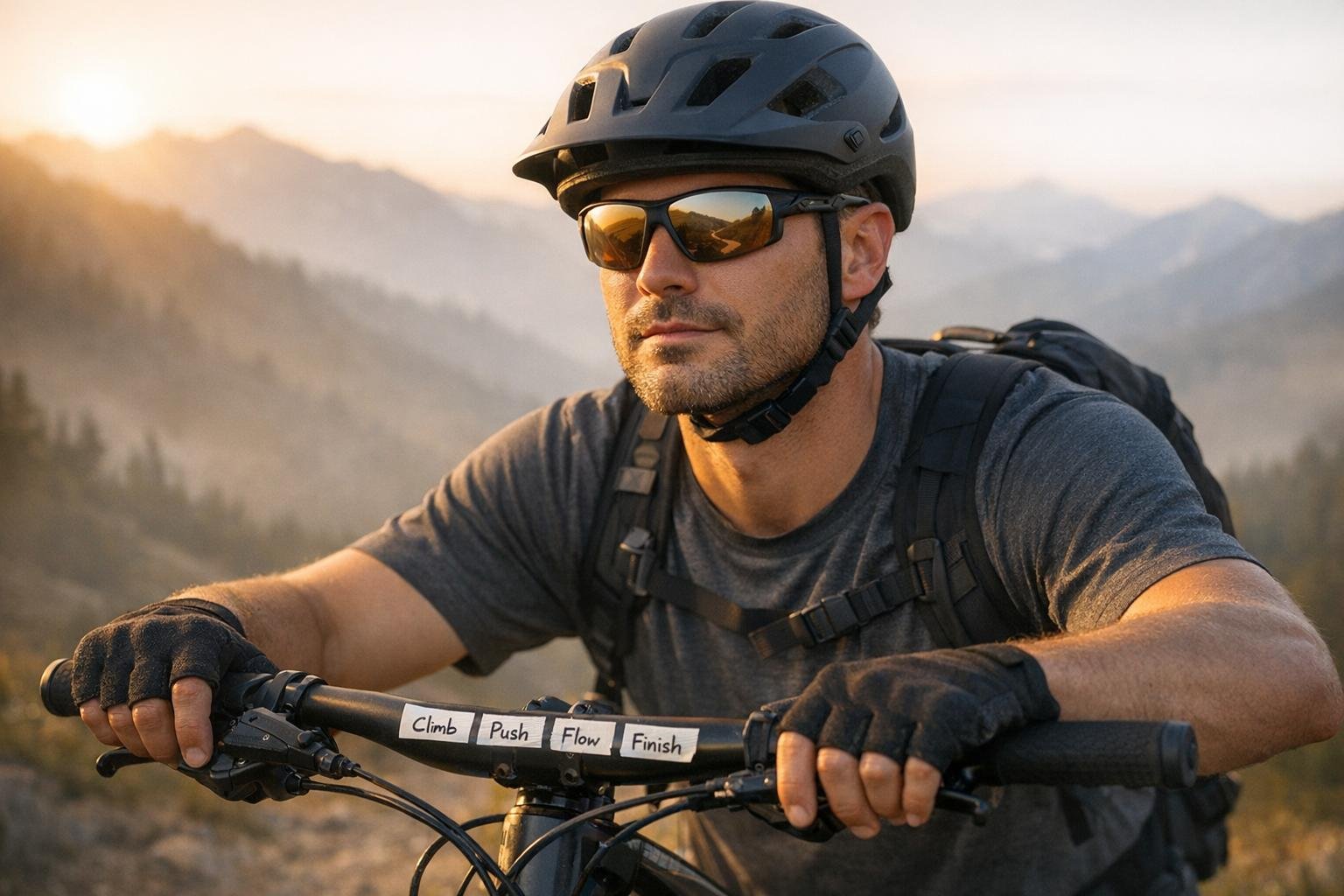
At the venue, stick to familiar routines, like putting on your gear in the same order every time. If possible, preview the start and finish areas and plan your positioning for key sections like singletrack bottlenecks. Create a short mantra or acronym, such as "Smooth is fast" or "BRAILUM" (Breathe, Relax, Attitude, Intensity, Look Up, Moto), and tape it to your bike stem as a visual reminder to stay focused.
As endurance coach Grant Holicky notes:
"One of the best ways to manage anxiety is to reframe it. If we’re anxious, we’re not focused on the present".
Managing Pre-Race Anxiety
Feeling nervous before a race is normal, but managing that energy can make all the difference. The key is to reframe anxiety as excitement or potential energy rather than fear. Positive self-talk can significantly improve endurance performance. Interestingly, research shows that athletes who smiled during exercise improved their running economy by nearly 3% and reduced oxygen consumption.
Your inner dialogue matters. Sports psychologist Peter Terry emphasizes:
"Self-talk plays an influential role in endurance performance. Even if we know that the hill isn’t really flat, telling ourselves that it is can reduce the negative effects of anxiety".
To calm your nerves, try box breathing: inhale for four seconds, hold for four seconds, exhale for four seconds, and hold again for four seconds. Repeat this for three minutes to activate your parasympathetic nervous system and reduce stress. Break the race into smaller, manageable sections – like aid station to aid station – instead of focusing on the entire distance. This keeps your mind from feeling overwhelmed.
If anxiety spikes, start counting silently. This activates the logical part of your brain, helping to drown out emotional reactions. In the days leading up to the race, reduce mental fatigue by staying off social media and resolving external stressors. This ensures your mind is as fresh as your body.
As Olivia Smedley, a Liv Trail Squad athlete, wisely advises:
"Control what you can control. Accept that there are some things you can’t control".
Maintaining Mental Strength During the Race
When the race kicks off, keeping your mind sharp is just as important as relying on your physical endurance. The mental strategies you practiced before the race become your secret weapon when the going gets tough. These tactics can help you push through fatigue and stay on track.
Breaking the Race into Smaller Goals
Your brain isn’t built to process the enormity of a 50- or 100-mile race all at once. Trying to do so creates what’s known as "cognitive load", which can sap your energy before your legs even start to feel tired. Dr. Justin Ross, a clinical psychologist, explains:
"The human mind can only comfortably hold seven to 10 bits of information. We’ve come to learn that one of the greatest flow or performance robbers we have is cognitive load, or mental fatigue, that comes from trying to absorb too much information".
The trick? Break the race into bite-sized chunks. Instead of thinking about the entire distance, focus on smaller goals like reaching the next aid station or completing one mile at a time. Trail runner Bailey Kowalczyk uses this method effectively:
"I know where the aid stations are along the way and mentally motivate myself to get to each of those aid stations before reassessing the effort and pushing the throttle a little bit".
Another approach is "riding gel to gel" – using your scheduled nutrition breaks every 30 to 45 minutes as mini-goals. For looped courses, mix things up by assigning themes to each section. For example, one loop could be about listening to nature, another about spotting colors in your surroundings, and the final loop could feature a special playlist you’ve saved for the home stretch.
Focusing on process-based goals – like maintaining a steady cadence or sticking to your nutrition plan – can also help. These goals keep your attention on what you can control, rather than worrying about your finish time or placement. These smaller goals naturally lead into using positive self-talk when the race gets tough.
Using Positive Self-Talk and Mantras
That little voice in your head? It’s more powerful than you think. Research shows that positive self-talk can delay exhaustion by 18%, and cyclists using this technique boosted their performance by an average of 23.4%.
For the best results, use second-person phrases like “You’ve got this” instead of first-person ones. Instructional self-talk – focusing on specific techniques like “Relax your shoulders” or “Pedal smoothly” – can be especially helpful during tricky climbs or technical sections.
Different situations call for different types of self-talk:
- During steep climbs, use association thinking by counting pedal strokes or syncing with your breathing rhythm. This keeps you grounded in the moment.
- On flat, easier sections, try dissociation by shifting your focus to the scenery or other external distractions to take your mind off the fatigue.
Here’s a handy table to guide your self-talk:
| Technique | Best Used For | Example Phrase |
|---|---|---|
| Instructional | Technical terrain, steep climbs | "Relax, look ahead" |
| Motivational | Pushing through tough moments | "You are powerful" |
| Association | High-intensity efforts | "Count your pedal strokes" |
| Dissociation | Low-intensity sections | "Absorb the view" |
| Reward | After a hard segment | "Great job" |
Keep your mantras short, direct, and in the present tense. For example, “I am strong” is more effective than “I will be strong”. Practicing these phrases during training ensures they’ll come naturally when you’re tired and less able to think clearly.
Staying Present and Focused
Staying in the moment is key to overcoming tough patches during a race. Often, mental "dark places" are signals that your brain is running low on glucose. A quick fuel-up can restore both your energy and mood. When you feel yourself slipping, try a head-to-toe body scan: relax your jaw, drop your shoulders, and wiggle your toes. This simple check-in can help you reset and refocus.
Instead of fixating on how much distance remains, zero in on immediate metrics like your current power output, heart rate, or cadence. If you catch yourself zoning out or staring at your front wheel, look up, turn your head, and reconnect with your surroundings.
Take Jeff Barber, for example. During the Huracan 300 mountain bike race in 2022, he dropped out at the 300-mile mark due to mental exhaustion, even though he was physically capable of finishing. When he returned in 2023, he succeeded by using strategies like smiling through tough moments and focusing on his current speed instead of the remaining distance. Even a forced smile can improve efficiency by 3%.
Professional athlete Rebecca Rusch also highlights the importance of controlling your inner dialogue:
"There isn’t space in your head for more than one voice at a time. We all have voices but we can choose a positive one or a negative one".
For anxiety-inducing technical sections, try diaphragmatic breathing through your nose to calm your mind and lower your heart rate. If you’re feeling mentally stuck, shifting to a lower gear to increase cadence can activate different muscle groups and give you a fresh sensation to focus on.
Post-Race Mental Recovery and Reflection
Crossing the finish line doesn’t mean the mental effort stops. Just like the strategies you use before and during a race, post-race mental recovery plays a key role in maintaining and boosting your mental strength. Your body’s stress-response system needs time to settle, or you risk burnout. Without this mental cooldown, many athletes face what’s commonly known as a post-race slump.
Mental Recovery After the Race
In the days following a race, it’s not unusual to encounter the "arrival fallacy" – the idea that achieving a goal will bring lasting happiness. When the post-race high fades, you might feel a sense of emptiness or even question your purpose. Sports psychologist Jim Afremow describes this phenomenon:
"Post-race blues aren’t something to fear or be ashamed of. It’s perfectly natural to get on the other side of a goal… and feel like you’re in a slump. Much like pre-race nerves, it’s just part of a normal racing experience."
To help your mind transition, create a closure ritual. This could be journaling about your race, packing away your gear, or enjoying a favorite post-race meal. Taking a deliberate mental break from cycling – what experts call psychological detachment – can restore your motivation and prevent burnout. Activities like yoga, swimming, or meditation offer a great way to stay active while giving your mind a rest.
Mike Schultz, founder of Highland Training, highlights the importance of emotional recovery:
"Racing and training take a large toll emotionally, and at times you need to unload the emotional stress to have fun again."
After a few days of light recovery, try a short "system check" workout – maybe a brief sprint or hill climb. This isn’t just about testing your legs; it’s also a way to gauge your mental readiness. If the thought of riding feels overwhelming or the effort seems unusually tough, it might be a sign your mind needs more time to recharge.
Once you’ve allowed yourself to mentally unwind, shift your focus to evaluating your performance.
Evaluating Your Mental Performance
Reflection helps you grow, while dwelling on mistakes can hold you back. Ask yourself, "What can I learn?" rather than fixating on, "Why did I mess up?". Take note of which mental strategies worked and which didn’t. Did your mantras help during the toughest moments? Were you able to stay focused, or did distractions pull you out of the zone?
Focus on process-based goals – things you can control, like timing your nutrition or practicing effective breathing. These are more productive than obsessing over outcomes you can’t control. If you had a crash or a mechanical issue, try to see it as a learning moment instead of a failure. As Woodcreek MTB puts it:
"Remember that failing is a mindset, if you choose to fail, you will, if you choose to learn from an experience, you will."
Pay attention to the self-talk that resonated with you, the moments you felt mentally strong, and the times you struggled. These observations can serve as a foundation for improving your mental approach in the future.
Planning for Future Races
Use what you’ve learned to refine your mental strategies. Tweak your mantras and visualization techniques based on what genuinely helped during the race. If certain distractions threw you off, consider building transition routines to help you focus before the start.
It’s also a good idea to set goals in other areas of your life, not just racing. This can prevent your self-worth from being tied to a single event. Dr. Kristin E. Keim, a sports psychologist, emphasizes:
"Your inner dialogue and thought processes are in your control. You just have to train them as you do everything else."
Keep in mind that mental fatigue, which can reduce endurance performance by up to 16%, doesn’t vanish overnight. When you start to feel genuinely excited about training again, it’s a strong sign that you’re mentally recharged and ready to take on your next challenge.
Conclusion
Mental preparation is just as important as physical training when it comes to endurance mountain bike racing. Your brain essentially runs the show – when it decides you’re done, your body follows suit. Studies highlight this connection: positive self-talk can extend your endurance by 18%, while mental fatigue can cut your peak power output by 16%. Clearly, your mindset plays a massive role in how you perform.
The strategies discussed – like visualization, positive self-talk, race segmentation, and structured routines – are designed to train your mind with the same focus you give your body. Professional cyclist Crystal Anthony captures this perfectly:
"Racing is 90 percent mental, 10 percent physical… it is more accurately 100 percent mental and 100 percent physical!"
To start, try adding one or two mental techniques to your next training ride. Repeat a mantra when the climb feels endless. Picture yourself staying calm while fixing a mechanical issue. Use a pre-race checklist to keep stress in check. These small steps can make a big difference over time.
Mental toughness isn’t built overnight – it grows through consistent practice. Focus on what you can control, like your training, nutrition, and mindset, and let go of what you can’t, such as weather or other racers’ performances. Shifting your perspective in this way can completely change how you approach both training and racing.
FAQs
How do I practice visualization for MTB racing?
To get better at visualization for mountain bike racing, picture yourself excelling during the event. Use a first-person perspective and involve all your senses. What do you see as you navigate the trail? What sounds surround you – perhaps the crunch of tires on dirt or the wind rushing past? Imagine the feel of the handlebars in your grip and the steady rhythm of your breath.
Visualize yourself tackling the course with confidence, smoothly handling every twist, turn, and obstacle. By replaying these positive scenarios in your mind, you can sharpen your focus, boost your confidence, and mentally prepare for challenges. This mental practice can translate into better performance when it’s time to hit the trail.
What should I do when I hit a mental low mid-race?
When you find yourself struggling mentally during a race, the first step is to recognize those feelings without panicking. Stay composed and give yourself a moment to regroup. Try breaking the race into smaller, more achievable sections – this can make the challenge feel less overwhelming. It also helps to prepare for potential setbacks ahead of time by thinking through "what-if" scenarios, so you’re not caught off guard. Finally, remind yourself why you’re racing in the first place. Whether it’s a personal goal, a cause, or simply the joy of competition, reconnecting with your motivation can help you push past the rough patch and keep moving forward.
How can I avoid post-race blues after an endurance event?
After an endurance mountain bike event, it’s not unusual to feel a bit down – this is often called the post-race blues. To navigate this phase, start by acknowledging these emotions rather than brushing them aside. Shifting your focus toward a positive outlook can make a big difference. Take time to reflect on what you’ve achieved during the race, no matter how big or small. Setting fresh goals or incorporating lighter training sessions into your routine can help you maintain a sense of structure and purpose.
Don’t forget about your body’s recovery needs, either. Physical fatigue can directly affect your mood, so give yourself the time to rest and recharge. When you’re ready, ease back into training gradually to avoid feeling stuck or unmotivated. Balancing mental and physical recovery is key to bouncing back stronger.