When it comes to mountain biking, having reliable brakes is non-negotiable. The right brakes provide power, modulation, and lever feel – key factors for safety and performance on challenging terrain. This guide breaks down the top 5 MTB brakes available, highlighting their strengths, pricing, and who they’re best suited for.
Quick Overview:
- Shimano SLX M7120 ($180): Affordable with powerful four-piston calipers, great for enduro and e-bikes.
- SRAM Maven Ultimate ($330): High power and smooth modulation, ideal for steep descents and technical trails.
- Hayes Dominion T4 ($325–$350): Lightweight with precise control, perfect for long rides and technical terrain.
- Formula Cura 4 ($180–$225): Smooth, progressive braking for gravity riders who value control.
- Magura MT5 ($139–$149): Budget-friendly, strong stopping power, and great for aggressive riders or e-bikes.
Quick Comparison:
| Brake Model | Power (Torque) | Modulation Style | Weight (Set) | Price (Per Brake) |
|---|---|---|---|---|
| Shimano SLX M7120 | 199.9 Nm | Sharp/Instant | 600 g | ~$180 |
| SRAM Maven Ultimate | 219.1 Nm | Smooth/Precise | 710 g | ~$330 |
| Hayes Dominion T4 | 210.6 Nm | Linear/Controlled | 530 g | ~$325–$350 |
| Formula Cura 4 | 197.6 Nm | Smooth/Progressive | 544 g | ~$180–$225 |
| Magura MT5 | 178.1 Nm | Gradual/Easy | 538 g | ~$139–$149 |
Each brake caters to different needs, whether you prioritize power, modulation, weight, or budget. Let’s dive deeper into what makes these brakes stand out and how they can transform your riding experience.
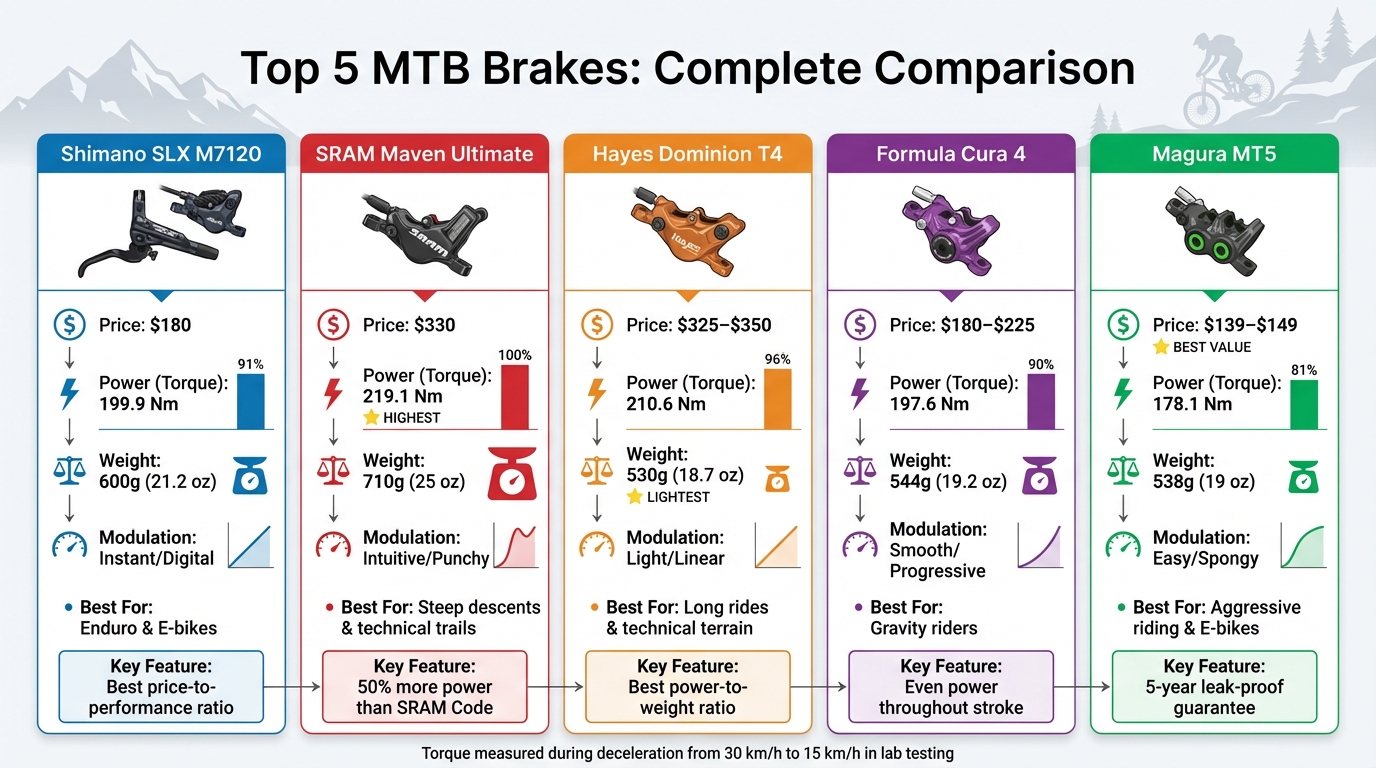
Top 5 MTB Brakes Comparison: Power, Weight, Price & Modulation
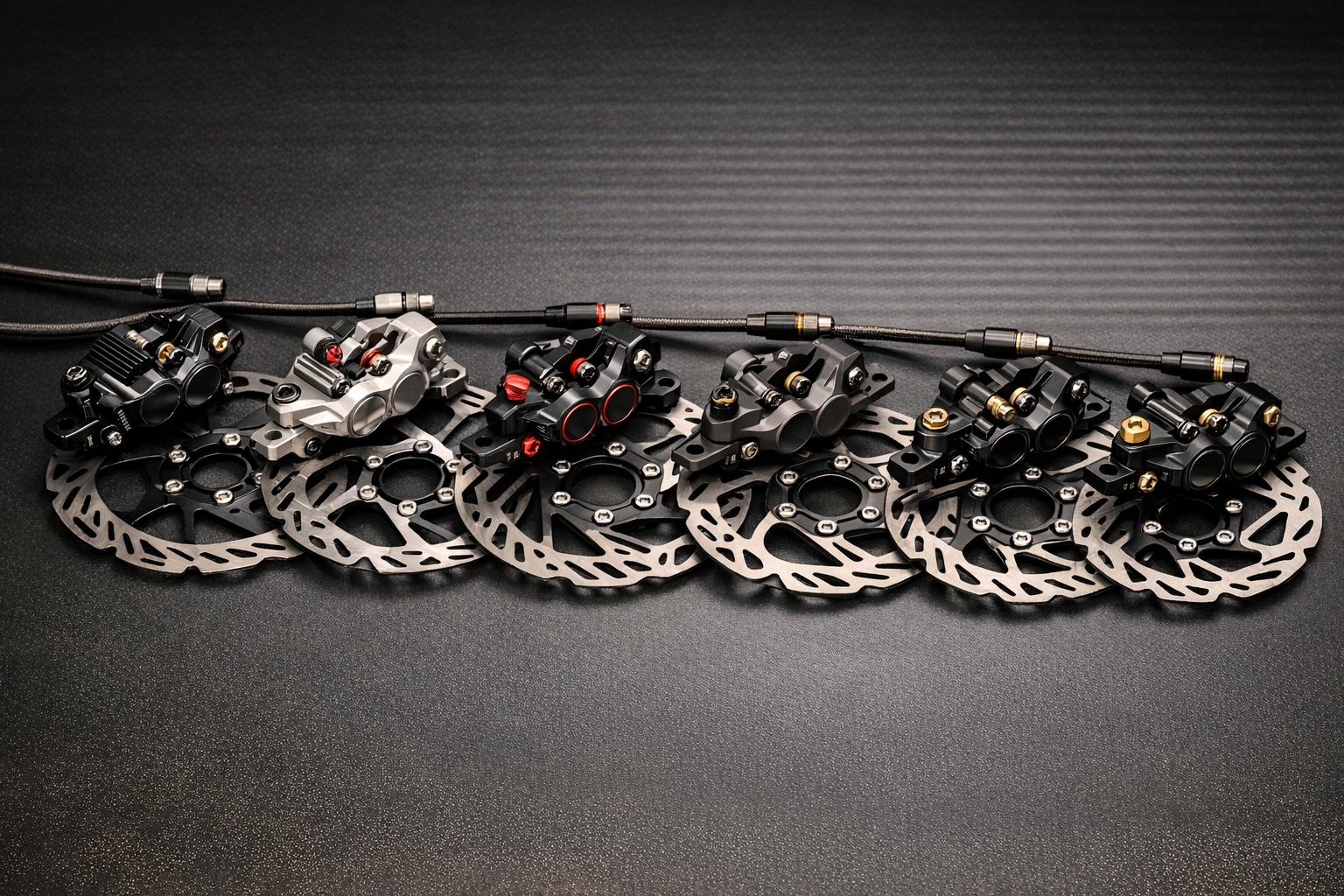
Six MTB Brakes Tested in the Whistler Bike Park
sbb-itb-9d75ae1
1. Shimano SLX M7120
The Shimano SLX M7120 delivers impressive stopping power for about $180 per brake, making it a standout choice for its price-to-performance ratio in 2024. It even earned the Best Buy badge, with Julian Schwede from ENDURO Mountainbike Magazine praising it as:
"The Shimano SLX strikes the best price‐performance ratio in the entire test field, impressing with powerful deceleration and excellent modulation."
Here’s a closer look at what makes this brake system a top performer.
Braking Power
With a four-piston caliper design, the SLX M7120 is built to handle the demands of heavy enduro bikes and long-travel e-bikes. Tom Marvin from BikeRadar backs this up:
"As I often find with Shimano’s four‑pot brakes, power is excellent. I’ve ridden these brakes on heavy longer‑travel ebikes and haven’t found them lacking."
The inclusion of ServoWave technology ensures quick pad engagement followed by a higher leverage ratio for controlled, powerful braking. The staggered pistons (17 mm and 15 mm) engage sequentially, allowing for a smooth and gradual power increase. For those looking to enhance performance further, upgrading to Sinter Green pads can elevate the SLX’s braking torque to rival premium options like the Trickstuff MAXIMA.
Modulation
The sequential piston engagement of the four-piston design provides precise control, while the firm mid-mount clamp reduces lever flex, even during intense braking sessions.
Lever Ergonomics
The lever blade measures 70 mm from pivot to tip and includes a tool-free reach adjustment. While it doesn’t offer the "Free Stroke" adjustment found in Shimano’s higher-end models, most reviewers find the setup more than adequate. The I-SPEC EV system allows for sleek integration of shifters and dropper remotes, and the weights – 307 g for the front and 320 g for the rear – are competitive for a four-piston brake system.
Heat Management
Ceramic pistons are used to block heat transfer from the pads to the mineral oil, acting as effective heat insulators. The system is also compatible with ICE TECHNOLOGIES finned pads (like the N03A resin or N04C metal options), which help dissipate heat during long descents. For riders tackling extended alpine rides, the N04C metallic finned pads are a better choice for handling extreme heat compared to resin pads. If noise reduction is a priority, non-finned pads such as the D03S or D02S can help minimize unwanted sounds on rough terrain.
2. SRAM Maven Ultimate
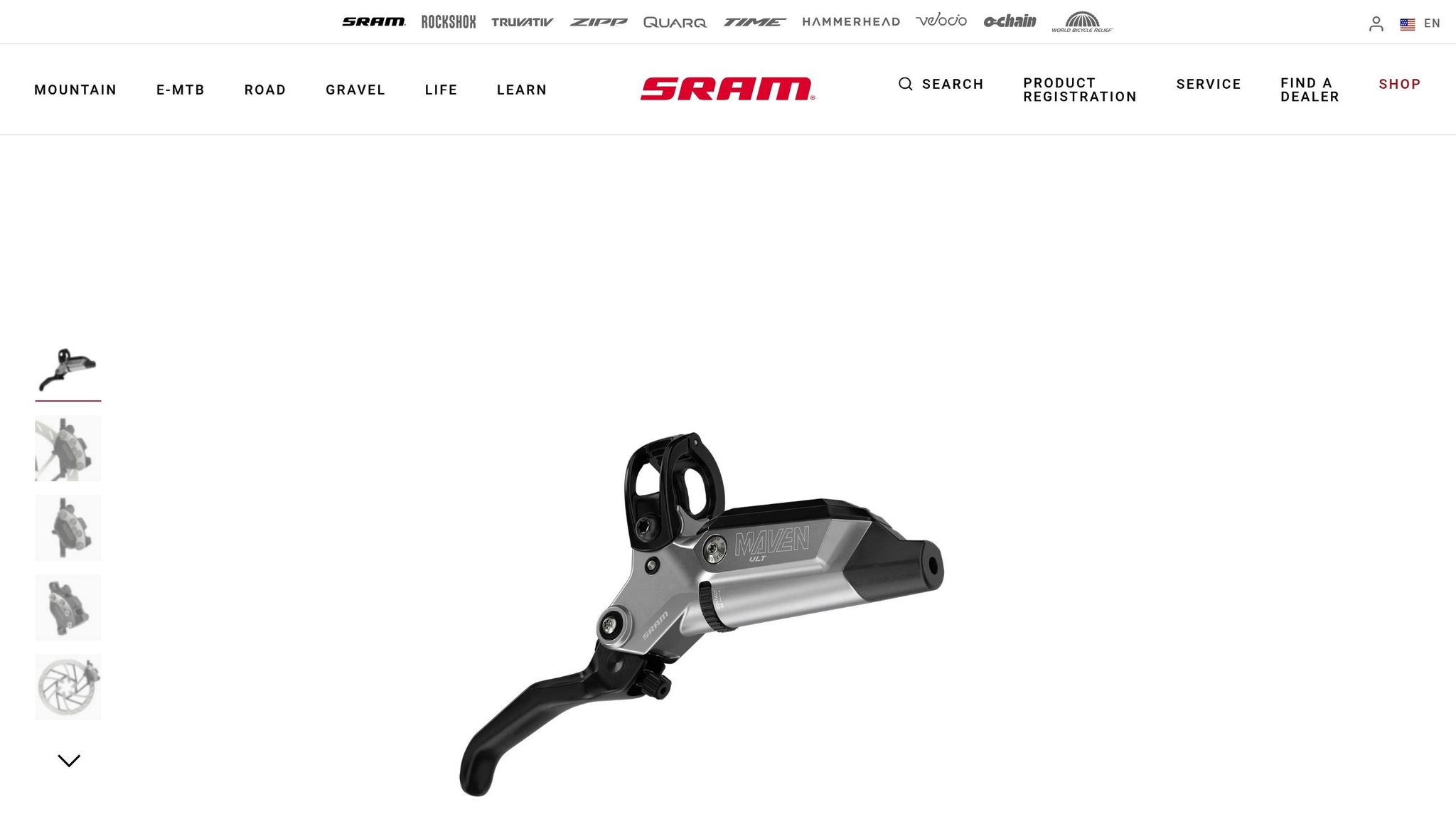
The SRAM Maven Ultimate sets a new benchmark for brake performance, priced at around $330 per brake. This is SRAM’s first premium brake to use mineral oil instead of DOT fluid, offering up to two years between service intervals and eliminating concerns about moisture absorption.
Braking Power
The Maven Ultimate boosts braking power by approximately 50% compared to the SRAM Code, thanks to its oversized pistons – measuring 18mm and 19.5mm versus the Code’s 15mm and 16mm pistons. Its sturdy caliper body is secured with four titanium bolts, reducing flex and ensuring maximum power transfer to the rotor. This enhanced power requires 32% less force at the lever, making it easier to achieve strong braking with minimal effort.
Robin Weaver from BikeRadar explains:
"The Maven offers 50 per cent more power than its closest counterpart, the SRAM Code"
With this extra power, many riders can downsize their rotors – such as switching from 220mm to 200mm – while maintaining excellent stopping performance and shedding some weight. SRAM also advises monitoring rotor spires for discoloration: a brown or bronze hue indicates optimal heat levels, while purple or rainbow colors suggest the need for a larger rotor.
Modulation
The Maven Ultimate incorporates SRAM’s SwingLink technology, which uses a cam mechanism to create a progressive leverage rate. This design avoids a harsh "on/off" braking feel, allowing for smooth and precise speed adjustments. It comes equipped with organic pads, chosen for their strong initial bite and superior modulation compared to sintered pads. The caliper’s four-bolt design further minimizes flex, ensuring your input at the lever translates directly into consistent braking force.
Greg Heil from Singletracks describes the experience:
"Use less lever force to achieve braking power, a change riders quickly adapt to."
Lever Ergonomics
The Maven Ultimate features a "Stealth" master cylinder design, positioning the lever closer to the handlebar for cleaner hose routing. Its forged aluminum blade pivots on a bearing, delivering a smooth, low-friction feel. Both reach and bite-point adjustments are tool-free, making on-the-fly tweaks hassle-free.
James Costley-White from MBUK shares his thoughts:
"I could scrub off all the speed I wanted to near-instantly. Hand fatigue and arm pump were no longer issues, and I could focus on enjoying the ride."
For the best results, SRAM recommends performing a "piston massage" during setup to ensure smooth piston movement and proper seal lubrication. These ergonomic features complement the brake’s advanced performance seamlessly.
Heat Management
Designed to handle intense conditions, the Maven Ultimate uses high thermal mass and specialized heat-resistant seals to maintain stable temperatures and prevent brake fade, even on long descents. The caliper body includes heat ducts to dissipate heat during heavy braking. Weighing roughly 362g for a rear brake without the rotor, the Maven Ultimate is about 60g heavier than the Code Ultimate, but this added weight improves its thermal stability.
3. Hayes Dominion T4
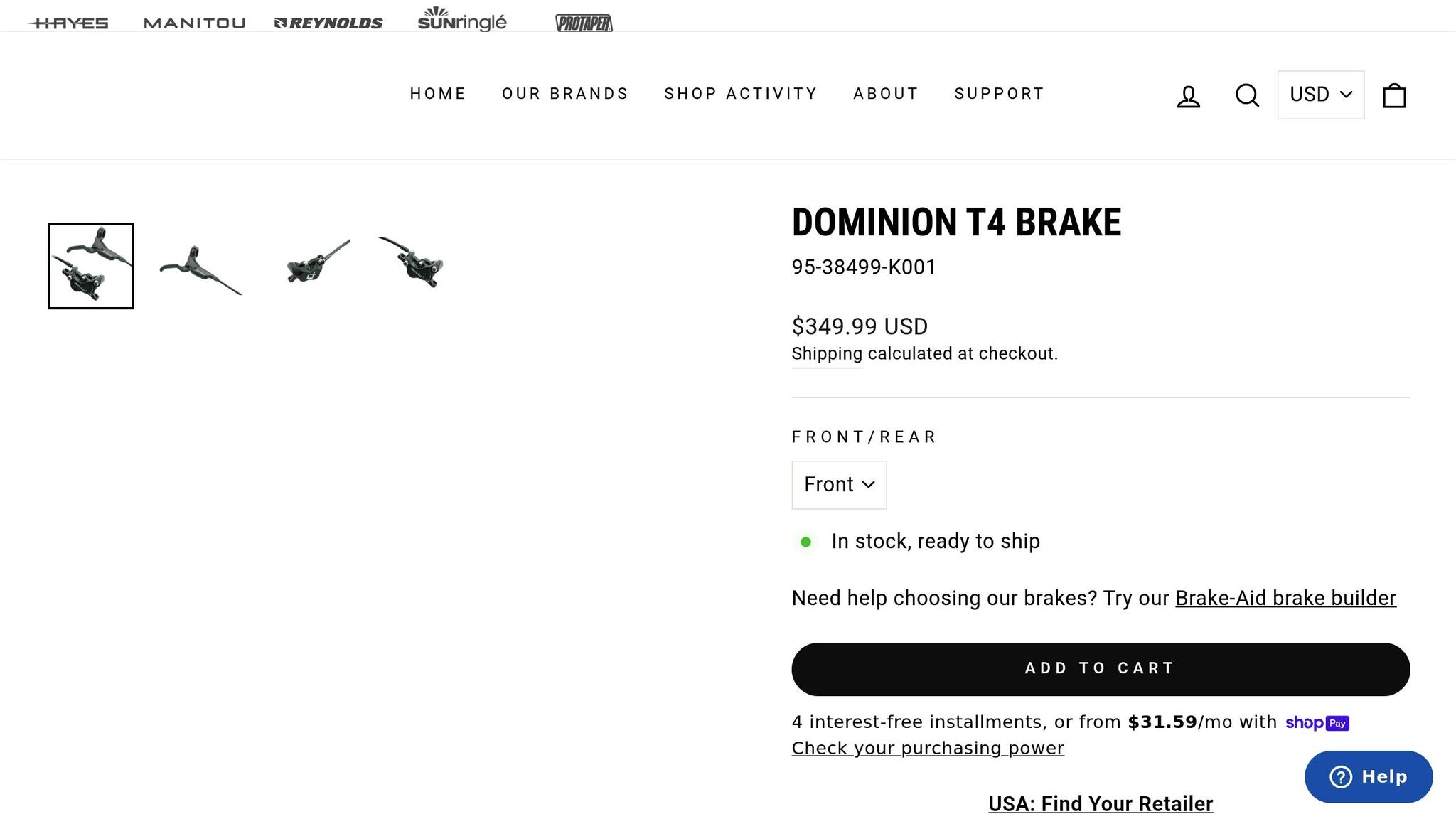
The Hayes Dominion T4 delivers exceptional control at a price of $325–$349.99 per brake, earning the title of Best in Test in ENDURO Mountainbike Magazine’s 2024 review. Weighing around 257g (9.1 oz), it’s approximately 45g (1.6 oz) lighter than the Dominion A4. This weight reduction is achieved through the use of a Reynolds carbon fiber lever blade, titanium hardware, and a composite reservoir cover. Let’s dive into its performance in braking power, modulation, ergonomics, and heat management.
Braking Power
Equipped with a four-piston caliper featuring 17mm pistons and the SRL system, the T4 delivers impressive stopping power with minimal effort. In lab testing, it ranked fifth overall in raw braking power – just behind the Shimano XTR but ahead of the XT M8120.
David Golay from Blister shared his experience:
"The combination of very good power, extremely light free stroke, firm-ish bite point, and excellent consistency that they offer won me over."
Modulation
The T4 stands out with its "LoFi" (Low Input – High Fidelity) system, which provides a light free stroke and a crisp, easily controlled bite point. Features like sealed ball bearings at the lever pivot and a glide ring on each piston reduce friction, ensuring smooth actuation. While it doesn’t offer the softer modulation of SRAM brakes, its snappy engagement is ideal for riders tackling technical terrain.
Julian Schwede from ENDURO Mountainbike Magazine remarked:
"The free stroke before the bite point is super smooth, while the bite point itself is pleasantly snappy, yet easy to modulate."
Lever Ergonomics
The Reynolds-designed carbon fiber lever blade offers a warmer touch compared to aluminum and pivots on sealed cartridge bearings, ensuring a smooth and consistent pull. Adjustments for reach and pad contact require an Allen key, which keeps the weight down but means setup must be done beforehand. For precise rotor alignment, the "Crosshair" caliper system uses set screws, though the tighter pad clearance demands careful adjustment to avoid rubbing.
Heat Management
The T4 employs aluminum-backed semi-metallic pads (T106) for effective heat dissipation. It uses DOT 5.1 fluid to maintain consistent performance even under extreme temperatures. Additionally, its Kevlar-reinforced K2 hose and D-Series rotors with Modal Resonance Cancellation help minimize expansion and reduce vibration when the brakes heat up.
4. Formula Cura 4
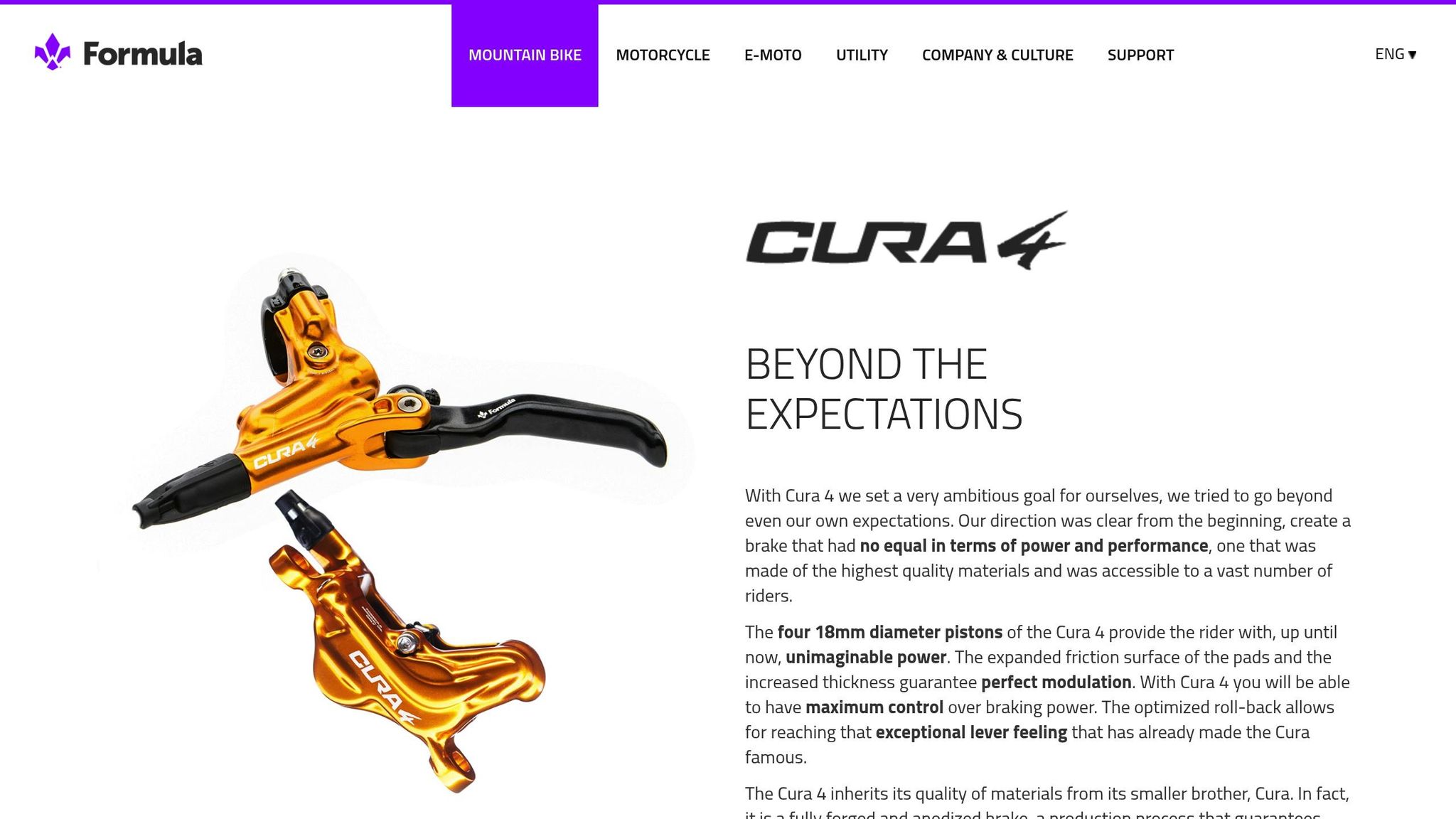
The Formula Cura 4 is built with gravity riders in mind, offering impressive stopping power at a price range of $180–$225 per brake. Weighing approximately 270 g without the rotor, this brake features four 18 mm pistons, giving it a larger friction surface compared to many standard four-piston models. Notably, it was Formula’s first four-piston brake to move from DOT fluid to mineral oil.
Braking Power
The four 18 mm pistons provide strong, early stopping power, reducing the need for heavy lever pulls. As Matt Beer from Pinkbike observed:
"You get more power for less pull… I’d take the Cura 4s due to the power that they deliver early on in the stroke and ability to stave off fade."
While the stock organic pads perform well, upgrading to sintered pads can boost braking power by over 10%, delivering a sharper bite for steep descents.
Modulation
The Cura 4 stands out for its smooth and predictable modulation throughout the lever stroke. Unlike Shimano’s four-piston brakes, which can feel abrupt, the Cura 4 builds power gradually. This helps prevent accidental wheel lock-ups and minimizes hand fatigue during long, technical descents. Tom Marvin from BikeRadar highlighted this difference, saying the brake feels less "digital". Similarly, Matt Beer noted:
"The power that the mechanical advantage in the Cura 4 brings is extremely even throughout the lever stroke."
This even power delivery enhances control, especially during demanding rides.
Lever Ergonomics
The lever design features a rounded 14 mm blade with an axial layout, fitting comfortably under your fingers. Reach adjustments require a 2 mm Allen key, though a longer tool is often more convenient for accessing the adjustment bolt. For added customization, an optional Feeling Control System upgrade allows bite point adjustments for about $45 per brake. Additionally, the flip-flop master cylinder design means the same lever can be mounted on either side of the handlebar.
Heat Management
The Cura 4 is compatible with 203 mm and 220 mm rotors, which are 2.3 mm thick to increase thermal mass and durability. Its mineral oil system resists water absorption, ensuring consistent performance over time. For extended descents, sintered pads maintain a steady bite as the system heats up, while an optional two-piece rotor design adds only 20 g but significantly improves heat dissipation. BikeRadar gave the Cura 4 a 4 out of 5-star rating, with Tom Marvin praising its controlled power, stating:
"Power is impressive, especially when there’s a bit of warmth in the brake."
5. Magura MT5
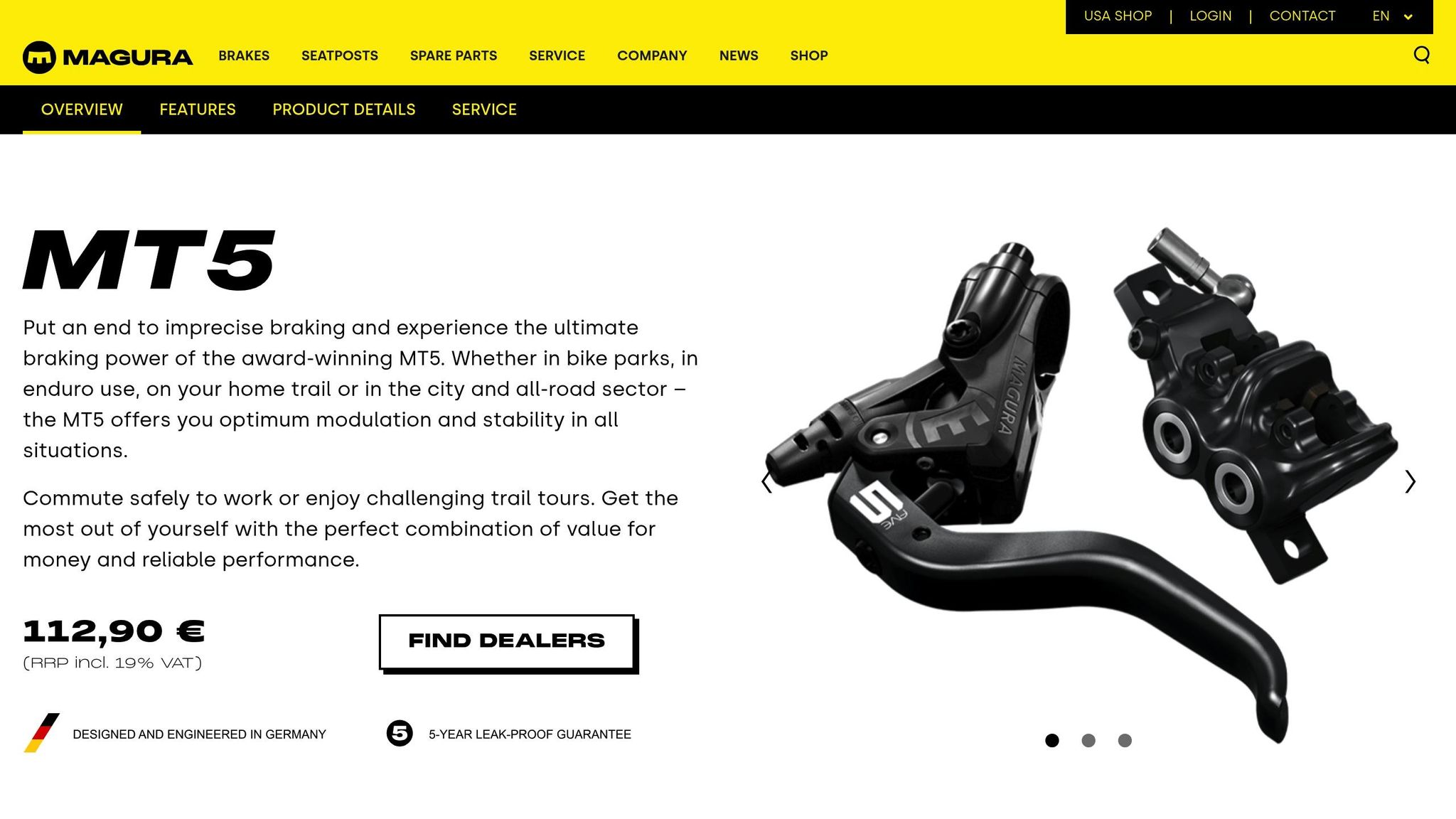
If you’re after strong braking performance without breaking the bank, the Magura MT5 might just be what you’re looking for. Priced between $139 and $149 per brake, it delivers four-piston power at an affordable cost. Weighing roughly 255 g (9 oz) without the rotor, the MT5 features a one-piece forged aluminum caliper and a Carbotecture master cylinder. This fiber-reinforced polymer design keeps the weight low while maintaining durability. Plus, Magura backs it with a 5-year leak-proof guarantee on the lever and cylinder.
Braking Power
The MT5’s one-piece, four-piston caliper ensures impressive stopping power. Pirmin Fischer from ENDURO Mountainbike Magazine described it as:
"On the trail, the Magura MT5 is a real anchor. Despite enormous braking power, the brake is easy to modulate."
This brake’s performance rivals higher-priced gravity-focused options, earning it the nickname "Price Performance Wonder". Thanks to Magura’s magnetiXchange technology, the caliper uses magnets to hold the brake pads in place, making replacements quick and hassle-free.
Modulation
The MT5’s radial master cylinder design minimizes friction, resulting in smooth, progressive braking. Unlike brakes with an abrupt "on/off" feel, the MT5 provides a softer initial bite, building power later in the lever stroke. Tom Marvin from BikeRadar highlighted this feature:
"This slightly less direct feel adds a little more modulation, certainly earlier in the lever’s stroke, while the application of power is progressive through the lever’s travel."
This balance between power and control is ideal for technical sections. Xan Marshland of Blister Review added:
"Magura has struck a great balance between modulation and all-out power. I felt remarkably confident both in situations where I had to scrub off a lot of speed before a corner, and in low-speed situations."
The result? Intuitive and precise lever handling.
Lever Ergonomics
The MT5’s flip-flop lever design means you can mount it on either side of the handlebar. Its two-finger aluminum blade includes a T25 Torx reach adjustment, which is particularly useful for riders with smaller hands who need the lever closer to the handlebar. While the Carbotecture lever body keeps the brake lightweight, some reviewers note it doesn’t have the same premium feel as full-metal alternatives.
Heat Management
Equipped with a one-piece forged caliper and Magura’s Royal Blood mineral oil system, the MT5 offers excellent thermal stability. Even during long, demanding descents, the brake’s bite point remains consistent. The mineral oil resists water absorption better than DOT fluid, which means less frequent maintenance and reliable performance over time. BikeRadar gave the MT5 a solid 4 out of 5 stars, praising its combination of power and modulation.
Comparison Table
The table below provides a breakdown of lab-tested torque (measured during deceleration from 30 km/h to 15 km/h) for various brake models.
| Brake Model | Power (Torque) | Modulation Style | Weight (Set) | Price (Per Brake) |
|---|---|---|---|---|
| Shimano SLX M7120 | 199.9 Nm | Instant/Digital | 600 g (21.2 oz) | ~$180 |
| SRAM Maven Ultimate | 219.1 Nm | Intuitive/Punchy | 710 g (25 oz) | ~$599 |
| Hayes Dominion T4 | 210.6 Nm | Light/Linear | 530 g (18.7 oz) | ~$324.99 |
| Formula Cura 4 | 197.6 Nm | Smooth/Progressive | 544 g (19.2 oz) | ~$190 |
| Magura MT5 | 178.1 Nm | Easy/Spongy | 538 g (19 oz) | ~$139 |
Key Metrics Breakdown
The SRAM Maven Ultimate delivers the highest torque at 219.1 Nm, but it’s also the heaviest at 710 g. On the other hand, the Hayes Dominion T4 strikes a balance with its impressive power-to-weight ratio – producing 210.6 Nm of torque while weighing just 530 g, making it 180 g lighter than the Maven. For riders on a budget, the Magura MT5 is the most affordable option at $139 per brake, though it offers the lowest torque of 178.1 Nm among the group.
When it comes to modulation, each brake has its own character. The Shimano SLX M7120 provides a sharp and immediate "digital" feel, ideal for riders who prefer instant braking response. In contrast, the Formula Cura 4 delivers smoother, more progressive control, helping to maintain traction during braking. The Magura MT5 offers a softer lever feel, allowing for gradual deceleration, though it might not appeal to those who favor a more precise, crisp response.
Conclusion
Each brake in this lineup offers tailored performance to meet various riding needs.
The Shimano SLX M7120 delivers sharp and immediate braking for $180, with the added benefit of widely available replacement parts. For riders tackling technical, feature-packed trails, the SRAM Maven Ultimate shines with its precise modulation. If long descents leave your arms feeling fatigued, the Hayes Dominion T4 offers a light lever feel while maintaining strong braking power. The Formula Cura 4 is ideal for riders who value smooth, progressive power, helping you maintain control in loose or off-camber sections. And for those on a budget, the Magura MT5 is a solid option at $139, delivering sufficient power for aggressive riding and e-bikes, even with its softer lever feel.
As BikeRadar’s Luke Marshall emphasizes:
A well-maintained set of £100 brakes, set up optimally, will outperform a misused £500 set installed carelessly every time.
Brakes featuring wide reach adjustments, like the Hayes and SRAM models, are particularly accommodating for smaller hands. Shimano’s tool-free adjustment system also simplifies setup. Additionally, upgrading to thicker rotors (2.0–2.3 mm) or investing in premium brake pads can significantly enhance braking performance without the need to replace your entire system.
These choices equip you with the confidence and control needed to tackle even the most demanding descents.
FAQs
How do I choose the right rotor size for my riding?
Choosing the right rotor size comes down to your riding style and the type of terrain you tackle. If you’re into downhill riding, ride aggressively, or weigh a bit more, larger rotors (like 180mm or 200mm) are a solid choice. They offer stronger braking power and handle heat better during intense rides. On the other hand, smaller rotors (160mm) are lighter and work best for cross-country adventures or smoother trails. Think about your weight, the terrain you ride, and your bike’s setup to strike the right balance between stopping power and efficiency.
Should I use mineral oil or DOT brake fluid?
The type of brake fluid you choose should align with your brake system and how much upkeep you’re willing to handle. Mineral oil is known for requiring less frequent maintenance, offering longer service intervals, and being kinder to the environment. On the other hand, DOT fluid boasts a higher boiling point, making it suitable for high-performance needs, but it absorbs moisture over time, meaning you’ll need to bleed your brakes more often. To guarantee both safety and optimal performance, always stick to the brake fluid recommended by your manufacturer.
What pad type is best for long, steep descents?
For extended, steep descents, resin or organic brake pads are a great choice. They provide smooth braking control and remain reliable even under the intense heat generated during long downhill rides.