
Electronic drivetrains have transformed biking, with Shimano and SRAM leading the way. Here’s the bottom line:
- Shimano Di2: Faster shifting, longer battery life (1,000–2,000 km per charge), and lighter components. Ideal for riders prioritizing precision and endurance. Prices start around $945 for MTB setups.
- SRAM AXS: Fully wireless, easier to install, and better at shifting under heavy load. Batteries last ~60 hours and can be swapped mid-ride. Prices range from $1,180 to $2,299 for MTB systems.
Both systems excel but cater to different preferences. Shimano focuses on reliability and efficiency, while SRAM emphasizes simplicity and ruggedness.
Quick Comparison:
| Feature | Shimano Di2 | SRAM AXS |
|---|---|---|
| Shifting Speed | Faster, especially front shifts | Slight delay (wireless signal) |
| Battery Life | 1,000–2,000 km per charge | ~60 hours (~465–620 miles) |
| Installation | Semi-wired, more complex | Fully wireless, quick setup |
| Load Handling | Smooth but less under extreme | Superior under heavy load |
| Price (MTB) | Starts at $945 | Starts at $1,180 |
Choose Shimano for efficient power use and lighter weight. Go with SRAM for a cleaner wireless setup and better trail durability.
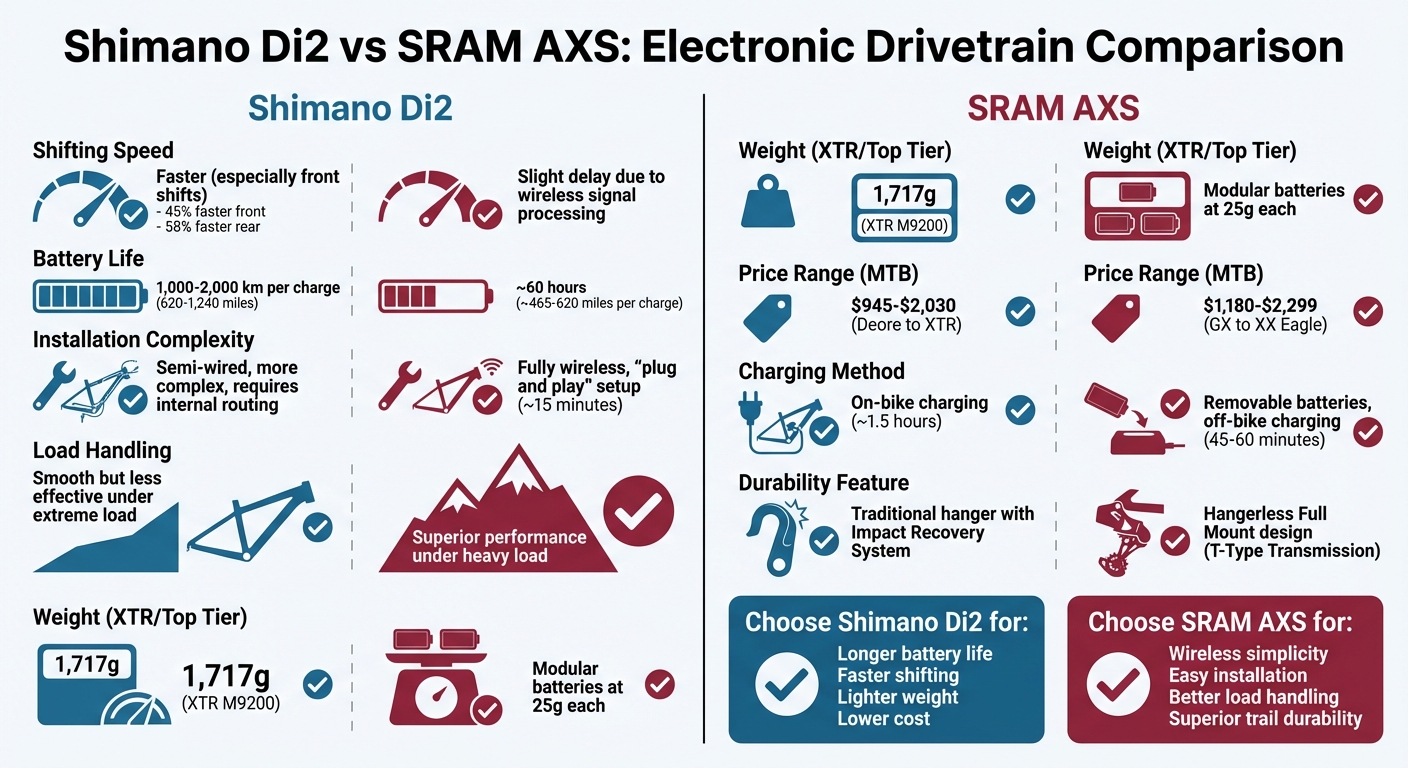
Shimano Di2 vs SRAM AXS Electronic Drivetrain Comparison Chart
Shimano Finally Went Wireless – Is New XTR Di2 Better Than SRAM?
sbb-itb-9d75ae1
Shimano Di2 Electronic Drivetrains: Features and Performance
Shimano’s Di2 system comes in two configurations: a semi-wired design for road and gravel bikes, where wireless shifters communicate with derailleurs powered by a seatpost-mounted battery, and a fully wireless setup for mountain bikes (XTR M9200). The MTB version uses a 305mAh battery that offers a range of 200–210 miles per charge.
Semi-Wired Technology and Battery Life
In the semi-wired Di2 setup, a single, high-capacity battery hidden in the seatpost powers both derailleurs. This battery provides a range of 1,000–2,000 km per charge and maintains performance for 7–10 years, handling over 500 charge cycles. When the battery runs low, the system prioritizes rear derailleur functionality, disabling the front derailleur first to allow for an additional 100–200 rear shifts.
"A wired system is absolutely reliable… Di2 is a faster shifting system. The amount of time it takes for the shift to be performed from the time you push the button to the shift being complete is smaller."
- Nick Legan, Road Brand Manager, Shimano North America
This reliable power system is a cornerstone of Shimano’s various groupset options.
Mountain Biking Groupsets
Shimano’s MTB Di2 lineup includes three levels: XTR (M9200, priced at $2,030, with a carbon derailleur cage and weighing 1,717 g), Deore XT (M8200, priced at $1,380, featuring an aluminum cage), and Deore (M6200, priced at $945, with a steel cage). All are compatible with 12-speed Hyperglide+ components. Gravel riders can opt for the GRX Di2, which offers a streamlined, cable-free design built on the semi-wired platform.
The XTR derailleur features an Impact Recovery System, enabling the motor to reset the gear position after strikes on the trail. Shimano has also replaced the traditional friction clutch with a stabilizer that boosts chain tension by approximately 70%, requiring no maintenance.
Shifting Performance
With its efficient power management, Shimano’s Hyperglide+ technology ensures smooth and fast gear changes, even under load. Shifting is significantly quicker, with front and rear shifts improving by 45% and 58%, respectively, compared to earlier versions. Riders also benefit from 36 trim options for precise gear alignment.
"I’d describe the new XTR as having a gentler, finer crunch… it’s as smooth as I think we can ask for with a chain-driven drivetrain. And it’s fast."
The system’s E-Tube Project app and four-way "Shift Switch" with haptic feedback allow for quick and customizable adjustments. These features highlight Shimano’s focus on precision and rider-centered design, setting the stage for a direct comparison with SRAM’s offerings.
SRAM AXS and Transmission Drivetrains: Features and Performance
SRAM’s AXS system ditches traditional cables in favor of its proprietary AIREA wireless protocol, delivering a neater cockpit and easier setup. The components communicate wirelessly and are built to withstand tough conditions, with an IPX7 rating for water and dust protection, and some parts even meeting the IP69K standard for high-pressure cleaning.
Wireless AXS Technology
The AXS system brings convenience with modular, rechargeable batteries that work across the entire ecosystem – including derailleurs and the RockShox Reverb AXS dropper post. Each derailleur battery provides about 60 hours of ride time and takes just an hour to fully recharge using its cradle. Meanwhile, the handlebar controllers rely on a CR2032 coin cell battery, which lasts around two years. If a derailleur battery dies mid-ride on a 2× system, you can swap the front battery to the rear to keep rolling.
Shifting is intuitive: the right paddle upshifts, the left downshifts, and pressing both triggers a front derailleur shift on 2× setups. The system also includes an overload clutch that disengages the derailleur’s motor gearbox during impacts, allowing it to move inward to avoid damage before returning to its original position. Plus, the derailleur cage offers 10 mm more ground clearance compared to mechanical versions, reducing the risk of trail damage.
"SRAM’s mechanical-shifting development will continue. [AXS] is simply another option for riders."
- Chris Hilton, SRAM Mountain Bike Product Manager
These wireless advancements set the stage for SRAM’s next step: the Transmission system.
Transmission Lineup for MTB
In March 2023, SRAM unveiled the Eagle Transmission (T-Type), an evolution of the AXS platform. This system features a hangerless, direct-mount design that attaches directly to the bike frame using the Universal Derailleur Hanger (UDH) standard. This eliminates the need for fiddly B-tension or limit screw adjustments. The Full Mount design is so strong it can support a rider’s full weight if they stand on the derailleur, emphasizing its trail-ready durability.
The Transmission system excels at shifting under load, allowing smooth gear changes even during intense pedaling – perfect for tackling steep, technical climbs. If the derailleur takes a hit, it can rotate backward and easily reset by loosening and retightening the rear axle.
"Full Mount has significantly reduced the chances of a derailleur strike forcing an early end to the ride. It’s one less thing to worry about (as much), and it highlights how modern mountain bikes are now much more dependable and advanced than ever before."
- Matt Phillips, Senior Test Editor, Bicycling
SRAM offers the Transmission in three tiers to suit different budgets: XX Eagle ($2,299), X0 Eagle, and GX Eagle ($1,180). The system uses X-Range gearing with 10-tooth starting cogs, and for riders tackling technical terrain, there’s a "high clearance" option featuring a 9-45 cassette paired with a shorter cage derailleur.
Beyond the hardware, SRAM enhances the experience with powerful app-based customization.
Customization and App Integration
The SRAM AXS app, available for iOS and Android, allows riders to tailor their setup. You can remap every button on AXS shifters and controllers, even using them to operate the RockShox Reverb dropper post. Features like Sequential Shifting automate front derailleur adjustments, while Compensation Mode fine-tunes rear shifting during manual front shifts.
The app also lets you adjust Multishift settings, controlling how many gears shift when holding a button. It monitors battery levels, provides firmware updates, and sends service reminders. For deeper insights, the AXS Web Tool combines ride data with drivetrain diagnostics, helping you analyze gear usage and power output. Thanks to built-in Bluetooth and ANT+ connectivity, the system connects directly to your smartphone without extra adapters.
Shimano vs SRAM: Direct Comparison
This section takes a closer look at how Shimano and SRAM systems stack up in real-world riding scenarios.
Shifting Technology and Performance
When it comes to shifting speed, Shimano Di2 is often seen as quicker, particularly in front shifting. On the other hand, SRAM AXS can feel slightly delayed due to how it processes wireless signals, especially during rapid gear changes on uneven terrain.
The two brands also differ in their shifting logic. Shimano’s dual-button design, similar to STI shifters, allows for a high degree of customization. However, some users find the buttons hard to distinguish when wearing thick gloves. SRAM simplifies things with a single-paddle design: the left paddle shifts to easier gears, the right to harder ones, and pressing both simultaneously operates the front derailleur.
Red Rock Bicycle Co highlights the strengths and trade-offs of each system:
"XT far exceeds the speed of SRAM’s latest iteration. However, the trade off is in shifting under load".
In terms of load handling, SRAM’s Transmission models shine under heavy pedaling pressure, while Shimano Di2 may feel less smooth when pushed to its limits.
| Feature | Shimano Di2 | SRAM AXS |
|---|---|---|
| Shifting Speed | Faster, especially in front shifting | Slight delay due to wireless signal processing |
| Shifting Logic | Dual-button system, highly customizable | Single-paddle system, intuitive |
| Load Handling | Quick but can be less smooth under extreme load | Superior performance under heavy load |
| Tactile Feedback | Distinct mechanical "click" | Lighter, "clicky" electronic feel |
Next, let’s look at how they compare in battery life and installation.
Battery Life and Installation
Battery design and maintenance are key differentiators between Shimano and SRAM. Shimano uses a centralized internal battery, typically located in the seatpost, which lasts between 600 and 1,200 miles per charge. In contrast, SRAM employs modular batteries for each derailleur, offering about 60 hours of ride time (roughly 465 to 620 miles).
Charging is another area where SRAM stands out. Its removable batteries can be charged indoors in 45–60 minutes. Shimano, however, requires on-bike charging via a cable connected to the rear derailleur, which takes around 1.5 hours.
| Feature | Shimano Di2 | SRAM AXS |
|---|---|---|
| Battery Type | Centralized (internal, typically in the seatpost) | Modular (each derailleur has its own battery) |
| Battery Life | Approximately 600–1,200 miles per charge | Roughly 60 hours (~465–620 miles per charge) |
| Installation | More complex due to internal wiring | Simplified with a "plug and play" wireless setup |
| Charging | Via a cable to the rear derailleur (~1.5 hours) | Removable batteries charged off-bike (45–60 minutes) |
Compatibility and Frame Integration
Compatibility with frames is another area where Shimano and SRAM take different approaches. SRAM AXS, with its fully wireless design, works with nearly any frame built for derailleurs. However, its newer Transmission (T-Type) models require a frame equipped with a Universal Derailleur Hanger (UDH) to support their hangerless Full Mount system. Shimano Di2, on the other hand, relies on frames that can accommodate internal wiring and provide space for its centralized battery, which might not fit older or minimalist frame designs.
For mountain biking, the way these systems mount to the bike can impact performance on rough trails. Shimano sticks with traditional derailleur hangers, which act as a "fuse" to absorb impacts. SRAM’s Transmission system eliminates the hanger entirely, opting for a direct-mount design robust enough to support a rider’s full weight. As Matt Phillips from Bicycling explains:
"Full Mount has significantly reduced the chances of a derailleur strike forcing an early end to the ride".
Both systems also use coin cell batteries in their shifters – CR1632 for Shimano and CR2032 for SRAM – that typically last around two years.
Trail Performance: Gearing, Durability, and Maintenance
Let’s dive into how these systems stack up when it comes to actual trail performance.
Gearing Options for MTB and Gravel
When comparing gear range, SRAM’s Eagle 10-52t cassette offers a slightly broader range (520%) compared to Shimano’s 10-51t Microspline cassette (510%). For gravel riders, Shimano provides the choice between 1×12 wireless or 2×12 semi-wireless GRX Di2 setups. On the other hand, SRAM focuses on 1×12 or 1×13 XPLR wireless configurations. These gearing systems aren’t just about numbers – they need to hold up against the demands of tough terrain.
Durability and Trail Performance
SRAM’s T-Type Transmission introduces a unique design by eliminating the traditional derailleur hanger, opting instead for a direct frame mount (compatible with UDH). This design addresses a common weak point in traditional setups. Field testing has shown that Shimano’s derailleur hanger can fail under severe impacts, sometimes leading to wheel damage. In contrast, SRAM’s hangerless Full Mount design allows the derailleur to rotate backward during impacts, resetting itself with minimal fuss.
"Full Mount has significantly reduced the chances of a derailleur strike forcing an early end to the ride. It’s one less thing to worry about" – Matt Phillips, Senior Test Editor, Bicycling
Maintenance and Long-Term Use
Long-term reliability comes down to battery management and ease of maintenance. Shimano’s battery lasts between 620 and 1,240 miles per charge, meaning fewer recharges are needed. SRAM’s modular batteries, while offering about 60 hours of ride time, can be swapped between derailleurs if needed during a ride. SRAM’s fully wireless design avoids the risk of snagged cables, a vulnerability in Shimano’s semi-wired E-Tube system where wires exit the frame.
When it comes to setup, SRAM’s Transmission removes traditional adjustment screws, simplifying the process. Both SRAM and Shimano allow firmware updates through their apps, keeping the systems up-to-date. For emergencies, carry a spare CR2032 battery for SRAM shifters or a CR1632 for Shimano, as these coin cell batteries typically last about two years.
Conclusion: Choosing Your Electronic Drivetrain
After diving into shifting capabilities, battery performance, installation ease, and trail functionality, the decision ultimately comes down to what matters most for your rides. Both Shimano Di2 and SRAM AXS deliver outstanding features, but each caters to different priorities.
Shimano Di2 stands out for its quick shifting and impressive battery life, lasting 1,000–2,000 km per charge. However, its internal wiring can be tricky to install, especially on frames not designed for Di2 systems.
SRAM AXS, on the other hand, offers a fully wireless setup that’s incredibly simple to install – just "bolt-on and pair" in about 15 minutes. Its modular batteries provide around 60 hours of ride time, weigh only 25 grams (0.9 oz), and the T-Type Transmission’s direct-mount design helps reduce derailleur damage on rough trails.
"AXS for MTB… Di2 road for weight savings… Di2 for battery life." – Bruce Lin, Technical Writer
Price is another factor to consider. Shimano Di2 groupsets generally cost about $200 less than SRAM AXS systems and have more affordable replacement parts. For example, SRAM GX Eagle AXS electronics start at approximately $600, while Shimano XTR Di2 comes in at around $1,210.
If your focus is on longer battery life, lighter components, and faster shifts, Shimano Di2 is likely the better fit. However, if you value effortless installation, a clean wireless setup, and better derailleur protection, SRAM AXS may be the way to go. Both systems shine in their own ways, making it easier to find one that aligns with your riding style and needs.
FAQs
Will my bike frame work with Di2 or AXS?
Your bike frame’s ability to work with Di2 (Shimano) or AXS (SRAM) depends on its design and features. Di2 relies on internal cable routing and needs space to house its batteries, while AXS operates wirelessly, with batteries mounted directly on the derailleurs, making it easier to fit onto a range of frames. To ensure compatibility, check your frame for internal routing options, battery storage space, and appropriate mounting points. If you’re unsure, reach out to the manufacturer or consult a local bike shop for guidance before making a purchase.
Which is easier to charge and manage on long rides?
When it comes to power management on long rides, SRAM AXS stands out for its convenience. Its swappable batteries are easy to remove, charge separately, and replace. This means you can carry spares and swap them out quickly if needed – perfect for emergencies or extended adventures.
On the other hand, Shimano Di2 batteries are built differently. While they last impressively long – typically around 2,000 to 3,000 kilometers per charge – they are internal and not designed to be swapped in the field. This requires careful planning to ensure your battery is fully charged before heading out.
For riders tackling long distances or multi-day rides, SRAM’s system provides added flexibility and peace of mind.
Do I need UDH for SRAM Transmission?
SRAM Transmission doesn’t require UDH (Universal Derailleur Hanger). Instead, it follows its own standard for mounting derailleurs, making it completely independent of UDH compatibility.